
"I really feel bad for the
Cipriano Erice
young boys with families. There are
no jobs for them."
Former employee of Waialua Sugar Co.
"I really feel bad for the
Cipriano Erice
young boys with families. There are
no jobs for them."
Former employee of Waialua Sugar Co.
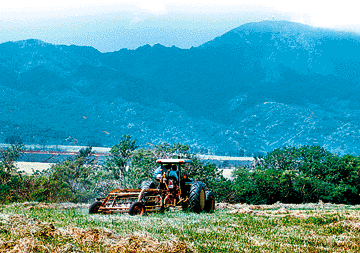
A tractor rakes hay on former sugar lands. Dole Foods' plans to diversify the area's agriculture include producing up to 1,500 acres of hay for cattle and leasing land for farming to former sugar workers. See stories in business section. Photo by Terry Luke, Star-Bulletin
By June WatanabeIn Waialua, where the mill whistle
ruled family life for years, sugar's imminent
death has a community grasping for
the means to stay alive
Sugar cane, which has nurtured the plantation town, still covers many acres. The red-dirt-weathered Waialua Sugar Co. mill that's dominated the community for nearly a century still chugs smoke from its single stack, the tallest structure around for miles.
"Still" is a word that captures the country pace of Waialua. But it's a word loaded with extra meaning these days as the town heads into a new century, when sugar no longer will define its borders and when the mill whistle no longer will sound the start of work, lunch time and 8 p.m. curfew.
The end "is coming sooner than people realize," observed Ray Camacho, division director for Local 142 of the ILWU, which represents most Waialua Sugar workers. Fewer than 200 workers are left, down from the 350 who heard the heart-shattering announcement in 1994 that the company no longer could make economic hay out of sugar cane.
Sometime in September, after the last fields of cane are harvested, Waialua Sugar Co. will be gone. Although the mill will continue to operate, Waialua Sugar as an entity will disappear, said Jerry Vriesenga, president of Dole Foods-Hawaii, the parent company. In its place, a new subsidiary, with a different name and a broader focus, will be created.
Sugar cane is being replaced by smaller crops - papayas, coffee, cattle feed and grass among them. The latter will continue to provide fuel to produce a small amount of power at the mill, which may become a papaya pest eradication and packing plant.
Already, motorists zooming down Kamehameha Highway from Wahiawa to Waialua/Haleiwa no longer are surrounded by cane. On the right, acres of what look like corn stalks wave in the wind. But it's really sorghum that's as high as a pachyderm's eye, planted primarily as windbreaks to protect foot-high sprouts of coffee-trees-to-be.
To the left of the two-lane highway, more sorghum, plus 125 acres of forage plants and different kinds of grass to be bundled as hay or wet silage for dairy farmers.
John Hirota, community service/land manager for Waialua Sugar, points to the remaining cane fields in the distance, the mill just a smudge on the landscape. At one time, 12,000 acres were devoted to cane here. By this time next year, Hirota said, there won't be any sugar cane left.
Dole Foods will oversee most of the new plantings, but it is making more than 100 acres available to displaced workers looking to find a new livelihood in the old soil, this time as independent farmers.
Camacho said Waialua workers will find it harder to adjust to life without a plantation than Oahu Sugar Co. workers, who lived and worked in Waipahu.
When Oahu Sugar shut down last year, workers "didn't have to confront the same kind of reality that workers on the North Shore have to - being in a rural setting, with that kind of lifestyle that's pretty much intact," Camacho said. Waialua workers will have to face "the realities of looking for work and not having work right in your back yard."
The ILWU, Waialua Sugar and the city's WorkHawaii program have cooperated on job training and placement programs. WorkHawaii is using a $709,000 federal grant to aid 150 displaced workers. More funds will be sought to help dozens more expected to seek help eventually, said WorkHawaii's Nancy Olipares.
Among the fields of retraining: Computers, warehouse management, physical therapy assistant, landscaping, medical assistant, barbering and entrepreneurship.
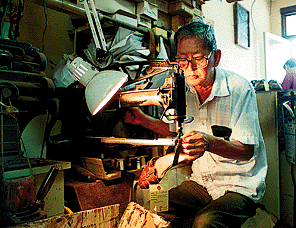
Chester Shigeoka has cobbled shoes since 1951, when he opened
Waialua Shoe Repair. "To make a living, you have to do a lot
of different things because this is not a big community."
Photo by Ken Sakamoto, Star-Bulletin
Meanwhile, Camacho said the ILWU and Waialua Sugar have worked out "the fairest solution short of just turning (homes) over" to retirees and workers.
A major concern was that once the plantation closes, the lease the company has with Bishop Estate for Kawailoa Camp's 40 homes also would end. The agreement is to give pensioners there first crack at homes in the company-owned Mill Camp, at rents frozen at $42 a month.
"As homes become vacant, as employees are laid off, they will be given a period of transitional housing at reduced rents to give them time to seek alternative housing," Camacho said.
Outside the Special Plates drive in, the only "restaurant" in town, old sugar workers often gather at picnic tables to talk story.
"Here, everything stand still," one said recently of his hometown. "We like the way it is. Everybody say, 'Hi, hi.'" Now 77, he was in charge of irrigation when he quit in 1980 after 43 years.
"I was born and raised here and I will die here," he said, reluctant to reveal his name. He's got good benefits and a plantation house he bought for $8,400 45 years ago. Can't complain about how the company has treated old-timers, he said. "But we pity the guys who are young."
Cipriano Erice, 69, Nicolas Sagaysay, 74, and Isidoro Sumile, 87, shared his concern. Together, they worked for "the company" more than 100 years, although Sumile is more known as the former owner of "Smiley's Service Station."
"I really feel bad for the young boys with families," Erice said. "There are no jobs for them." Some have applied at a big discount store, he said, but while janitors for Waialua Sugar make $7.75 an hour with benefits, the store is offering only $5.75, "with no benefits."
"What's hard on people is that they're not sure what their future is about," said Jenny Vierra, owner of Waialua Florist. In the late '80s, when there were signs that sugar wouldn't be around forever, "Those who were still young went and found other jobs." The closing "was inevitable," Vierra said, "but you had hope."
Dole Foods' Vriesenga described "a certain sadness" that envelops the community. "As with an older parent passing away, there is an inevitability. But there is still a tremendous void - a sadness - when it finally happens."
That's because it will be the end of a company that, since the late 1890s, has cast a shadow much longer and wider than its symbolic smokestack. Waialua is the kind of town where someone's father, grandfather and neighbors all worked for one company.
Like Arnold Suzuki's grandfather, father and mother. Suzuki, 45, worked eight years before he quit in 1984; he now works at the Vet Center downtown. "But I miss the plantation life," where everyone woke at 5 a.m. and gathered before work, he said. "It was a family type of job."
Vierra went off to college but ended up, like so many others, back in Waialua, joining Waialua Sugar in 1981. She left in 1989 to take over Waialua Florist, a fixture in the dusty town square known as Waialua Shopping Center, where there's a liquor store, feed store, bank and post office, but no clothing shop or supermarket.
"I had a choice of moving out of Waialua," Vierra, 42, said. "I didn't want to." Business is up and down. Flowers are a luxury item, she noted, but "even when people are down, they buy."
"We can make the bills for now," said Angelo Arrechi, owner of Special Plates. But "You have to adjust prices according to the environment," he added, noting the impact of the pending shutdown of the mill on regular customers - retirees and kids from three area schools. "The only tourists we get are the ones who get lost," he joked.
Just a few doors away, Chester Shigeoka's Waialua Shoe Repair shop is stuffed with the well-worn shoes of a country town.
Shigeoka has no idea how many shoes he's cobbled since he opened in 1951, not to mention repairs made to saddles, bridles, zippers and purses. "To make a living, you have to do a lot of different things because this is not a big community," he said.
He seems apologetic about his business hours: 7 a.m. to 4 p.m., six days a week. There was a time, especially when his sons were going to school, that "I worked day and night."
Business has gone down over the years, Shigeoka acknowledged, and the closing of Waialua Sugar doesn't bode well.
At 71, "My boys tell me they want me to quit already. But when I wake up in the morning, I don't have anytime I don't want to come to work," he said.
Vierra sees a future for both her store and Waialua as a unique town.
She's part of a group "trying to help get the community together to find a vision and get more information to people."
Suzuki hopes they succeed because the fear is, "when the plantation closes, this will become a ghost town."
But Vierra says the shutdown of Waialua Sugar "is not the end; it's the beginning.
"You have to start again."