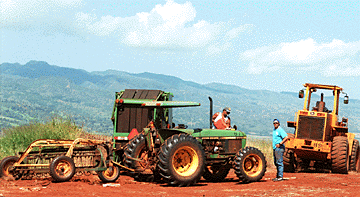
Employees work on equipment used in hay fields on former
Waialua Sugar Co. land. Hay is just one of the products Dole
is experimenting with as a replacement crop to sugar cane.
Photo by Terry Luke, Star-Bulletin
Employees work on equipment used in hay fields on former
Waialua Sugar Co. land. Hay is just one of the products Dole
is experimenting with as a replacement crop to sugar cane.
Photo by Terry Luke, Star-Bulletin

Sugar will become a nostalgic crop of old, but a host of smaller ventures aimed at keeping the land open and green have already begun to take root. About 100 sugar workers, many of them already in their new jobs, will be rehired by the new company, said Dole Foods-Hawaii President Jerry Vriesenga.
The hope is that the diversified agriculture operations will succeed, creating more jobs. "But the question remains," he said, "can we do it profitably?"
Already in the works:
Of the mill itself, "a lot of it (not dealing with power generation) will be torn down," Vriesenga said.
Depending on how this goes, Dole will spend about $500,000 to convert the mill's sugar storage facility into a heat vapor plant and packing area, Vriesenga said.
"The problem is the ring spot virus," which has devastated papayas on the Big Island, he said. So far, the 200 acres - at high elevations - are disease-free. The trick is to see what kind of fruit is produced at that height. If all goes well, another 200 acres will be planted.
Fifteen workers are involved in papayas, with a total of 50 expected by year's end.
"It will not be a huge business," Vriesenga said, but part of the company's "niche marketing." Waialua Coffee is being touted as the North Shore's only coffee, but sold only at a few places.
All these efforts, individually, may be "small potatoes," Vriesenga acknowledged, "but it's not small potatoes if you take them all together." They will fall under a Dole Tropicals umbrella and involve thousands of acres.
Additionally, Dole is leasing small plots to displaced sugar workers and others interested in farming. Total acreage for this is not expected to exceed 700, Vriesenga said.
For the future, "The hillsides will look pretty much the same," he said. An environmental plus: "We burn cane now, but we won't burn cane anymore."
He also said that no development is planned any time soon on either the 6,000 acres owned by Waialua Sugar or the 6,000 acres it leases from Bishop Estate.