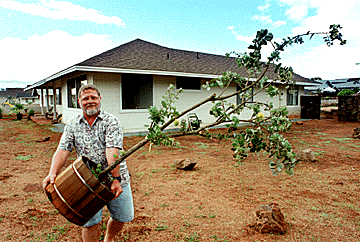
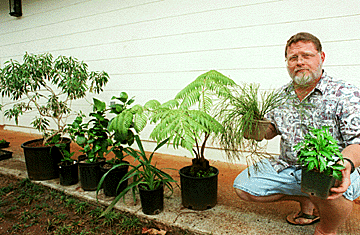
Vince Mahoney shows the Ohia Lehua tree that's destined to become part of the rain forest in his Mililani Mauka yard. He plans to plant 10 of them, as well as hapu'u, ukiuki, kokiokeokeo and naio now growing in pots around his yard (below). Photo by Dennis Oda, Star-Bulletin
Save the rain forest:
Plant One
By Kim Murakawa
Star-Bulletin
A native Hawaiian rain forest will soon grow in Mililani.
Forget the bougainvillea, croton and areca palm plants commonly growing in local gardens. Vince and Elaine Mahoney are part of a growing number of local folks choosing something a little more natural, a little more Hawaii.
"It makes us feel good to be surrounded by natives," said Vince, who teaches classes on native plants for the Moanalua Gardens Foundation Inc. "We get a lot of pleasure by just looking at them."
Native flora that formerly covered most of the islands are back in favor, and being used more often in landscaping, despite a reputation of being hard to care for, according to several local native plant experts.
"It's related to the resurgence of Hawaiiana and a great revival in Hawaiian culture, especially with halau, who are interested in growing a lot of things instead of going up the mountain," said Kenneth M. Nagata, author of "How to Plant a Native Hawaiian Garden."
Nagata published his book in 1992 for the state Office of Environmental Quality Control as a tool to educate the public about native plants. About that time, environmental issues captured the attention of the hula and lei-making communities concerned with overpicking.
Last March, just weeks before the annual Merrie Monarch hula festival, a native Hawaiian conservation group held a first-ever conference to teach halau how to gather flowers without harming the native ecosystems.
"I think they are looking at ways they can perpetuate the art of hula while balancing it with conservation in mind and making sure that we don't do much more damage to the forest than that's already been done to it," said Keali'i Pang, president of the conference organizers, 'Ahahui Malama I Ka Lokahi.
Kumu hula John Lake said he began to take an avid interest in growing his own native plants about three or four years ago. Lake grows palapalai, maile and ohia lehua, plants commonly used in hula and lei-making, at his Waialae-Kahala home.
"We try and see if we can get people to nurture their own so they don't have to strip the forests," he said. He also teaches his students about caring for the plants and about having respect for the forest.
 The growing interest is also due to the debunking of a long-held misconception about native plants, said Bill Garnett, the Mahoneys' landscaper.
"It's a myth that native plants are very difficult to grow - some are and some are not," he said. The trick, according to Garnett and Nagata, is picking the right plants for the climate they will be grown in.
For instance, a cold-weather plant will not grow successfully in arid, drought-like conditions on the Leeward Coast or the Ewa Plain. Likewise, the wiliwili, a beach plant, wouldn't fare well in wet, rainy parts of Manoa. Keep in mind that salt sprays have an impact as well.
Nagata said space will dictate what plants can be grown. A small backyard will not accommodate a koa tree, but a few upright variety of ohia lehua would fit nicely.
"There are a lot of things you need to consider when you want to plant a native garden," he said.
Those who live in areas where there is claylike soil, including parts of Palolo and Kalama Valley, will want to mix compost into the soil because native plants require good drainage.
Basically, Nagata said growing a native garden is no different from maintaining any other type of garden. Weeds will only be a problem if they're neglected and plants will need a little fertilizing.
The biggest threats to a flourishing garden are mealy bugs, scales and ants, he added. Some native plants are sensitive to insecticides and it may be necessary to use a solution of dishwashing liquid and warm water to kill bugs.
"You do have to have a relationship with the plants," Garnett said. "You can't just stick them in the ground and walk away."
For the Mahoneys' rain forest, Garnett made sure to select plants that grow well in cool weather. He is also installing hidden fog mist nozzles to make watering easier and to simulate forest conditions.
When Garnett is done, the garden will have 25 different types of native plants, including white and red hibiscus and red and rare yellow ohia lehua as its centerpiece.
"No matter where you go in the world (landscapers) use the same tropical plants," he said. "Hawaiian plants are unique to the world. It's just a different kind of aesthetics."
Garnett, who also propagates endangered plants for the state Forestry and Wildlife Division, focuses most of his small landscaping business on native plants. Although he grows native plants for his own use, Garnett said some nurseries provide the more popular varieties.
The Related Story: