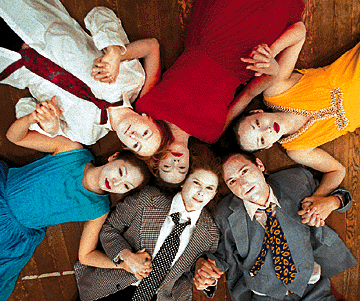
Iona Pear founder Cheryl Flaharty (in black and white checks above and below) and troupe members (clockwise from Flaharty) Joana Taira, Caroline Sutton, Andrea Torres, Summer Partlon and Dennis B. Miller. Photos by Dennis Oda, Star-Bulletin
Iona Pear founder Cheryl Flaharty (in black and white checks above and below) and troupe members (clockwise from Flaharty) Joana Taira, Caroline Sutton, Andrea Torres, Summer Partlon and Dennis B. Miller. Photos by Dennis Oda, Star-Bulletin
"So I rented the apartment, based on the quilt," she says. "Later, he and I became good friends, and I learned that the quilt had been sewn by his aunt back in Memphis, Tennessee. He said her name was Iona Pear."
Iona Pear. Iona Pear. The name looped through Flaharty's consciousness. The etimology of it was fascinating to Flaharty, who was deeply immersed in world cultures at the time.
 "Iona is the Greek word for white dove. A pear is a very feminine symbol, like the artistic side of the mind. And it is a fruit! When an artist performs, it's like presenting a fruit, a gift to the audience," says Flaharty. "So Iona Pear is a spiritual metaphor - a flight of the feminine spirit."
Whatever Iona Pear meant, it seemed to fit. After studying dance for years in Hawaii and New York, Flaharty was forming her own company, one true to her unique vision, and it needed a name. It became, sure enough, the Iona Pear Dance Theatre. Flaharty's not sure the woman in Memphis knows anything about it.
Now moving into its second decade, Iona Pear is performing a retrospective concert tomorrow and Saturday at the newly rehabbed Hawaii Theatre. Called "The View From Above," it includes some of Flaharty's early work plus a "greatest hits" production of some of Iona Pear's best-known works.
At a recent show-and-tell for Alu Like's seniors program at the Jehovah's Witnesses church in Waimanalo, Flaharty paced the room - barefoot - and asked if they believed in angels.
"Like, with halos on?" one oldtimer asked.
"Angels are messengers. They exist in every culture on Earth," Flaharty said. "Isn't that interesting? Today, three angels are going to pay a visit, plus a special friend. You know, once you've made a pair of angel wings, you feel like you can do anything!"
The angels had been meditating in another room - "Meditation is very important to us," Flaharty said later. "Most dancers concentrate on getting their body ready, we concentrate on getting in the right frame of mind, becoming part of the flow of the universe. The body just follows along." - and they glided slowly into the room to the churchly suspirations of Enya's "On Your Shore." The seniors fell instantly silent.
The angels, followed by a dancer playing Maui, were in flat white body make-up, clad in garments that echoed many cultures, but never explicitly so. Their movements were slow, graceful, reacting to an invisible environment but clearly breaking through to this one. You found you didn't want to look a dancer in the eye for fear of breaking their concentration.
They passed out notes to the seniors: "Inner peace can be reached when we practice forgiveness." "Let there be more joy and laughter in your life."
The effect was otherworldly, beautiful, a glimpse into a state of grace. Many seniors had tears glistening in their eyes.
When it was over. Mapuana Ringler, the Alu Like leader, said, "Man! They look for real!" and compared their movements to the physical discipline of tai chi.
"If there were angels that looked and acted like that in heaven, then I want to go to heaven," said Lei Moss.
"You can tell our folks was interested," Ringler said. "None of them fell asleep, which usually happens with a group this old."
"We once played a mental hospital, and the patients - and the staff - were focused on us the whole time," said Flaharty.
"The supervisor tried to warn us that they wouldn't pay attention," said Malia Oliver, one of the angels. "And we played at the women's prison. Afterwards, the women were hugging and crying. The guards told us they never do that. One said she wouldn't have traded a day in the free world in exchange."
"They were so abused - you could see it in their faces," Flaharty said. "Some people don't need to be penalized. They need only to be healed."
Spiritual healing through dance? Flaharty's particular brand of butoh taps into a kind of cosmic unconscious and is deliberately meant to be visually nourishing. Butoh - a theatrical, stylized modern Japanese dance that's part German expressionism, part street mime, part polemic, and all jarring edges - has been filtered by Flaharty into something warmer.
"Certainly no one else in Hawaii is doing anything like Iona Pear, and very, very few in the United States," said Gregg Lizenbery, director of Dance at the University of Hawaii-Manoa. "It adds considerably to the breadth of modern dance.
"It's visually arresting, like walking into an art gallery where the images affect you strongly. Poignant. Funny. Breathtaking. I think her work and her dancers have a great deal of integrity."
What: "The View from Above," a retrospective of dance by Iona Pear Dance Theatre
When: 8 p.m. tomorrow and Saturday
Where: Hawaii Theatre
Cost: $20, $25, $30
Call: 262-0110
"The butoh dancers in Japan were very affected by the atomic bomb, and that shadow is in their work today," Flaharty said. "I was looking for something that was more imagetic - is that a word? - a form that deals with higher images, not something dark and grotesque."
Once back in Hawaii, Flaharty offered a workshop in butoh, and was stunned "when all these beautiful dancers showed up. There was clearly a hunger for a spiritual approach to dance."
This group became a troupe, which today averages 10 members.
The dancers volunteer their own rehearsal time, create their own costumes, spread the word. They exist on grants from local foundations, awards from the State Foundation on Culture and the Arts and "cutting corners like crazy," said Flaharty, who triples as artistic director, choreographer and executive director of Nova Arts Foundation, Iona Pear's umbrella organization.
They'd really like to tour "The Mythology of Angels" on the mainland, to share the vision, but there's nothing in the budget. Maybe there's an angel with deep pockets out there.
The resemblance to tai chi is accidental, but not unexpected. All movements come from the chi, the center, an energy that flows through the universe. Because the dancers are channeling that universal energy, instead of simply burning up carbs in their own body furnaces, their movements tend to be slower, more sharply focused, more directional than traditional dance choreography, like time-lapse photography of a plant seeking the sun.
"We meditate to separate ourselves from our bodies, to look back on ourselves - I call it 'the witness' - and see things and ourselves as part of a wholeness," Flaharty said. "In that light, you don't see different cultures, divisiveness between peoples. The trick is in creating dance that shows this to the audience."
Norbert Larsen, who also studies flamenco, modern, ballet, African, Caribbean and Hawaiian dance, was attracted to Iona Pear because of the "spiritual qualities," he said.
"It's more than just movement. The things we learn in Miss Flaharty's workshops - they've changed my life. Like not being judgmental about movement, about entering the state of witness. When you apply that to your life, you become a better person."
The dances are about half-improvised. "We rehearse to the extent that we know that we enter HERE, at this point in the music, and that by that point we're supposed to be over THERE," Flaharty said. "In between, the dancers improvise and adapt themselves to the performance area and the audience, to take down the performance 'wall' and make the audience part of the energy flow."
Indeed, one of the striking things about the Alu Like performance was that it didn't feel like a performance. More like a visitation.
"She has us follow a linear path, one that never returns to the starting point," Larsen said. "That way, you're always in a new place, always going forward, and you always discover something new."
"We're going for what Jung called the 'collective unconscious,' using allegorical archtypes that speak to the inner person," Flaharty said. And there are people who can't get enough Iona Pear, showing up at performances just for that glimpse of the great beyond, the inner truth.
"There's more to life than just our bodies. There's also our souls. Most of our culture and our art focuses on the body and not the soul, and that's out of balance. We know this, inside, even if we don't know how to express it," Flaharty said. "We dance to appease this hunger for the spiritual.
"Powerful stuff."