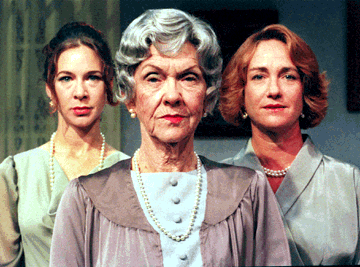
From left, Kristine Altwies plays C, Jo Pruden plays A and Patrice Scott plays B in "Three Tall Women." By Kathryn Bender, Star-Bulletin
From left, Kristine Altwies plays C, Jo Pruden plays A and Patrice Scott plays B in "Three Tall Women." By Kathryn Bender, Star-Bulletin
The play won Edward Albee the 1994 Pulitzer Prize for Drama in 1994. Honolulu is fortunate to get theater this fresh.
Albee evidently has a very dark and grim view of life. The best moments are gone by your mid-20s. Death is the ultimate release from the pains and betrayals of life. He makes his case in two dramatically different contexts.
In Act I he goes for reality. A (Jo Pruden) is wealthy and old - 91 or 92, she's not sure which. She is at best semi-continent, slips in and out of lucidity, and is barely mobile. The bones of her broken arm are held together with pins but are degenerating, not healing.
Her personal aide and caretaker, B (Patrice Scott), is tolerant at best - and more often patronizing. C (Kristine Altwies), a sour and sarcastic young woman from A's attorney's office, mocks and taunts her. It gradually becomes evident that A once embodied all those unpleasant qualities and more. However, she's now long past her prime and sinking fast. It doesn't take much to tease a senile woman.
Act I will likely be uncomfortable for adults with parents who are anywhere close to being either physically or mentally infirm. Much of the humor is at the expense of the senile woman. Pruden performs so effectively that she becomes a chilling portrait of living death. A perennial favorite with the Po'okela adjudicator clique, she deserves yet another for her performance.
Albee switches from realism to fantasy in Act II. A has died. Her consciousness has split into three selves - as she was in her wild and free mid-20s (Altwies), as she was in her bitter post-menopausal early 50s (Scott), and as she was at the time prior to the fall that broke her arm and precipitated her final decline (Pruden). The three selves have a spirited time sorting out the salient facts of her life and her relationships with those closest to her - father, mother, sister, first lover, wealthy husband, nasty and wealthy in-laws, and estranged bisexual son.
The basic elements of her life have been presented in Act I in the ramblings of a senile old woman. The shift to fantasy brings each vignette into sharper focus.
Twenty-six-year-old C can't believe that the best days of her life are past and that her marriage to a man she hasn't even met yet will turn out badly - he's short, witty, generous, extremely wealthy, has a glass eye, is promiscuous (or becomes so after she refuses to perform a basic sex act), and will die horribly of prostate cancer at 66. B and A take sadistic delight in telling C in sardonic detail just exactly how badly her - or, their - life is going to turn out. Her "Prince Charming has the morals of a sewer rat" but he'll give her expensive jewelry ("tangible proof that we're valuable"). Oh yes, after his death you'll discover that the jeweler cheated him.
Women cheat for many reasons, they tell her, but "men cheat because they are men."
A gives B a similar caustic dose of enlightenment. No matter how bad marriage to "the penguin" was in its first 25 years it would get worse in the 14 years remaining. How many couples really want to know which one of them is going to die first and what the cause of death will be?
Pruden defines confused bitterness, Scott cynicism, Altwies smug sourness and incredulous denial. All rise to dramatic challenges posed by Albee's dark, sardonic dialogue. Key phrases reoccur and key moments in a woman's life are refracted through different perspectives. The quality of the script, the performances, and Susan Park's direction makes this challenging study of an uncomfortable subject a production that intelligent adults and teens should be sure to see.