Evergreen

By Lois Taylor
Photos by Terry Luke, Star-BulletinFriday, April 19, 1996
Friday, April 19, 1996
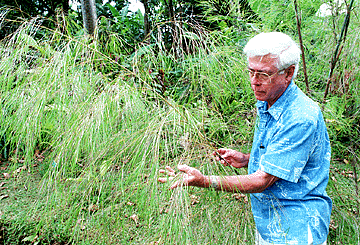
Paul Weissich examines Mexican bamboo, suitable for local gardens.
The first and non-negotiable requirement when choosing bamboo for your garden is the assurance that it will not run. Only clumping bamboo should ever be considered for urban gardens, otherwise it will not only send up shoots all over your landscape, but in the neighbors' yards. That's a one-way trip to trouble.
Once bamboo has run, or sent up random shoots, it is almost impossible to contain the planting and to remove the shoots. That is why the Friends of Foster Garden have promised that the new and exotic bamboo plants they are offering at their plant sale Saturday and Sunday, April 27 and 28, are all clumpers and won't take over your garden.
The sale will be held from 9 a.m. to 3 p.m. both days at Foster Garden, 50 No. Vineyard Blvd. at Nuuanu Avenue. Parking is available at the municipal parking lot across from Foster Garden on Vineyard Street, entered from River Street.
When you are considering bamboo for your landscape, clumping isn't the only consideration. Unless you want your your garden to look like the movie set for "Bomba, the Jungle Boy."
Think about the height. There's a giant bamboo that will grow as much as 18 inches a day, which in two months will reach a height of 100 feet, with stalks 8 inches in diameter. A conversation piece, but you really don't want it.
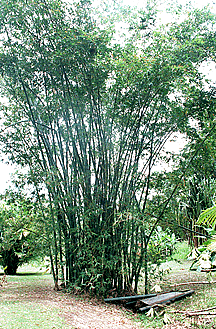
Bamboo, like sugar cane, is a member of the grass family. The right urban bamboo, such as the well-behaved dendrocalamus below, will clump. The wrong kind will cause grief as it spreads from your yard to your neighbors'.
 Paul Weissich of the Friends of Foster Garden recommends the delicate Mexican bamboo, a slender feathery plant that grows to 10 feet. It grows as a clump, either as a garden accent or in a tub on a lanai or terrace.
The plant will thrive in full sun and heat, and is one of the few that will grow near the ocean. Generally, bamboo grows better in a damper climate. Mexican bamboo can be used as a hedge or a windbreak, and also makes an elegant screen for unwanted views.
A new introduction for larger gardens is the Thai Monastary bamboo that grows to 30 feet. It grows in compact, upright clumps, and is the most widely cultivated bamboo in Thailand. Its young shoots are edible.
Bamboo, like sugar cane, is part of the grass family. Known in the Hawaii tradition as ohe, bamboo was one of the early Polynesian introductions. Its stems have thinner walls than the later introduction of Chinese bamboo, which makes it easier to split.
Because of the silica, a hard and glassy mineral, in their cell walls, bamboo stalks are hard, strong, elastic and light. Because they split cleanly, the stalks were made into delicate tools to stamp designs on tapa. They were also used to make pu'ili, the slivered stalks hit together in the ancient seated hula.
If you are willing to take a second look at bamboo, then you might be adventurous enough to think about lantana, long considered a weed. The new lantana, "Patriot Rainbow," bears masses of flowers in pink, red and yellow and grows to about 18 inches in height. It is a dense, drought-tolerant shrub that can also be used as a potted plant.
Bonsai growers will be interested in the new dwarf boxwood with small dark green leaves. Use it as a low border plant or as a specimen in an Asian garden.
THE sale will also feature native plants for landscape use. Look for lehua mamo, a yellow-flowered easy-to-grow ohi''a lehua. Its gray-green liko is prized by haku lei makers. There is also a low-growing shrubby ilima with fuzzy gray leaves and bright yellow, rather than orange, flowers.
Two other introductions to Oahu gardeners are a dwarf ixora and a dwarf bougainvillea, both unnamed and from Thailand. The ixora bears clusters of brilliant orange flowers, and can be used as a highly colorful low border hedge or as a potted plant. The bougainvillea grows to 2 feet and is densely branched and covered with bright purple flowers.
A new ground cover, particularly for slopes prone to erosion, is Arachis Pintoi, a peanut relative developed in tropical America. It grows to only 4 or 6 inches, but forms a dense ground cover that supresses weeds and halts erosion.
Foliage is an attractive fresh green and the small flowers are yellow. Unlike many other ground covers, it will tolerate moderate foot traffic. Stay calm, we could be looking at the wedelia of the next millenium.