
[ SUNDAY TRAVEL ]
|
Historic site gives We cherish our special hideaways, those places that calm and comfort us, heal and rejuvenate us, and fill us with peace and happiness. Hulihee Palace in Kailua-Kona was just such a sanctuary for the 19th-century ali'i (Hawaiian royalty).
glimpse of ali’i life
The palace houses an array of
priceless artifacts and gives
insight into Hawaiian cultureBy Cheryl Chee Tsutsumi
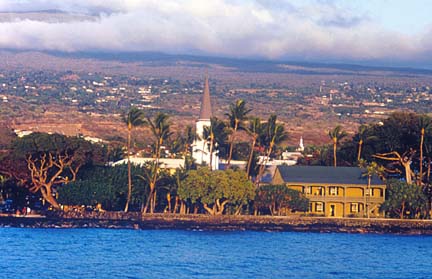
Special to the Star-BulletinBuilt by John Adams Kuakini, the second governor of the island of Hawaii and a cousin of Kamehameha I, this gracious two-story residence occupied a choice parcel on the shores of Kailua Bay. Measuring 60 feet long and 30 feet wide, it encompassed six rooms: an entry hall, parlor, dining room, second-floor sitting room and two second-floor bedrooms.
Kuakini directed the construction of the simple yet stately structure, employing laborers and craftsmen from foreign vessels who had abandoned the sailors' life to plant roots in Kona. The men hiked into the lush uplands to gather koa for the house's paneling and ohi'a for its joists and beams, and used lava rock and coral lime mortar to form the exterior.
|
Construction of Hulihee Palace was completed in 1838. Its name means "the turning," supposedly referring to a great battle that was fought at the site between warring Big Island chiefs.One army was pursued until it came to the spot where Hulihee now stands. There, the warriors turned and waged a gallant fight, eventually emerging victorious.
Hulihee was Kuakini's primary residence. After his death in 1844, it passed to his adopted son, Leleiohoku, who died four years later during a measles epidemic. Leleiohoku bequeathed the palace to his wife, Princess Ruth Keelikolani, who encouraged her royal kin to vacation there.
Ruth's half-brother, King Kamehameha IV, and his wife, Queen Emma, especially relished their visits to Hulihee. In the summer of 1861, Emma and her 3-year-old son, Prince Albert, arrived for an extended holiday. At the time, Hulihee was furnished with only the barest of necessities, and the queen decided to work on its interior.
She sent a letter to her husband in Honolulu, asking him for "things to fill and finish off the drawing room, some pictures, paintings, vases." The king obliged by shipping those items as well as dining room chairs, a large table, a piano and sofas. Emma found appropriate spaces for them all, and when Kamehameha IV arrived at Hulihee shortly thereafter, he was able to see the fruits of her labor. The royal family members so enjoyed their stay, they did not return to Honolulu until the end of the year.
Hulihee was a refuge for other ali'i as well. Shortly after being elected king in 1873, Lunalilo became ill. Concerned, Princess Ruth and Queen Emma convinced him to spend time with them at Hulihee. They hoped the serene environment, far from the pressures of governing, would cure the ailing king.
Address: 75-5718 Alii Drive, Kailua-Kona, HI 96740 Hulihee Palace
Hours: 9 a.m. to 4 p.m. daily
Admission: $5 for adults, $4 for seniors 65 and older, $1 for children under 18, including a guided tour. Kamaaina adults receive $1 discount.
Call: 329-1877
Web site: www.huliheepalace.org
Much of their entertainment revolved around music. Lunalilo summoned Henry Berger and the Royal Hawaiian Band to the palace, and throughout the Christmas season and into the new year, they presented concert after concert. But the king's condition did not improve. He returned to Honolulu in January 1874 and died less than a month later.
In 1883, Princess Ruth's health began to fail, and she retreated to Hulihee. Queen Emma and Princess Bernice Pauahi Bishop journeyed to Kona to care for her, but the princess passed away in the place she had grown to love so well.
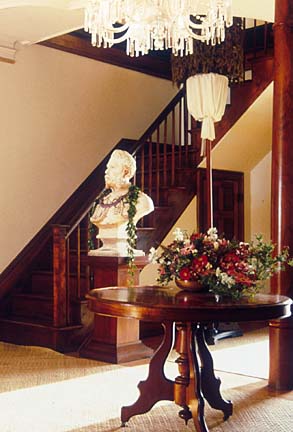
Kalakaua, who ascended the throne in 1874, was a frequent visitor to Hulihee. He finally purchased the property in 1885 from the estate of Princess Ruth's heir, Bernice Pauahi Bishop, who had died a year earlier. No doubt influenced by his many travels, the globe-trotting king made dramatic changes to the palace. He covered the stone exterior with stucco; plastered the koa-paneled interior; enlarged the lanais; hung crystal chandeliers in the entryway; decorated the ceilings with an ornamental cornice; and filled the rooms with rugs, paintings, photographs, satin cushions, and ornate sets of china and glassware.
When Kalakaua died in 1891, his widow, Queen Kapiolani, became the keeper of Hulihee. Upon her death in 1899, her nephews, Prince Jonah Kuhio Kalanianaole and Prince David Kawananakoa, inherited the palace. Fifteen years later, they sold it for $8,600 to wealthy Mrs. Bathsheba Allen, who died just a month after the transaction was finalized.
For years afterward, the property languished. By 1921, its once beautiful landscaping had become a dense, unkempt tangle of overgrown grass, weeds and untrimmed trees. Within three years, the palace looked anything but royal. Its floors were rotting; many of its windows were broken; plaster was peeling everywhere; and its railings, lanais and staircases were on the verge of collapse.
In stepped the Daughters of Hawaii, a civic-minded group of women who were daughters of Protestant missionaries and citizens of the Hawaiian kingdom. They championed the introduction of a bill before the territorial legislature in 1925 that directed the commissioner of public lands to acquire Hulihee Palace. The governor, they urged, should then turn the palace over to them so they could restore it and maintain it as a museum.
|
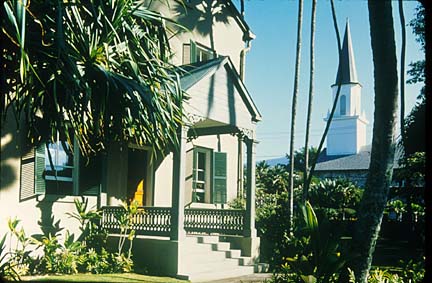
Two years later, that became a reality and an extensive renovation project was launched. On June 11, 1928, Hulihee Palace, spruced up and standing proud once again, officially opened as a museum under the stewardship of the Daughters of Hawaii.Designated as a National Historic Site, the palace houses an array of priceless artifacts, many of which belonged to the ali'i. Exhibit highlights include some of King Kamehameha's spears, the longest of which measures 22 feet; a covered calabash carved from the trunk of a coconut tree that Princess Ruth used as a hatbox; Queen Kapiolani's mirrored wardrobe, built of fragrant sandalwood and inlaid with ivory; a guitar embellished with a dainty floral design, that was owned by King Kalakaua; and a lovely teak and rosewood music box given to Princess Kaiulani, Kalakaua's niece, by author Robert Louis Stevenson, a personal friend of the king.
In homage to its history, one Sunday a month, Hulihee Palace presents a free concert of Hawaiian songs and hula on its makai, or seaside, lanai. Each performance starts at 4 p.m. and honors a different member of the royal family. The next performance is Feb. 24 and honors Princess Ruth Keelikolani.
As palace administrator, Fanny Collins Au Hoy recognizes the significance of the structure in her care. "Hulihee Palace's collections bring to life the history and culture of the Hawaiian people," she says. "They offer fascinating stories; they provide a glimpse of how the Hawaiians lived before and after Western contact."
Cheryl Chee Tsutsumi is a Honolulu-based free-lance writer.