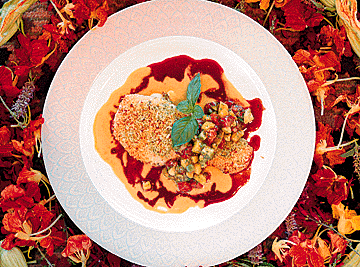
Beautiful blossoms add exquisite color, fragrance and flavor to even the most ordinary dishes
Incredible edible
Flowers
Beautiful blossoms add exquisite color, fragrance and flavor to even the most ordinary dishes
 A ROSE is a rose is a rose. Unless, of course, it's a salad ingredient, a seasoning for vinegar, or the fundamental flavoring of a dessert sauce.
Color: Throw a few deep-orange nasturtiums or sun-yellow calendulas into a leafy, green salad, sit back, and wait for the "Wow!" But, don't stop there. Serve grilled mahimahi with a light, lemon butter sauce made with tuberous begonia. Garnish a scoop of ice cream with brilliant red, sweet-and-fruity pineapple sage petals. You'll think you're dining in an upscale restaurant.
Fragrance: Fragrant flowers, such as rose and scented geranium, give a subtle essence to breads and desserts. Flower blossoms from orange trees can be used to flavor jelly or honey. Dried hibiscus, chamomile and jasmine flowers make soothing, aromatic teas.
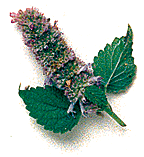
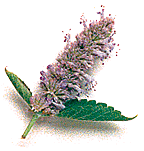
Flavor: If you're looking for intense flavor, the tiny white blossoms of the garlic chive pack a powerful punch. Basil flowers may taste like lemon, clove, cinnamon or mint, depending upon the plant variety. In the mood for something sweet and tropical? Try the pink and white blossoms of the pineapple guava. Licorice lovers will adore the "Good 'n' Plenty" flavor of anise hyssop.
If these flowers sound so good you want to try them all, purchase some "confetti," a floral term for a blend of multi-colored flower petals. Confetti has a myriad of culinary uses, according to Dawn Trunk, a commercial flower grower on the Big Island.
You can garnish the edge of the plate with confetti, sprinkle it in punch, decorate the base of cake, or add it to salads and gelatin molds - just to name a few.
 "Don't be afraid to eat edible flowers. Just try them!" challenges Dean Okimoto, owner of Nalo Farms in Waimanalo. Okimoto finds that children are often much more daring to sample edible flowers than adults. But, once they muster up the courage to try them, people of all ages tend to enjoy eating the blossoms.
Where can you buy edible flowers? Nalo Farms, Strawberry Connection and R. Field Wine Co. carry a variety of cut edible flowers for retail sale. Prices start at around $4.25 for about 25 blossoms. Occasionally, flowers can be purchased by weight. Don't be put off by their seemingly high price per pound. Cut flowers are generally light in weight.
"Growing your own flowers at home can be very satisfying," Trunk said. For the residential gardener, she recommends buying a hard plastic kiddie pool, poking holes in the bottom for drainage, then filling it with potting mix. (You can even paint the pool if you want a more sophisticated look). The result is a contained flower garden that is easy to tend.
"There are a lot of flowering herbs that are great for home gardening," Trunk said. "Rosemary gets a small purple blossom. Different varieties of basil will get different colored flowers. For example, cinnamon basil has a dark purple flower. Common basil and lemon basil have white flowers. You can use these flowers to season fish, soup and salads."
 Flo Stanley of Mililani has been growing edible flowers for about 10 years. In fact, her entire residential landscape is edible. On a small scale, she formerly supplied several Honolulu restaurants (including the Willows and Philip Paolo's) with fresh herbs and flowers.
"I think nasturtiums are probably the most popular and tastiest edible flower. They are peppery like watercress, with a little sweetness. They can be grown all year round. But, because nasturtiums require lots of water when it is hot and sunny, they are easiest to grow during the cooler, rainy months. Planting them in an area that gets morning sun and afternoon shade would be ideal," she said.
The Mexican mint marigold grows well in Hawaii, Stanley said. It is a perennial, so will continue to bloom year after year. The tiny, five-petal yellowish-orange flowers can be used to flavor salads and vinegars. Its leaves are also edible, and similar in flavor to French tarragon.
"Not only is the day lily edible, the plant makes an attractive hedge to line a sidewalk or driveway. I prefer to grow the old-fashioned orange variety because I think it tastes the best," the Mililani gardener said. "I cut the day lily before the heat of the day and put the bottom part in some water. Or if you refrigerate it."
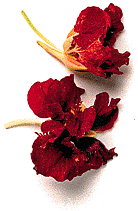 Day lilies can be used to accent salads or soups, or to garnish a platter of cold appetizers. The buds of the plant - commonly called Chinese lily buds - are also edible. They have been cultivated in China for hundreds of years. Lily buds can be used in Chinese dishes such as stir-fry or hot and sour soup.
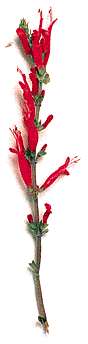
"Pineapple sage has tubular red flowers. The leaves are very aromatic and smell like pineapple. I pluck the flowers and sprinkle them on top of ice cream or sorbet or on top of salads. The leaves can be used, as well, to flavor herbal teas and sorbet," Stanley said.
Edible flowers not only add color and dramatic flair to a meal, they can even result in a few surprises. For example, when you eat very dark-colored pansies, your tongue will turn black. Don't worry. The condition is only temporary. But, when choosing edible flowers to decorate a wedding cake, stay with the romantic rose.
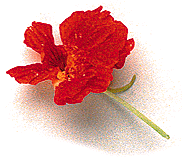 It's important to note that not all flowers are edible. Some, such as poinsettia and azalea, are toxic. Like foods, certain flowers may cause allergic reactions in susceptible people.
According to the Hawaii Poison Center at Kapiolani Medical Center, common orchids and plumeria are nontoxic, but may cause stomach upset.
Here are some tips and rules about eating flowers from "The Ten Rules of Edible Flowers" by Cathy Barash, author of "Edible Flowers - from Garden to Palate":
2. Just because it is served with food does not mean a flower is edible.
3. Eat only flowers that have been grown organically.
4. Do not eat flowers from florists, nurseries or garden centers.
5. If you have hay fever, asthma or allergies, do not eat flowers.
6. Do not eat flowers picked from the side of the road. They are contaminated from car emissions.
7. Remove pistils and stamens from flowers before eating. Eat only the petals.
8. Not all flowers are edible. Some are poisonous.
9. There are many varieties of any one flower. Flowers taste different when grown in different locations.
10. Introduce flowers into your diet the way you would new foods to a baby - one at a time in small quantities.