
|
Bear Tracks
The mighty polar bear lures
travelers into the great white
wilderness of Churchill, Canada
CHURCHILL, Manitoba, Canada » The October temperature was well below freezing when the helicopter arrived, its blades chopping noisily through the icy air. It lowered a line to the ground where a small group of men tied it to a net.
Earlier they had carefully dragged a furry, white, thousand-pound burden onto the same mesh. Breathing easily, but hardly in a fighting mood, was a thoroughly tranquilized adult male polar bear.
Once everything was secured, the chopper noisily flew away with its live cargo dangling beneath it, and watched by a small crowd of camera-laden tourists and grateful townspeople. It would not land until it reached a location 50 miles or so to the north.
There the crew would gently lower the animal to the ground and would wait nearby to protect their passenger until he was fully awake. They would not leave until he was able to fend off any other bears that might otherwise take advantage of a bleary-eyed beast that had been banished to the wilderness.
This scene takes place as much as 100 times a year in the town of Churchill, which proudly claims the title of "Polar Bear Capital of the World."
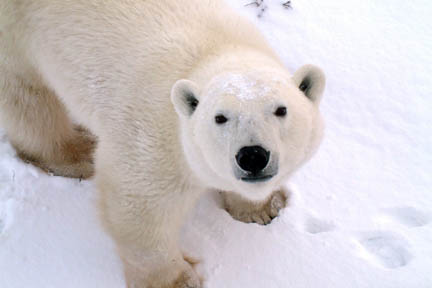
It's right in the middle of the migration route of Ursus maritimus, the "great white bear."
Despite the apparent contention by the spooky new TV Series "Lost," now being filmed on Oahu, that a polar bear could conceivably be found on a tropical island, these white-coated creatures live only in the cold climes of the far North.
|
A polar bear might show up in the Churchill neighborhood at any time of the year, but in late October or early November, hungry bears hang around by the hundreds, waiting for the "freeze-up" on nearby Hudson Bay. Then they can once again pad their way out on the ice to hunt seals, which make up the favorite part of their diet.
All of the town's residents have a bear story or two -- generally surprise encounters that seemed scary at the time but came out all right in the end. Polar bears have been known to turn over a car and then walk away after losing interest in the game.
The town sells plenty of bear souvenirs, too. Popular are reproductions of the warning signs placed at strategic points at the edge of town. There are also two museums mostly devoted to bears and other wildlife.
Generally speaking, the animals stay beyond the bear limits, but every now and then, one decides to go for a stroll on neighborhood streets and alleys.
Then the town bear patrol captures or traps the rogue explorer. They either put them in the barnlike Polar Bear Jail outside of town to wait for freeze-up or else fly the animal immediately to other locations in the wild.
"We used to give them food in there," said one bystander. "But then we found bears trying to break into jail, so now we just provide them with water."
|
AS MUCH AS Churchillians love their bears, they are constantly on watch, especially in the fall. Costumed children go trick-or-treating on Halloween night, accompanied by doting parents toting guns and rifles. The last fatal encounter of the furry kind was more than 20 years ago, but nobody believes in taking chances.
Polar bears are meat eaters, after all. Unlike more omnivorous grizzlies or black bears, they would never be satisfied with a bush full of berries or a few purloined chocolate bars.
Tourists who want to see polar bears are welcome in Churchill, so long as they follow the rules. No roads lead to the town. They come either by an all-day train ride north from Winnipeg, or via airplanes that land at a former air force base near the town. Local hotels can arrange for day trips out on the nearby tundra to see the white-coated animals.
My own all-inclusive experience was with Natural Habitat Adventures, a Colorado-based outfit that is the largest tour operator there. It offers small-group polar bear tours in October and November, two of them geared to dedicated amateur photographers. These are headquartered on the tundra itself where most of the bears gather to wait for weather cold enough to form their icy road to the seal hunting grounds.
For photo tours, Natural Habitat's accommodations are in the Tundra Lodge, a trainlike set of rubber-tired frame buildings that can be placed in the expected center of the action. Each train car holds a group of tiny rooms equipped with bunk beds, a lamp and not much else. Still, it's less primitive than some other operations, and no one had any trouble sleeping or keeping warm.
Toward one end of this stationary train is a cozy lounge equipped with a bar and a TV set, which is often playing tapes or DVDs of wilderness and bear experiences. And attached to that is the last car, containing a kitchen and dining room, which serves breakfast and dinner.
Walking the open spaces between the cars provides brief, sharp experiences in Arctic air for those living near the end of the train, especially at night. Nevertheless, some stop occasionally to admire the northern lights, which can be dramatically colorful at these latitudes and at this time of year.
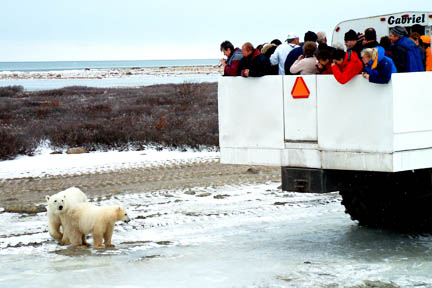
Lunch is taken out on the tundra where daily photo excursions are made in specially constructed tundra buggies. They seem like outsize school buses, but each contains a space heater, a chemical toilet and, in one corner somewhere, a seldom touched but always ready 12-gauge shotgun. These vehicles lumber slowly around the landscape looking for bears. Harassing or baiting the animals, however, is not allowed.
|
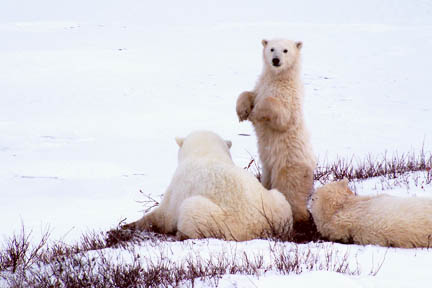
PHOTOGRAPHERS CAN aim through open windows in the tundra buggy. Hardy souls will occasionally brave the wind and cold to stand on an open-back deck, where some photo fans set up their tripods and telephoto lenses. Everyone hopes for the biggest prize, a full-frame photo of a sow with her cubs.
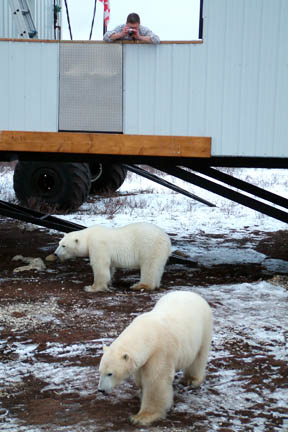
Like the hotel train, the tundra buggies are high enough off the ground so a standing bear cannot quite shake hands with the human cargo.
They are usually more curious than aggressive, although some decide to chew on a tire now and then.
The back deck is a grating through which guests might see a really close black nose, maybe even feel its breath. But it would be a mistake to stick a finger through it. These cuddly animals with their gentle, kind-looking faces have powerful teeth.
Natural Habitat Adventures has a close affiliation with the World Wildlife Fund. In addition to getting some dramatic images or footage of polar bears and other wildlife, their guests learn a considerable amount of northern wilderness lore, especially in the evenings before and after dinner when everyone is sitting around talking about the things they have seen throughout the day.
Not enough people realize the dangers that modern life has placed on future enjoyment of the Arctic wilderness, said our expedition leader, Matthias Breiter.
"People who have not been to the Arctic tend to see it as simply a white wasteland and that developers won't ruin anything if they go there," he said. "As far as I am concerned, the entire purpose for promoting eco-tourism in the Arctic is so that people can see that it needs to be protected."
|
Frequent bear encounters are often separated by other animal experiences, such as sightings of the Arctic fox or the small birds called the willow ptarmigan. Both creatures have coats that turn from brown to white and back again, in concert with the seasons. Snowy owls also sometimes appear.
One thing potential guests should be aware of is that no one knows exactly when the bears will be most numerous.
"The best time to come is the week before freeze-up, but no one knows exactly when that is," said Breiter. "Generally speaking, that is the last few days of October and the first 10 days of November. Anything earlier, it's warmer and there's not as much snow. Anything later, and most bears have already made their way out onto the ice."
If freeze-up happens early, most bears might be gone by your arrival time.
Still, Breiter says, the company makes sure its guests have some sort of a bear experience, no matter what happens with the weather. One year, they piled everyone into helicopters and found groups of bears via an aerial reconnaissance.
If you go...
Where: Natural Habitat Adventures, 2945 Center Green Court, Boulder, Colo. 80301;Price: Begins at $4,195 for the eight-day photo tour, per person double occupancy, including air transportation from Winnipeg. Includes accommodations, meals, boots and parkas and daily guided excursions in the tundra buggies. Non-photo polar bear tours last six or seven days and cost $2,995 and $3,195 respectively, per person, double occupancy.
Call: 800-543-8917
E-mail: infoATnathab.com; www.nathab.com.
More information
» Travel Manitoba: 155 Carlton St., Winnipeg, Manitoba R3C 3H8; call 800-665-0040; www.travelmanitoba.com» Frontiers North Adventures: Box 40063 RPN Nairn, Winnipeg, Manitoba, Canada R2L 2G2; call 204-667-1051; wwwltundrabuggy.com
» World Wildlife Fund: 1250 24th St. NW, Washington, D.C. 20037; call 202-293-4800; worldwildlife.org/polarbears
