
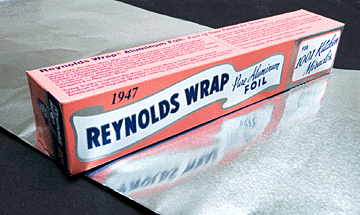

In a simpler time, all that was necessary after using Reynolds Wrap or other aluminum foil was to ball it up and throw it away.
That method of disposal is archaic in these days of global consciousness, shrinking resources and Earth Day celebrations.
Recycle your foil at Reynolds Aluminum, with 14 locations on Oahu. Call 487-2802 to find out location and hours near you.
Reynolds takes foil, soda, Spam and Vienna sausage cans. Rinse off items before recycling. If you have less than a pound of foil, it can be mixed with cans. Separate if more than 1 pound. Pays 23 to 38 cents per pound depending on volume. Pays 1-cent bonus per pound for flattened cans and another 1-cent bonus per pound of aluminum for seniors age 55 and older on Wednesdays and Thursdays.
Other sites take aluminum cans:
 Hawaii Environmental Transfer: 611-A Middle St., 842-3181. Soda cans only. Pays 29 cents a pound up to 100 pounds; pays 31 cents a pound for 101 pounds or more. Open 7 a.m. to 3:45 daily.
Island Recycling: 1811 Dillingham Blvd., 845-1188. Takes scrap aluminum, soda, Spam and Vienna sausage cans. No foil. Pays 32 cents per pound up to 100 pounds; 35 cents per pound 101 pounds or more; 38 cents per pound 201 pounds or more. Open 8 a.m. to 4 p.m. Mondays to Saturdays and 9 a.m. to 4 p.m. Sunday.
"What researchers have found is traces of aluminum in brains of autopsied individuals (who suffered from Alzheimer's). We still don't know if that's a cause or an effect of the disease."
Aluminum is a naturally occurring substance, so Olmsted said long-term research would have to focus on where people live as well as what they eat.
According to a study by the University of Wisconsin's Department of Nutritional Sciences, most Americans consume 2 to 25 milligrams of aluminum daily. The largest sources of ingested aluminum are water (up to 10 milligrams daily) and food additives (up to 20 milligrams). In comparison, aluminum from pans and utensils account for up to 2 milligrams daily. Also, the intake of aluminum from foods is less than 1 percent of that consumed by individuals using aluminum-containing pharmaceuticals.
The most commonly used aluminum-containing food additives are sodium aluminum phosphates (leavening used in baked goods and the emulsifying agent in processed cheese), aluminum sulphates (acidifying agents), food dyes and aluminum silicates (anti-caking agents).