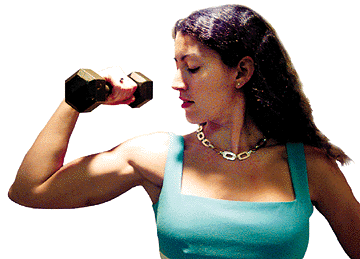
Personal trainer Jennifer Bos flexes some muscle in a turquoise shift ($148) and oval link necklace ($79) from bebe at Ala Moana Center. Photo by Dean Sensui, Star-Bulletin
Personal trainer Jennifer Bos flexes some muscle in a turquoise shift ($148) and oval link necklace ($79) from bebe at Ala Moana Center. Photo by Dean Sensui, Star-Bulletin
Question is, are you ready to enter the battle ground of clothing racks teeming with shifts a la Jacqueline Kennedy and Audrey Hepburn, halters, sleeveless blouses and dresses? These garments offer a conspiratorial lack of camouflage for the unsightly wattle - that bit of loose flesh hanging under the triceps - known to attack women at age 30, when nonexercising adults begin to lose about half a pound of muscle tissue each year, according to the American Council on Exercise.
 The appearance of the wattle is a matter of gender inequality. Men get the Y chromosome, women get the X that marks certain spots as ideal - upper arms and thighs - for fatty deposits.
But there is hope. With consistent effort, it's possible to correct this evolutionary injustice. According to fitness professionals, one can develop shift-ready arms by working the triceps and related muscle groups at least twice a week - three times is better - and see results in a month to six weeks, just in time for the first day of summer, June 20.
Still, be aware that short of liposuction, there is no such thing as a quick fix. "It takes time to get the body in shape and to stay in shape," said Susie Scott, fitness director for Gold's Gym. "The best approach is prevention, never really letting yourself go that bad."
Dieting and incorporating aerobic exercise to lose a little body fat is an important first step according to Tony Taclan, manager at the Punahou Spa Fitness Center.
"Maybe the muscles are weak because they've never been used, but they're there. Everybody has muscle, but you have to lose body fat for it to show," said the former Mr. Hawaiian Islands.
At the Honolulu Club, too, personal trainer Jennifer Bos was reluctant to focus on triceps only, stressing that any fitness regimen should involve the whole body.
"We get a lot of women in here who say, 'All I need is to work my triceps and my abdominals. I look fine everywhere else.' But they're more likely to injure themselves.
"Combining cardiovascular, with strength training, which is weight training, and flexibility exercises or stretching - you need all three for the quickest, best and safest results."
For beginners, Bos recommends an exercise routine that starts with at least 5 minutes of aerobic activity, whether it involves walking around the block or riding a stationary bicycle. She then recommends 6 to 10 minutes of warm-up stretching. The same amount of stretching should follow one's work-out.
These are steps even long-time exercisers neglect. She spends part of her shift in the Honolulu Club weight room like a fitness lifeguard, looking out for people who might be working out in a way that might cause injury. "We approach them gently and try to correct them. A lot of them get defensive because they've been doing the same thing so long, they don't want to hear they've been doing the wrong thing all that time.
"A lot of them are professionals who are busy, so they rush through their exercises too quickly and neglect stretching. They don't warm up and they don't cool down."
While the following tricep-toning exercises would work for anyone, those who regularly exercise all muscle groups will likely benefit the most.
"You never want to work just one muscle group. You need to work all the major muscle groups in the body, and you always want to work opposing muscles," Bos said. "When you strengthen your triceps you stretch your biceps and vice versa. They go hand in hand."
Scott said, "When you're talking arms, you're talking shoulders and biceps. All of them together create 'the look,' it's not just one part."
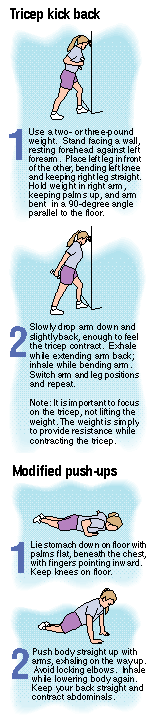
She's most enthusiastic about modified push-ups, saying, "It's a good starting point. Anyone can do them at home and it's probably one of the safest exercises."
Modified push-ups are done on the knees, but to increase difficulty, one can later graduate to full push-ups, which keep the toes on the ground.
Scott is also big on tricep kick backs, which involve weights, but which can be performed with a can of soup in hand. "I try to remind people that fitness doesn't have to be expensive. You don't need to belong to a gym to do these exercises."
When using dumbbells, limit yourself to weights of two or three pounds to avoid unnecessary strain and injury.
"The important thing is you must find exercises you enjoy and have some fun," Scott said. "If it's too hard and too painful, you won't continue. You want to feel like you've accomplished something, not like, 'I never want to do that again.' "
For each exercise, start with one set of eight repetitions. When this becomes too easy, increase to 12 or 15 repetitions. Over time, increase to three sets of 8 repetitions, then three sets of 15.