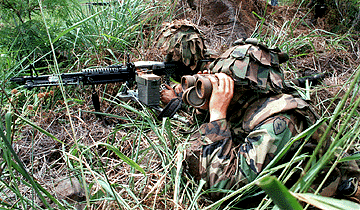
"Wolfhounds" of the Army's 25th Division take aim at a target during field exercises this week at the Makua training area. The reservation, in use since World War II, is a key live-fire training facility, the military says.
"Wolfhounds" of the Army's 25th Division take aim at a target during field exercises this week at the Makua training area. The reservation, in use since World War II, is a key live-fire training facility, the military says.
Today, with pressure to get more out of defense dollars, the Waianae military training facility takes on greater importance, says Maj. Gen. John Maher, commander of the 25th Infantry Division (Light).
Eighty percent of the live-fire training on Oahu by Army soldiers and Kaneohe Marines takes place on the 4,190 acres the Army leases from the state.
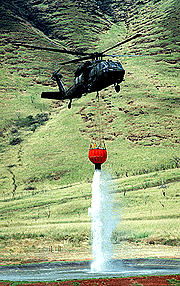
An Army helicopter drops water from a bucket at the dry range.
 "If we couldn't train here to meet our readiness requirements," Maher said during a recent media tour of the site, "the Defense Department would have to look elsewhere to station their soldiers."
Maher said he believes the need for combat-ready troops in Hawaii will not decrease in the next 50 years as the country's commitment to the Pacific continues to rise.
The Army points out that Makua Military Reservation is the only place on Oahu where company-size units of about 120 soldiers can safely fire live ammunition and train under battlefield conditions.
At Schofield Barracks, soldiers develop and practice individual skills, firing on targets at fixed distances. Other areas, such as Kahuku, allow development of only tactical skills.
At Makua, units can combine these two types of training. Although the Army leases more than 4,000 acres, the combined arms live-fire and maneuver area is limited to 600 acres because of environmental concerns.
During a recent training exercise, a platoon from A Company, 1st Battalion, 27th Infantry practiced taking an "enemy" objective.
Firing live ammunition at radio-controlled dummy targets, the "Wolfhounds" employed their arsenal of mortars, rifles, machine guns and grenade launchers.
The Waianae training range is in use 80 percent of the year, Maher said.
If it were not available, the only alternative for the Army National Guard, Marines and the Army would be to transport troops and equipment to the Big Island's Pohakuloa Training Area.
Maher said his role as the leader of the Army in Hawaii is "to train the force, to protect the soldiers and to protect the environment . . . leaving it better than the way we found it."
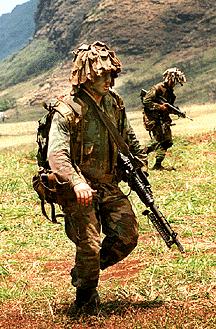
Full-dress soldiers deploy on a mission in Makua Valley.
 At Makua, that means protecting the 22 endangered plants, nine endangered species candidates and 17 rare plant species found around the slopes and ridges as of 1993.
Margo Stahl, program leader with the U.S. Fish and Wildlife Service, said the Army has been "very cooperative" in working to protect endangered plants and animals in the valley.
Most native plants and animals that once lived on the valley floor disappeared years ago, victims of cattle-grazing and other human uses.
Many rare and endangered native species, including the Oahu tree snail, are now found on remote ridges of the Waianae mountain range above the valley floor.
Stahl said the major environmental threats in Makua are fire, goats, pigs and weed-producing plants.
Environmental concerns also influenced the Army's decision to modify its training activities in 1989. It no longer allows rockets or missiles to be used on the range.
Two 300,000-gallon helicopter dip ponds - both 40 feet wide, 40 feet long and 15 feet deep - have been constructed and the Army maintains a firefighting crew.
To further combat fire, the Army realigned the pop-up targets on five firing points to prevent live-round tracer bullets from landing outside of the firebreak.
Makua Military Reservation straddles three valleys between Waianae and Kaena Point. Military background on Makua reservation
- 1869-1941: Most of the valley was leased to cattle ranchers.
- 1942-1943: U.S. Army confiscates 6,600 acres.
- 1964: Army returns 2,400 acres to state.
- Present: 4,190 acres leased to the Army until 2029.