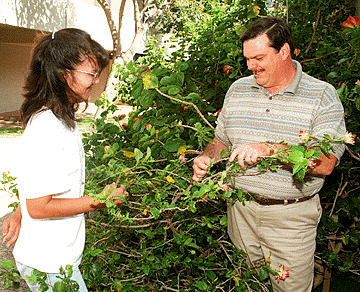
David Hensley, examining hibiscus with lab technician Julie Yogi, is known as the Plant Doctor. By Terry Luke, Star-Bulletin
David Hensley, examining hibiscus with lab technician Julie Yogi, is known as the Plant Doctor. By Terry Luke, Star-Bulletin
Call the Plant Doctor, even if he isn't covered by your medical insurance. Anyway, he's free.
Dr. David Hensley, University of Hawaii extension division landscape specialist, is a general practitioner in the field of plant health. He will be available for consultation this weekend at the Ward Flower Festival.
The free event will be held from 10 a.m. to 5 p.m. tomorrow and Sunday at Ward Warehouse and Ward Centre. The daily programs include a display and sale of hundreds flowers and plants, live entertainment, halau performances, and a spring fashion show.
Hensley says that you don't actually need to bring the patient with you as long as you can accurately describe the problem. A diseased leaf or withered flower could help with the diagnosis, though.
Hensley's daytime job is to aid the agricultural and horticultural industries here with cultivation problems on a large scale. But he often appears at garden shows and plant sales in the role of the Plant Doctor.
You will be able to spot him this weekend because he has, without much enthusiasm, agreed to suit up in a surgeon's green scrubs. If he appeared at a commercial anthurium grower's or a lettuce farm in the outfit, he said that they'd probably call a real doctor.
"Most of the problems (of the home gardener), beyond bugs, are due to the wrong plant in the wrong place, lack of maintenance or wrong maintenance. People tend either to ignore their plants to death, or to love them to death," Hensley said.
"Take a panax hedge. Panax is tough, so it will grow pretty much anywhere, but it gets to 15 or 20 feet. I've seen people trying to keep a hedge at 5 feet, so it gets gnarly and deformed. "Ixora is a great plant when it is grown well, but it is finicky about its pH factor. You won't have beautiful ixora plants near the beach where the pH is high."
Ph is the soil's level of acidity or alkalinity, on a scale of 1 to 14. Neutral soil is expressed as 7, but anything between 4.5 and 8 is acceptable.
If your soil lurches to either extreme, it means that the soil's minerals are difficult for your plants to absorb, and the necessary bacteria are less vigorous. The University of Hawaii Cooperative Extension Service will, for a small charge, test your soil. For further information, call 956-5434. Too much or too little water is a common problem, along with watering at the wrong time.
"The plant will tell you a lot," Hensley said. "I watch my impatiens. It's a drought sensitive plant, and it wilts before anything else, particularly in hot weather or at the end of the day. If the impatiens is thirsty, the other stuff is too.
"Some plants will change color they will take on a bluish cast when they haven't enough water, or the leaves will roll up. If you water right away, the wilt is reversible. But if you notice that a plant is wilted in the morning, that could be the end because it should recover overnight."
Too much water creates frequent disease and root rot. Too little water causes dehydration.
"The symptoms of both are much the same because too much water will suffocate the roots and they become unable to absorb the moisture. I have seen wilting plants that are standing in water that they can't absorb."
Sunshine is another factor. "When people put in landscaping, it is usually small. But as a tree grows, it provides more shade. Bermuda grass is shade intolerant, so it probably thrived when the tree was small, but it dies as the shade becomes heavy. Plants get leggy in the shade as they stretch for the light. In the full sun, a plant stays compact."
Do the strong trades blow through your garden? If so, keep the ginger and heliconia on the sheltered side of the house. Otherwise the leaves will shred.
Hensley takes a tolerant view of such garden pests as aphids and whiteflies. "You are better off not doing anything about them. Most of them have natural predators, so when the population of the pests builds up, something comes along to eat them. When they are gone, the predator moves on until the population grows up again. Decide on a level of damage you are willing to accept.
"If you need to spray, try Bacillus thuringiensis, called BT Bacteria, available at garden shops. It causes disease in some insects, but it doesn't affect people or pets. Unless your pets are insects," Hensley said.
"You need to remember that everything in the garden is connected. If you apply lots of water and lots of fertilizer, you'll get lots of grass. If you don't want to mow every five days, adjust the program so that the growth will slow down. Of course, you can't go too far, or things will die.
"But plants do die. I have seen more effort put forth to save a $4 plant growing in the wrong place than you'd believe. If it is a problem, dig it up and throw it out. Plants are inexpensive here, and they aren't forever they're just part of the landscape."