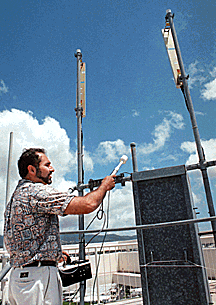
Damian Ameen, who helped Western Wireless set up its Oahu system, inspects antennas for the company, which he said could eventually have as many as 100 antenna sites on Oahu. Photo by Ken Sakamoto, Star-Bulletin
Damian Ameen, who helped Western Wireless set up its Oahu system, inspects antennas for the company, which he said could eventually have as many as 100 antenna sites on Oahu. Photo by Ken Sakamoto, Star-Bulletin
But is it a safe one?
Independent scientists and those funded by the wireless technology industry report no findings or identifiable biological problems from low-powered radio transmissions or cellular phones. Still, there are worries.
Louis Slesin, editor of Microwave News, which covers the cellular industry, said evidence is lacking to say with certainty that the antennas are safe.
"We're not playing with a full deck," he said in a phone interview from New York.
The studies that have been done focus on short-term exposure to high levels of electromagnetic radiation, not long-term exposure at the low levels emitted by the antennas, he said.
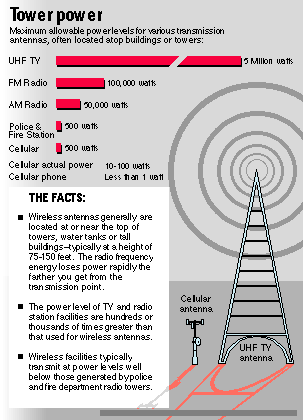
Slesin said residents here should be more worried about the high-powered radio and TV towers that dot the cityscape than the low-powered cellular antennas.
Yet, asked if he would live on the top floor of a building with cellular antennas on the roof, Slesin had a quick reply: He'd live elsewhere.
Dr. C.K. Chou, chairman of the Institute of Electrical and Electronics Engineers, told the Star- Bulletin that "for people with phones there is no problem."
The caution is for people working close to transmitters.
"There are circumstances where workers could be exposed to fields greater than the standards specify," Chou said. "In those cases, generally on rooftops, access should be restricted."
There also is a danger that the pulse generated by a digital cellular phone can disrupt the beating of an electric pacemaker implanted in a person's body. Physicians are supposed to warn patients about the possible problems from putting a digital pocket phone very close to a pacemaker.
There are also complaints about digital phones emitting a humming picked up by those wearing hearing aids.
Doug Carlson, a spokesman for PrimeCo Personal Communications, a wireless phone company setting up business here, said the problems may be only with certain phones.
"We are not aware of any conclusive scientific evidence that our technology has the same effect on these devices as some of the other digital technology that are under scrutiny," he said.
The concerns have moved Hawaii's U.S. Sen. Daniel K. Inouye, who sometimes wears a hearing aid, to call on the industry to solve the problem.
"We urge the (Federal Communications) Commission to see that all 4 million Americans who wear hearing aids have the ability to operate PCS equipment," Inouye said in a recent joint statement with several other senators.
Related Story:
Up On The Roof