Big-money phone companies have their sights trained on isle rooftops but residents' health concerns are causing interference

By Rob Perez
Star-Bulletin
By Rob Perez
Star-Bulletin
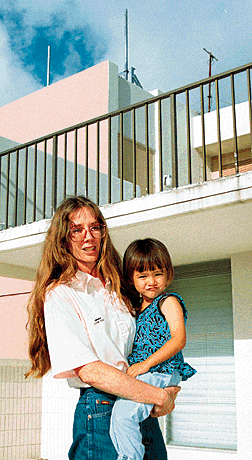
Sarah Pendleton was cleaning windows in her Kahala Towers penthouse when she noticed workers going up and down a nearby roof stairwell.
As Pendleton later learned, the workers were preparing to install microwave antennas atop the building for a new digital cellular phone company.
The condominium's board of directors had approved the installation without informing other apartment owners. But once word spread, the ensuing outcry, mainly about safety concerns, eventually derailed the project.
"These (antennas) don't belong on top of people's residences against their will," said Pendleton, a nuclear engineer who spearheaded the opposition.
Similar concerns - the industry says they're unwarranted - are surfacing at other condominiums as the new wireless phone companies search the state for more antenna sites.
At least two digital carriers, Western Wireless Corp. and PrimeCo Personal Communications, are looking on Oahu or the neighbor islands, offering to pay building owners thousands of dollars annually for the rooftop perches. Another company, DCR Communications Inc., also is in the hunt, though it has yet to be awarded rights to the local market.
As the wireless wave gains more of a foothold locally, the scramble for sites is expected to intensify, contributing to a cityscape that one lawyer sarcastically dubbed "high-rise antennas heaven."
"There's a real hustle going on," said attorney Jason Oliver, who represents condo associations. "The companies are very aggressive."
They have good reason to be. A lot is at stake.
Western Wireless, known locally as VoiceStream Wireless, and PrimeCo, formerly called PCS PrimeCo, paid more than $20 million each for federal licenses to serve Hawaii with personal communications services, the newest generation of cellular phones.
DCR has bid nearly $54 million for an Oahu license, and the federal government plans to auction three others this year.
The key to the PCS systems - or any wireless networks - are the antennas. Companies need enough of the transmitting devices in strategic places to provide sufficient calling coverage, especially with Hawaii's mountainous topography.
And as the companies' customer base grows, the need for additional sites rises as well.
Western Wireless, the first of the PCS companies to offer digital service here, has more than 50 antennas atop high-rise condos, office buildings, shopping centers and other structures around Oahu. As many as a third are on residential buildings.
Damian Ameen, a consultant who helped Western Wireless set up its network, said the company eventually could have as many as 100 sites on Oahu, plus dozens more on the neighbor islands.
For many financially pressed condo associations, the antenna deals represent a painless way to
make money. Some associations earn as much as $50,000 annually leasing out space that otherwise would be unused. They don't mind that their roofs look like antenna farms, though the newer panel- shaped antennas can be mounted on walls, blending in with the building.
"The way we see it, it's free, easy money," said Lane Brink, resident manager at Lunalilo Tower, a 12-story project with six Western Wireless antennas. The company pays $750 a month for the site and gave the association a $1,000 signing bonus, Brink said.
They contend that studies don't address whether long-term exposure to low-level electromagnetic radiation emitted by the antennas is safe - despite industry and government claims to the contrary.
"People being sucked into this tend to only see the money," said Henry Curtis, executive director of Life of the Land, an environmental lobbying group.
There is enough uncertainty about the safety issue that the California Public Utilities Commission last year advised cellular companies to avoid putting antennas near schools and hospitals.
Until the evidence is convincing, the skeptics say, antennas should be kept away from residential buildings, too.
Attorney Michael O'Connor, president of a Diamond Head apartment cooperative that is considering three antenna proposals, likens the issue to asbestos exposure. Years ago, no one considered the cancer-causing substance hazardous. Now people know better.
"I'm trying to be Mr. Conserva tive with this," said O'Connor, who opposes the proposals.
"If (the antennas) are really safe, then I'm being unreasonable. But who can assure me that 15 or 20 years later someone won't come up with cancer?"
which will bring many new benefits and services.
"Every study proves there are no harmful affects whatsoever," said Kevin Inda, a vice president with DCR Communications.
The energy emitted from a single PCS antenna is comparable to a 60-watt light bulb, and the levels diminish substantially as you move away from the site, according to Harvey Luke, Hawaii site acquisition manager for Western Wireless.
Still, Luke acknowledges that no amount of evidence will convince some skeptics. And because Western Wireless doesn't want to antagonize people, it won't erect antennas on buildings where even a minority of residents are in opposition, he said.
"We really try to avoid that because it's a no-win situation," Luke said.
The brouhaha about rooftop antennas is not new to Hawaii. Ever since analog cellular phones made their debut here 10 years ago, occasional controversies have erupted as the cellular carriers and other wireless communications companies looked for transmission sites.
But the issue has been getting renewed attention since the PCS companies jumped into the hunt over the past year. And because PCS antennas don't have as much reach as the traditional analog ones, those companies typically need many more sites.
The carriers say they like to get widespread support from condo owners - not just board members - before erecting antennas on residential rooftops.
But that isn't required, as the Kahala Towers case illustrated. Because the leases typically are for five years, sometimes with options to renew, the agreements usually need board approval only.
"I really felt stabbed in the back that (board members) didn't tell us" before voting on the
contract, said Pendleton, the Kahala Towers penthouse resident. "And then when I found out they really didn't know what they were dealing with (from a technical perspective), it made me extremely uncomfortable."
Victoria Custer, board president at the time the Western Wireless lease was signed, referred ques tions to a resident manager, who didn't return a phone call seeking comment.
Glenn Yee, current president and another penthouse owner, said residents should have been notified.
"But I don't think anything underhanded (with the board) went on."
Oliver, the attorney, said companies like to take advantage of residents' naivete with antenna issues by proposing very one-sided contracts. The rates that carriers offer are very low and the proposed contract provisions typically give companies the upper hand, he said.
The carriers, however, disputed Oliver's allegations. Among other things they said the lease rates paid in Hawaii are the highest of all their U.S. markets.
"We absolutely present a good deal in a good-faith process," said Stacey Mironov, a PrimeCo spokeswoman. "No one can say we fast-talk anyone through a contract phase."
Related Story:
Is It Safe?