[ SUNDAY TRAVEL ]
Hawaii's Backyard
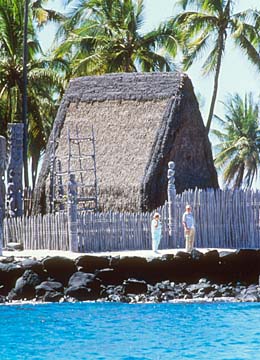
ROBERT COELLO / BIG ISLAND VISITORS BUREAU
Visitors explore Pu'uhonua O Honaunau, the City of Refuge
In olden Hawaii, death was the consequence for commoners who walked in the footsteps of the alii (royalty). Women who defied the law forbidding them to eat with men met the same fate, as did those who fished, hunted and gathered timber before or after the designated season. Refuge offers culture
festival on Big IslandBy Cheryl Chee Tsutsumi
Special to the Star-BulletinThe Hawaiians believed that to violate these and other sacred kapu (taboos) was to incur the wrath of the gods and to risk catastrophe in the form of famines, tidal waves, earthquakes and lava flows.
The offender was chased until he was caught and executed, or until he reached a pu'uhonua (place of refuge), where he could be absolved by a priest during a ceremony lasting a few hours to a few days, depending upon the nature of his crime. Only then was he free to return home to a normal life.
The Big Island's Pu'uhonua o Honaunau is the best preserved of the refuges. Three temples stood here, among them Hale o Keawe, which was built around 1650 to house the remains of Keawe-i-kekahi-alii-o-ka-moku, great-grandfather of Kamehameha I.
Scholars have determined that Pu'uhonua o Honaunau also was the home of the ruling chief of the area. The royal compound, comprising more than 10 thatched houses set in a grove of coconut palms, adjoined the pu'uhonua.
The chief's home was separated from it by a massive L-shaped wall measuring 1,000 feet long, 10 feet high and 17 feet wide. Although the wall dates back to 1550, a good portion of it remains intact. In an incredible feat of engineering, each stone in the wall was fitted perfectly to the next without the use of mortar of any kind.
Located nearby for the sole use of the alii were fishponds and a small cove that made an excellent canoe landing. Native trees and plants thrived throughout the complex in vivid abundance. These included noni, valued as a remedy for a host of ailments; hala, for weaving mats, canoe sails, pillows and sandals; and milo, a wood that was carved into beautiful calabashes.
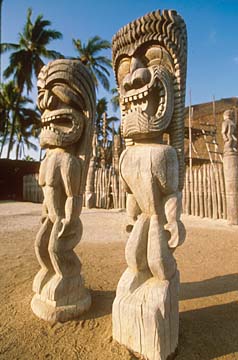
PHILIP ROSENBERG / BIG ISLAND VISITORS BUREAU
Gods presided in the form of carved figures, and priests offered absolution.
A 180-ACRE TROVE of archaeological treasures, Pu'uhonua o Honaunau was established as a national historical park on July 1, 1961. Since 1975, it has hosted a cultural festival on the weekend prior to its anniversary to honor its rich past. This year's theme is "Hoike Na Mea Hana Lima Na Kupuna (Demonstrating the Traditional Crafts of Our Ancestors)."
Blossom Sapp, a ranger in Pu'uhonua o Honaunau's Interpretation Department, has helped organize the event since its inception.
"There are other cultural festivals where visitors can learn how to do the crafts of old Hawaii, but never from people dressed in traditional attire -- in sarongs and loincloths -- and in a special setting like this. More than any other local cultural event, visitors experience a feeling of old Hawaii at our festival," she said.
True to its theme, the celebration will spotlight masters of lauhala and coconut frond weaving, wood carving, lei making, nose flute making and bamboo stamping.
"People can make whatever they'd like to take home," says Sapp. "There's no charge for materials; we supply everything."
Festival attendees also can participate in games such as ulu maika (bowling), konane (checkers) and ihe pahee (spear sliding). Food is always a draw, with crowds lining up to sample Hawaiian staples such as kalua pig, dried bananas, dried fish, opihi, poke, breadfruit, sweet potato, coconut, sugar cane, haupia, taro, poi and kulolo (a pudding made of grated taro and coconut cream).
Other highlights include a hukilau (fishing with a seine); presentations on taro and stargazing; and demonstrations of lomilomi massage and herbal medicine.
Each year, about 300 volunteers assist with the planning and implementation of the festival, from hula halau to community members who donate craft supplies to the 50 or so people who make up the royal court. Sapp and a fellow park staffer organized the court three years ago, and it has since grown to include not only a king and queen, but a full entourage of weavers, tapa makers, warriors, bird catchers, navigators, canoe makers, kahili bearers, farmers and fishermen.
Anyone can be a member of the court.
"It doesn't matter if they have blonde hair and blue eyes," Sapp says. "If they want to participate, they can."
That describes Pu'uhonua o Honaunau's cultural festival -- an event where aloha flourishes.
Establishment Day Hawaiian Cultural Festival: HERITAGE REMEMBERED
Where: Pu'uhonua o Honaunau Historical Park, 21 miles south of Kailua-Kona town. Take Route 11 to Keokea, where it intersects with Route 160 at Mile Marker 104. The park's entrance is on Route 160, 3.5 miles from the junction
When: 9:30 a.m. to 3 p.m. Saturday and Sunday, June 30
Admission: Free (the usual park entrance fee of $5 per car is waived for this event)
Call: 328-2288
Website: www.nps.gov/puho
SATURDAY / JUNE 29
9:30 to 10:30 a.m.: The royal court opens the festival with a ceremony that includes a hula performance and the presentation of gifts at Hale o Keawe heiau.
10:30 a.m. to 3 p.m.: Arts and crafts, Hawaiian games, canoe rides, lomilomi massage and hula performances.
11 a.m.: The Lore of Kalo features poi samples and a talk about the legends, chants and cultivation of taro.
7:30 p.m.: Howard Yamasaki from the Mauna Kea Astronomical Society presents a slide show and lecture on the stars and other heavenly bodies.
SUNDAY / JUNE 30
9:30 a.m. to 2 p.m.: Arts and crafts, canoe rides, lomilomi massage and hula performances.
10 a.m.: Presentation on lomilomi, ho'oponopono and herbal medicine by Ka Leo o Na Kahuna Lapaau o Hawaii Nei (The Voices of the Kahuna Lapaau of Hawaii)
10 a.m. to 1 p.m.: Tasting of traditional Hawaiian foods.
2 to 2:30 p.m.: Participants "net" great fun and a colorful catch at a hukilau (all fish will be released).
2:30 to 3:30 p.m.: The royal court presides over the closing ceremony.
Cheryl Chee Tsutsumi is a Honolulu-based free-lance writer and Society of American Travel Writers award winner.