
[ SUNDAY TRAVEL ]
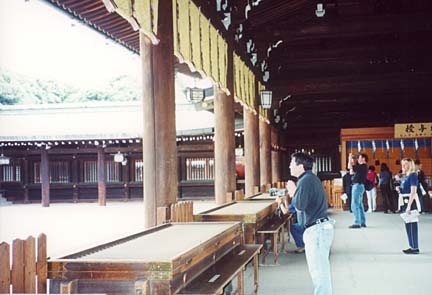
Visit to shrine and TOKYO >> Terrorists didn't hijack my plane and no one sent me any anthrax during a recent trip to Asia.
trip that was fine
Did the omomori provide
protection? Couldn't hurt
By Craig Gima
cgima@starbulletin.comIt could be that worries about travel safety are overblown.
Or it could be because of my visit to the Meiji Shrine in Tokyo and an omomori -- an amulet -- I picked up there to protect me from evil.
Our group left Honolulu on the day the U.S. bombing of Afghanistan began. Because of a missed connection on a flight to India, we were able to get in a nice Japanese dinner and a half-day of sightseeing in Tokyo.
After weighing our options, we decided to visit Harajuku and the Meiji Shrine. The area is an interesting mixture of old and new Japan. On Sundays young, trendy Japanese come to the park outside the shrine dressed in wild costumes to sing pop songs. On Takeshi Street you can get the latest in fashion and music.
In the park is the Meiji Jingu shrine, dedicated to the spirit of Emperor Meiji and his wife Empress Shoken, who ruled Japan from 1868 to 1912. The shrine is a holy place in the Shinto religion and one of the most popular shrines in Japan. More than 3.5 million people visit during the New Year's holiday, and it was at the shrine where Hawaii's Akebono and Musashimaru performed the ceremony that elevated them to sumo's highest rank of yokuzuna.
The shrine is crowded on weekends with visitors, weddings and couples who come there to announce the birth of a child to the gods. But during the week it's quiet and peaceful.
After exiting the Harujuku train station, visitors leave the busy Tokyo streets for a serene walk along a stone path lined with trees and gardens.
You enter the shrine area under a tori gate, one of the tallest in Japan, built from cypress trees said to be more than 1,700 years old.
Before the main shrine area, there's a stone washbasin where you wash your hands and mouth to purify yourself.
When you enter the inner shrine, worshippers give an offering of money, bow twice, clap twice and then bow again.
Emperor Meiji saw Japan transformed from a medieval to modern state during his reign. The shrine in his honor was completed by 100,000 volunteers in 1920. The original shrine was destroyed during World War II but was rebuilt in 1958.
In the courtyard before the inner shrine, you can buy omomori to bring you good luck, keep you healthy, protect your car and house, and protect you from evil.
Omomori are traditional charms that are sold at many shrines and Buddhist temples, including many in Hawaii. Many Japanese have stories about how the amulet protected them or someone they know from some sort of calamity.
In view of the events of Sept. 11, I figured it would be a good idea to buy the omomori to protect me. Around a large tree there is another area where you can write thoughts and make wishes on wooden tablets which can be purchased for about $5.
Of the tablets written in English, one wished that "I can get a job and to be a success." There were also several prayers for the victims of the Sept. 11 tragedy and wishes for peace and justice.
One member of our group made a wish for travel safety.
There's probably no direct correlation between the amulets and prayers made at the shrine and our safe journey.
But then again, who's to say it didn't help?