
Cloning star returns
to rust and mold
Despite his newfound fame,
By Helen Altonn
Yanagimachi is running
out of money
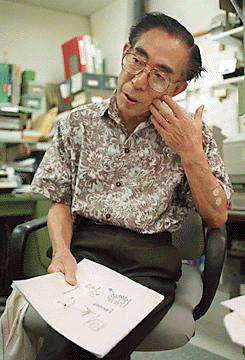
Star-BulletinTHE Hawaii researcher who stunned the science world with news of his team's repeated mouse clonings says he doesn't understand why it stirred such interest.
"I'm not very excited about this because we're second, not the first," says Ryuzo Yanagimachi.
"Dolly (the sheep cloned in Scotland) was first. If I did something first in the world, I would be more proud.
"The next project I must be first, not second," the acclaimed researcher added with a big smile.
Yanagimachi is back in his stifling University of Hawaii office after a media frenzy in New York last week over the announcement that his team had cloned more than 50 mice.
He has a lot of new challenges for his group, which includes Teruhiko Wakayama of Japan, who made the key discovery leading to the cloning, and Tony Perry of England.
But the scientist who thrust the UH and its Anatomy and Reproductive Biology Department into the international spotlight faces critical operating problems.
His research money is running out. The air-conditioning system in his laboratory is dying. And his office is falling apart with rusted pipes and mold. "Last week the ceiling dropped," he said.
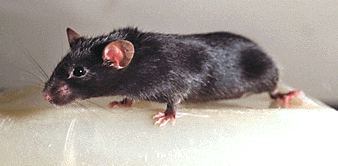
Because of federal standards, the cloned mice -- entering the fourth generation -- have better conditions than the scientists.
"Friends who visit me are surprised I am in such a shabby building," Yanagimachi said.
He started the crowded laboratory with nothing 30 years ago in a converted warehouse that also houses campus food services. He could have moved into the new medical building, but declined because he would have had only one room, he said.
Money is a nagging concern because one of his two National Institutes of Health grants has lapsed and the other ends next month. Combined, they provided about $330,000 annually.
Yanagimachi said he encourages his students to obtain fellowships to help cover expenses. It costs $67,000 a year just to buy and maintain mice, he said.
He had scarcely rested from his hectic trip when he had to start writing grant proposals Saturday. "I wish I didn't have to -- headache," he sighed in an interview.
"It is very competitive. I hate it. It detracts from research efforts." There's no stability because the grants are only for three years, he said.
ProBio America Inc., a Honolulu-based biotechnology firm, will provide $1 million over five years to Yanagimachi's lab under a licensing agreement with UH for the cloning technology.Yanagimachi said he hopes the company will provide other help, but it is more concerned with applying the technology for quick production of economically valuable animals than it is with basic research.
Nor is he counting on a lot of income from his research patents. "That is long range, after I'm dead."
One of the patents is for his work with Wakayama on freeze-dried sperm, which he said he respects more than the cloning achievement. They created live mice by freeze-drying sperm and using it to fertilize eggs.
Since the sperm is "100 percent dead," people said there was no way the procedure would work, he said. "But when we injected the DNA, it was a different story.
"Maybe I should pay more attention to this," he said, considering the implications. Freeze-dried sperm can be kept at room temperature instead of the current costly method of preserving it in liquid nitrogen, he pointed out.
"If it works for rabbits, I think it will work for all species," Yanagimachi said. "But you can't simply order a rabbit." He needs 40 or 50 under permits to pursue the project, he said.
Freeze-dried sperm and cloning are only two of about 10 projects Yanigimachi is interested in.
He opposes human cloning but is fascinated with the idea of therapeutic cloning, which he said is the right way to use the technology. "If we ban the whole thing, we ban this, too, so we must think carefully."
If it's possible to make a whole mouse from a cumulous cell, Yanagimachi said, "it means a single nucleus has the potential to develop into all types of cells."
For example, he said, it may be possible to direct cells to make a new kidney, insulin-producing cells, new brain cells, eggs or sperm. A cancer cell may be made normal or a cell made younger to help with aging diseases, he said.
"It's a dream now, but I think it's possible because a cell can differentiate." However, it may take 10 to 30 years, he said.
"I pray I can live that long," said Yanagimachi, who will be 70 next month.
But the kind of free thinking Yanagimachi inspires produces surprising results.
He said he asked Wakayama and Perry to do fertilization studies three days a week and spend two days on anything they wanted.
At first, Wakayama was afraid of asking questions, Yanagimachi said.
"This (cloning) came as one of the byproducts of his study. He showed me little mice in early August -- tiny, tiny babies. . . . That was the most exciting moment -- not Cumulina (the first cloned mouse to survive)."
Wakayama, called "Teru," produced two live cloned mice that died before he mastered the technique resulting in Cumulina, Yanagimachi said.
Yanagimachi is curious about how long she will live, noting a mouse's life span normally is about two years, depending on the strain. They could live four years if well cared for, he said.
So far, the scientists have only cloned females, but there's no reason males can't be cloned, Yanagimachi said.
