Saturday, July 25, 1998
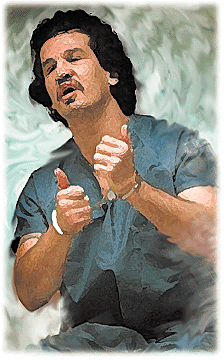
Frank Janto—car thief, child molester and murderer—
complained this week that prison has failed to give him
the rehabilitation he needs.
Don't believe it. The justice system gave Janto
too many chances.
Photo Illustration By Dean Sensui,
photo By George F. Lee, Star-Bulletin
By Peter Carlisle
Honolulu City Prosecutor
Special to the Star-BulletinFrank Janto was convicted of murdering Jackie Koja in Wahiawa last year. She was on her early morning exercise walk when he beat her to death.
This week I went before the Hawaii Paroling Authority and asked that Janto be given a minimum term of 100 years. (Janto yesterday received a mininum 75-year sentence, the longest minimum ever handed down by the parole board.) After he was sentenced to a life term last April, the Star-Bulletin reported my comment that the only time Janto should be taken from prison is on his way to the mortuary.
One problem with being an elected prosecutor is that people think you talk tough for the sake of votes. There are valid reasons for trying to keep Janto in prison for as long as he lives. Examining his path to murder is helpful in understanding the nature of crime and the criminal justice system.
Frank Janto was born in South Carolina in 1963, the youngest of seven sons. His father was in the military. His parents divorced in 1970 and his mother relocated to Hawaii.
As with all children enrolled in public schools, the state spent time and money trying to educate Janto. On Oahu, he attended Liholiho Elementary and Washington Intermediate. When his family relocated to Kamuela on the Big Island, he enrolled in Waimea School, but was expelled and chose not to resume his education.
By age 15, Janto was an alcoholic and would drink "as much as I can get," he has said. When he was drunk, he would behave violently until the alcohol wore off. Before reaching 18, Janto was referred to family court for terroristic threatening, car theft and two assaults. For these infractions, he received only 30 days confinement at the youth facility on Oahu.
On Oct. 17, 1983, he earned his first adult felony conviction. It was for one of the same crimes he had committed as a juvenile -- stealing a car.
Despite his juvenile record, Janto was not sent to prison but was placed on probation for five years. He was supposed to spend a year in jail as part of his probation, but instead of full-time incarceration, he was permitted to participate in a community service project and a job-seeking program. He also received substance abuse counseling.
So he learned that being an adult criminal, so far, wasn't much worse than being a juvenile criminal.
Within a year of being placed on probation, two restraining orders were filed against Janto by his girlfriend. He had hit her, tried to choke her and threatened to kill her.
He also told her, "You wait, one day (you're) gonna get where you have a face no one will look at."
The girlfriend apparently didn't follow up on the restraining orders because the case was dismissed for "lack of prosecution." She had other things to worry about. Janto was busy sexually molesting her daughters, ages 7 and 9.
Janto was indicted for molesting these children and convicted of rape in the second degree. Although already on probation for the car theft, he was again given probation provided he would spend one year in jail and undergo counseling for alcohol abuse and anger management.
Janto actually did spend some of his one-year term in jail. While incarcerated he was charged with numerous acts of misconduct, including fighting, injuring a person with a dangerous instrument, refusing to obey an order from a staff member and threatening another inmate with bodily harm.
Despite this prison record, he was granted a reduction of his jail term after serving about eight months, and was released provided he live with his brother in California.
But the family reunion didn't last long. The record shows Janto returned to Hawaii after causing "problems in his brother's house."
His reunion with Hawaii didn't go much better. Janto was soon convicted for disorderly conduct and driving under the influence of liquor. His probation was revoked, he was sent to prison and his sentence was promptly reduced back to probation, provided he go to a residential drug and alcohol treatment program.
As with previous reform efforts, this encounter with rehabilitation didn't go well. He left the residential program within days and was free on Oahu.
So in January 1988, Janto was returned to prison for a term of 10 years. This time he received misconducts for the use of force or threats to a correctional worker or the worker's family, possession of unauthorized material and fighting. Once he was segregated from other inmates for 60 days after striking another inmate with a folding chair. But while incarcerated he underwent more rehabilitation, including anger and stress class and reading comprehension. He was granted parole in March 1990.
Five months later, on Aug. 4, 1990, a 63-year-old Vietnamese woman was taking her usual exercise walk near the Ala Wai Canal when Janto came up from behind her and grabbed her throat with his left hand. With his right fist, he punched her in the head and face several times. Then he pushed her face into the ground. He dragged her to a nearby bush, but she was able to roll into the water of the canal, at which point the police arrived to save her.
Janto tried to escape by jumping into the canal. The police ordered him out of the water, and he rewarded them with a barrage of profanity. Honolulu Fire Department personnel were called and they went into the canal with surfboards. While in the water, Janto yelled at them that "all I like to do is work people over and beat them up. I'm going out there and work over the cops and throw blows with them, too." Janto was removed from the canal and taken to the police station, where an alcohol test confirmed that he was drunk.
The victim was taken to the hospital with bruises to the left and right sides of her face and neck, a possible fracture of the jaw, a fractured left cheek bone and abrasions to her nose and chin. Her right eye was swollen shut. An ambulance took her to Queen's Hospital where her injuries were recorded as "substantial" and her condition was listed as guarded. Her medical expenses totalled $2,969.72.
In January 1991, Janto was found guilty of assault in the second degree. This time compassion was checked, and he was sentenced to five years for the assault and required to spend what was left of his car theft and rape sentences in prison.
He started his term on Jan. 28, 1991. Requests for parole were denied in 1994, 1995 and 1996. But Janto was unhappy. He warned that if he had to stay in prison and was not put in an "outside" program or halfway house, it would only be a matter of time before he would be right back in prison.
Janto would prove to be a man of his word. His maximum term expired in October 1996 and he was again a free man. But not for long.
Bongak Koja was born in 1938. She came to Hawaii in 1962 and stayed, adopting the nickname was "Jackie." She was a small woman, about 5-feet-2 and only 100 pounds. She liked to keep active. She took exercise walks everyday and had been doing so for close to 20 years. She lived in Wahiawa, a peaceful rural community far away from the problems of the big city. Or so she thought.
On June 9, 1997, she awoke between 2-3:30 a.m. Even though it was her birthday, she followed her daily routine of taking her early-morning exercise walk. She left by the front door of her home and closed it behind her. She left her four dogs and her sleeping husband at home. He suffered from arthritis and needed Jackie to help him with grocery shopping, taking out the trash, working in the garden, cleaning the home and getting to the doctor.
She walked from her home to California Avenue, which extends from the hills where she lived past Leilehua High School and down into Wahiawa town. When she arrived at the school, she was confronted by Frank Janto.
Janto was bigger and younger than Koja. He was also a whole lot meaner. He felt that he might have been a professional boxer but for his frequent bouts with the law. Koja had spent the previous evening at home watching television with her husband before going to sleep. Janto had spent the night smoking crystal methamphetamine and cocaine.
Janto asked Koja what she was doing out at night, and didn't she know it could be dangerous. Janto grabbed for her. Terrified, Koja tried to douse him with pepper spray.
Janto went into a rage. He punched her in the face, knocking her glasses off and ripping the false teeth out of her mouth. Bleeding and without her glasses in the dark, Koja tried to run away but, after a few yards, she slipped and fell.
Janto was on her instantly. Koja screamed. He told her to shut up and punched her in the face again. He put her in a headlock and dragged her to a dark passageway on the school grounds. From this spot, he couldn't be seen from California Avenue.
By this time, Koja was unconscious. But Janto wasn't through. When she regained her senses, Koja struggled desperately for her life. She screamed and fought back, scratching and biting Janto.
He attacked again. He stomped on her stomach. He grabbed the sides of her head by her hair, slamming her head into the concrete pavement. Blood poured from her head and her mouth.
People who mistook the noise for rowdy high school students said there were three sets of screams. They estimated the time from the first to the last scream was about five minutes, an eternity for someone being beaten.
When Koja stopped moving, Janto decided to cover up his handiwork. He dragged her broken and bleeding body the length of almost two football fields toward the back of the school to a pair of trash dumpsters. The dumpsters were full, so he took out some trash and created a shallow grave. He threw Koja's body into the dumpster-turned-coffin and covered her with trash.
Around 11 a.m. a BFI garbage truck picked up the contents of the dumpster and continued on its rounds. When the load in the garbage truck was heavy and compacted, it was driven in the Waianae direction on H-1.
The truck got off the freeway at Exit 1 and drove to Campbell Industrial Park. At the third intersection, it turned right and drove into the H-Power plant, where Honolulu's garbage is burned and turned into electricity. Trucks were lined up with their loads.
The BFI truck waited its turn and then dumped its load onto a warehouse floor, which was already piled high with garbage. The mountain of garbage -- containing Jackie Koja's body -- was crushed, pushed onto conveyor belts by massive bulldozers and chopped up by a gigantic shredding machine. It was then placed into an eternal furnace that burns with heat so intense that it melts aluminum. In such an environment, human flesh, hair and bone would completely evaporate.
Even repeat offender law
By Peter Carlisle
isn’t enough to contain the
Frank Jantos in our midstAttorney Dan Foley, who has worked with the American Civil Liberties Union for 13 years to improve prison conditions, when talking about the Frank Janto case, said almost every prisoner needs a package of anger/stress management, educational and vocational training and substance abuse counseling, and they're not getting it.
Janto was given package upon package of rehabilitation, at taxpayer expense, and none of it worked. Nobody has a magic rehabilitative cure for the Frank Jantos of the world. Prison certainly didn't cure him. But while he was there, he never stole a car, raped a child, fractured the cheekbone of an elderly woman or murdered anyone.
On the mainland some states have a "three strikes" law. On a third felony conviction, the criminal is automatically given a life sentence without the possibility of parole. This law has been criticized as producing unjustly harsh results in some cases and stripping judges of any discretion. Even if every man, woman and child in Hawaii agrees that Janto, a criminal on his fourth felony conviction, deserves a life sentence without the possibility of parole, a Hawaii judge can't impose such a sentence.
Under state law, our judges don't have such an option. Hawaii does have a repeat offender statute that gives a criminal with prior felony convictions a term in jail without the possibility of parole. When a person with three prior felony convictions is being sentenced for murder in the second degree, he is required to spend a minimum of 30 years in jail. This would keep Janto in prison until age 65.
Janto has three prior felony convictions -- stealing a car, raping a child and assaulting an elderly woman. He was sentenced for murder in the second degree for the killing of Jackie Koja. So under the repeat offender law he would automatically spend 30 years in jail without parole, right? Wrong.
We have a provision in our law created by the Legislature, at the prompting of the public defender's office, that gives prior felonies a limited shelf life. Put simply, or maybe incredibly, Janto spent so much time in prison, that his prior felonies no longer counted in the eyes of the law when he was sentenced for murder. Efforts to correct this law have failed in the Legislature for the past two years.
The bed that Janto will occupy while in prison cost more than $100,000 to construct. Maintaining him in prison for a year will cost approximately $35,000. If he lives to be 68 years old, keeping Janto in prison will have cost the citizens of Hawaii more than $1 million.
"The American justice system is the finest in the world." "Judges need discretion so that they can exercise the compassion that makes us a civilized society." "We need to spend less money building prisons and more money rehabilitating criminals and drug users."
These are statements I often hear about the criminal justice system. But I find myself disagreeing with this wisdom. We must not dismiss the Frank Janto case as simply an extreme example that doesn't represent how the system usually works. I remember last year a person who was convicted of his third killing of his wife or girlfriend. His name was Eugene Barrett.
This year a man named Boy Carvalho who had previously beaten his wife to death is back in custody charged wtih kidnapping and raping his live-in girlfriend.
If you are not worried about Jackie Koja's death in Wahiawa, the history of her murderer and the way the system worked because there is only one Frank Janto in Hawaii, you might just be dead wrong.
(Editor's note: Frank Janto was sentenced to a life term
for killing Jackie Koja. Under his 75-year mimimum term set yesterday,
he will be eligible for early release in 25 years.)