By Angel Ramos, special to the Star-Bulletin
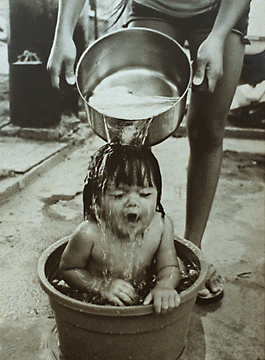
Former plantation worker Angel Ramos took this
picture of his granddaughter, 1, bathing in 1975.
Filipinos
celebrate how far
they’ve come
Hawaii's third-largest
By Susan Kreifels
ethnic group will mark
a free Philippines'
100th year
Star-BulletinFilipinos around the world are celebrating the 100th anniversary of Philippine independence Friday.
In Hawaii, where hundreds of ethnic organizations are planning year-long celebrations, Filipinos also see the event as a prelude to their own reckoning of how far they've come in almost a century.
On Dec. 20, 1906, the first 15 "sakadas," or Filipino plantation workers, stepped off the USS Doric to start new lives here. Today Filipinos make up the state's third largest ethnic group, with 168,682 of them totaling 15.2 percent of the population in the 1990 census.
They also are the fastest-growing ethnic group, with 3,995 to 5,208 immigrants from the Philippines arriving every year between 1991 and 1996.
They were once considered the "invisible community," where plantation workers had little political voice or economic clout. That is starting to change with a new wave of immigrants who have more education and who hope to create a stronger identity in the community.
Roland Casamina believes the planned $12 million Filipino Community Center represents that change. After earlier attempts to muster support for such a center, the nonprofit group he leads now claims two acres of donated land, and Casamina feels the project is well on its way.
"It's a monument saying basically that we have arrived," said Philippine-born Casamina, president of the financial institution House of Finance. "We're no more silent. Our children are more and more educated. Filipinos are generally much better off politically and economically than 25 years ago."
Gov. Ben Cayetano, the only governor of Filipino ancestry, is the community's proudest symbol. Other successful Filipinos include Eddie Flores Jr., owner of L&L Drive-Inns and Hawaii's Small Business Administration Entrepreneur of the Year; Supreme Court Associate Justice Mario Ramil; wavescape artist Roy Gonzalez Tabora; Robin Campaniano, president and chief executive officer of AIG Hawaii; and Lito Alcantra, president of Group Builders, one of Hawaii's Top 20 construction companies.
By Dennis Oda, Star-Bulletin
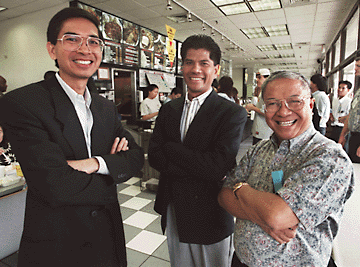
Standing tall in L&L Drive-Inn, are from left, Eddie
Flores Jr., owner of L&L Drive-Inns; Roland Casamina,
House of Finance president; and Lito Alcantra, president
of Group Builders, one of Hawaii's Top 20 construction
companies. They are combining their business savvy to
build the Filipino Community Center.
Cayetano, the son of an immigrant, says Filipinos here have "reached a new level of maturity. That I was elected governor indicates an acceptance of Filipinos as people who are as good as anybody. The old stereotypes tend to be erased, mostly by performance and actual experience."But a number of Filipinos interviewed believe that a governor does not a powerful community make -- yet.
Robert Bunda, the state's lone Filipino senator, still considers the group to be a "sleeping giant." Only six Filipinos are members of the Legislature, about 8 percent.
Bunda, born in Hawaii, worries that Filipinos don't focus enough on education and that the youth are still identified with gang violence. He says many struggle to survive working two and three jobs, leaving little time left for other issues.
And he believes the plantation attitude of following instead of leading continues to hurt them.
But Bunda agrees that things are changing.
Bunda said: "Once we get the numbers and understand the power game . . . it will make this group move. These are very exciting times to usher in that attitude."
Flores, who moved here at 16, agrees things are changing, but he says the community is not thinking enough about business. "We're not up to par with the Chinese, Koreans, Japanese and Vietnamese. Filipinos are more content to work for government," Flores said.
Campaniano said he and Alcantra are the only Filipinos to head businesses listed in the state's Top 250. Filipinos haven't made their way to the top of banks or into the board rooms of major corporations, he said.
"A big sore spot has been the inability for Filipinos to start a successful bank," Campaniano said, adding that Filipino businesses still tend to market within the ethnic community. "We need to see aggressiveness in the mainstream market."
A healthier economy in the Philippines could help move Filipino business here. Many still send money home. "They don't have the capital base to set up more businesses here," said Rose Cruz Churma, president of the Filipino Chamber of Commerce of Hawaii. "With economic gains in the Philippines, that will be minimized and more (money) will remain here."
Filipino leaders agree that education is the key.
In the public university system, the number of Filipino students has grown from 5,281 Filipino students, or 12.1 percent, attending the universities and community colleges in 1989 to 6,737, or 14.9 percent, in 1997. The heaviest percentages go to community colleges.
When the Philippine-born Ramil arrived here in 1976, he says there were a handful of Filipino attorneys. Today there are more than 100, plus four other Filipino judges in the state.
"I see how the Japanese did it," Flores said. "For us to get power is through education and politics."
Many also see the current wave of immigrants as a key to the future.
In 1965, family reunification policies loosened. Filipinos arriving since then are more educated and socially active, according to Sister Rosalinda Barrozo, a case manager with Catholic Charities Immigrant Services.
Many professionals are forced to take jobs below their skills, and Barrozo believes they still face discrimination. But that's starting to vanish, she says, as Filipinos have more role models and political leaders.
Immigrants are also taking active roles in community organizations. "They have community-minded qualities," she said. "We're proud to be Filipinos now."
Venny Villapando has been tracking Filipino success stories here for a decade on his TV show, "Filipino Beat." He says this wave of immigrants has not yet attached loyalties and is "fair game" to politicians and businesses.
And while others may leave Hawaii because of the poor economy, these immigrants are likely to stay put.
"Coming from the Philippines, this is truly a paradise," said Villapando, who was born in the homeland. "We worked so hard to come here; we're not going to leave.
"Our numbers will make a big difference eventually. It will be a very positive impact on the social life here."
Filipinos are the third-largest and fastest-growing ethnic group in Hawaii. Fastest growing
ethnic group
Important dates
1906: First Filipino plantation workers arrive in Hawaii.
State population
Filipino immigrants
By Dennis Oda, Star-Bulletin
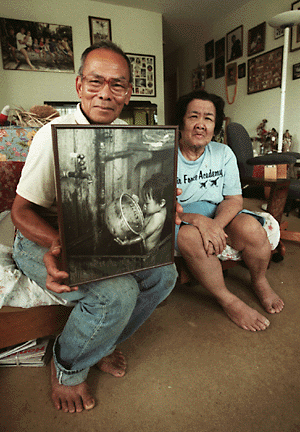
Angel Ramos began working at a sugar mill in Kahuku
with the last big wave of immigrant workers in 1946 at age 17
and stayed there until the mill closed in 1971. He has hoarded
plantation-time mementos, such as the picture he took of his
1-year-old daughter Carol bathing in the early 1950s at their
plantation house. He and his wife, Rose, will celebrate their 50th
wedding anniversary next year with their 13 children.
Retired ’46 Boy
fond of life on
the plantation
‘If the plantation
By Susan Kreifels
didn't go broke, I would have
retired a plantation man’
Star-BulletinThe sugar plantations kept Angel Ramos in the islands he grew to love and never left.
They led the 17-year-old Filipino to Hawaii in 1946, reuniting him with his love, Rose.
"The plantation was a good life," said Ramos, 69 and retired in Kahuku, where he worked in a sugar mill until 1971 and where he raised 13 children in plantation houses.
"If the plantation didn't go broke, I would have retired a plantation man."
Ramos arrived with the last big wave of workers to the islands. That year, 6,000 came from the Philippines, most from Ilocos Norte province. They were recruited to bust a strike by union workers.
But Ramos said union members were on the boats and recruited Filipinos before they arrived here.
The attempt to break the union failed, said Dean Alegado, a University of Hawaii professor on the Filipino experience in the United States. The " '46 Boys" were the last large batch of workers to be recruited.
That was also the first time a significant number of Filipino women and children came with the workers, encouraging them to stay here, raise families and develop permanent communities like Japanese and Chinese workers had done.
From 1906 more than 109,000 workers came here from the Philippines, plus 9,398 women and 7,006 children, Alegado said.
Ramos' father had been to Hawaii twice before he arrived, and his brother also came in 1946. Ramos eventually became a union officer.
"Lots were not outspoken," Ramos said. "They never went to school. I became militant. It was better than just, 'Yes, yes, yes.' "
But it was not all union life. Ramos loves the tale of how the plantations led him to his wife.
Rose Ramos had been born on Maui of Filipino plantation workers in 1932. Her family returned to Ilocos Norte, where a young Angel Ramos fell in love with her the moment he saw her.
He left for Hawaii, not knowing when he would see the young girl again.
But she ended up in Kahuku in 1946 with the same wave of workers. When Ramos learned of her move, he went to Kahuku and never left.
After being laid off at the Kahuku Plantation Co., Angel Ramos was hired at the Kahuku golf course, where he eventually became the senior operations clerk and retired in 1991.
In retirement, he's busier than ever. A self-described "pack rat," his car is squeezed out of a carport filled with memorabilia and antiques from the plantation days -- a Filipino washboard, a Japanese mochi mortar, a plantation office sign warning, "No cycling, no buggie and etc."
When Angel Ramos arrived, there were few educated Filipinos. Six of his children have university degrees.
Although many Filipino immigrants are still taking menial jobs, he says they will stay. Education is essential, he believes.
And while many Filipinos have lived quiet lives, not speaking out much over the years, he said progress demands more aggressive attitudes and actions.
In the plantation days, "You get up to go to work, you go home. Now everything affects us. We have to be more vocal.
"We are Hawaiians. We will shape what Hawaii is."
One hundred years ago Friday, the Philippines under Gen. Emilio Aguinaldo declared independence from Spain after more than three centuries of colonialism. Celebrating independence
Although the United States then colonized the country after winning the Spanish-American War in 1898, Filipinos still see the declaration as a defining moment that unified the Philippines, according to Dean Alegado, chairman of the local Centennial Committee.
Filipinos here, most first-generation immigrants, have planned a year of events. Major ones include:
For other events around the state, call the Philippine Consulate at 595-6316 or e-mail Phicongen@aol.com.