By Dennis Oda, Star-Bulletin
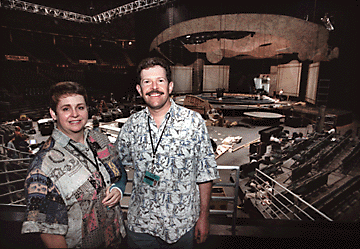
Miss Universe stage designers Vicki Baral and Gerry Hariton.
"We looked at everything that's very Hawaii and tried to blend it
into the stage," Baral said.
Backdrop reflects isle palette
By Tim Ryan
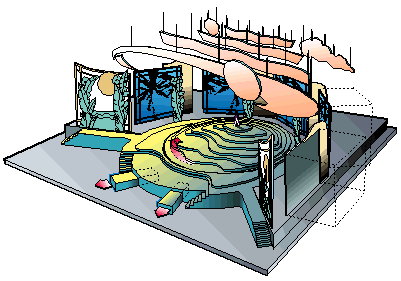
Star-BulletinTHE theme is decidedly Hawaii, captured in wood and plastic, blues and tans, lights and projected images. When the world tunes in to the 1998 Miss Universe Pageant tomorrow night, they'll see a stage 80 by 50 feet, tinted aqua and sand, gently rising from a simulated shoreline at 3 feet to the top of a flattened "volcano" at 8 feet.
"We looked at everything that's very Hawaii and tried to blend it into the stage," said Vicki Baral who designed the Miss Universe Pageant set with her husband Gerry Hariton. "When people look, we want Hawaii to come to mind quickly."
When you include the black curtains draped on the side of the stage to block off back stage views, the width is 120 feet.
The multi-lever, rotating "volcano" weighs about 10,000 pounds, and turns by way of a five-horse-power motor. The rotating platform can hold 20,000 pounds, Hariton said.
The controller stands out of sight at stage left using a portable remote that controls the rotation.
"Using a turntable gives us a variety of looks in a very expedient way," Baral said. "And it's a very efficient way to get the delegates onstage quickly."
By Kip Aoki, Star-Bulletin
Click the image to see the full-sized 132k illustration.
The entire stage top is painted the color of coral sand; facing is various hues of blue, "like Hawaii's ocean," Baral said.Four sets of stairs are in front of the stage to accommodate dancers in the show. Two ramps slide in and out from under the stage for some delegates to walk on.
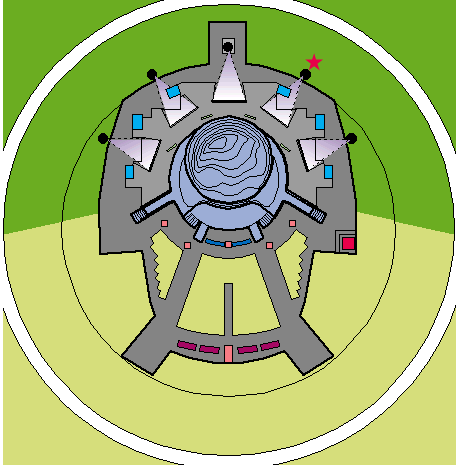
 Powerful 7,000-watt "Pigi" projectors will be
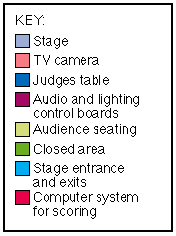
The two prosceniums incorporate giant palms and hibiscus flowers of a pliable, plastic material called Sintra. Above the stage are clouds, waves and two suns made of wood, covered in muslin and painted. Five 16-foot square projection screens encircle the stage on which continuous photo images of Hawaii will be shown, and the faces of the 81 contestants as they're introduced. Five projectors are 23 feet behind each screen and sit on a scaffold so the image is dead center. One person operates the projectors through a computer.
By Dennis Oda, Star-Bulletin
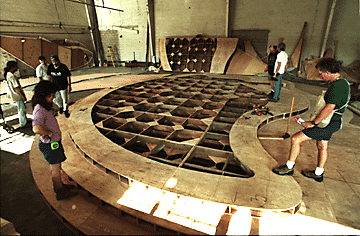
Three layers of the stage were readied at a Honolulu warehouse.
More than 350 sheets of plywood were used to build the stage.
Contestants enter through six on-stage areas; there are four dressing areas.The neutral colors for the stage and other props allows any kind of lighting to be used to create several different effects, Hariton said.
Stage is set
Pre-production: Stage designers Vicki Baral and Gerry Hariton came up with the concept in two weeks. It's normally a four-week process, but because of time contrainst they needed to speed up pre-production.