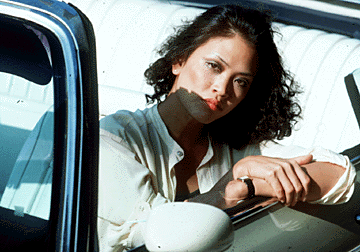
Edgy Lee
Edgy Lee says making films leaves her
little time for anything else.
‘Paniolo’
By Tim Ryan
sparked by memories
Star-BulletinIF Edgy Lee is anything, it's pragmatic. Very pragmatic. The Hawaii-born and raised award-winning filmmaker declines to have her photo taken even for an interview about her latest documentary -- "Paniolo O Hawai'i - Cowboys of the Far West" -- which she wrote, directed and produced.
"This story should be about the film; the stars are the cowboys not me," she says politely but curtly."
Lee explains the motivation for her film.
"I have great childhood memories of visiting my uncle's ranch in Pupukea and the smell of hay, and watching the cowboys working, and seeing the cows and horses dotting the rolling green landscape above the North Shore. I discovered that no real history had ever been written about paniolos. That's why."
"Paniolo O Hawai'i," which debuts to the public Sunday at Bishop Museum, is the first documentary film to chronicle the history and achievements of Hawaii's cowboys. The film had its national premiere in September at the the Smithsonian Institute.
The 76-minute film combines archival stills, newspaper clippings, historic and contemporary illustrations, vintage moving picture footage -- including film by Thomas Edison -- with contemporary interviews of Hawaii cowboys, some of whom are descendants of 19th-century cattlemen.
The film illustrates language -- Native Hawaiian and Spanish in particular -- as a central cultural element in the multi-cultural history and present-day life of Hawaiian cowboys. And if you have a hard time thinking of Hawaii as a sort of "Bonanza" in paradise, don't fret. So did Lee and that's why she decided to do the documentary.
It started with George Vancouver, a British sea captain, who introduced cattle on the Big Island in 1793 with a gift to King Kamehameha 1.
"There was immediately a kapu, a moratorium of up to 30 years in some places on anyone from touching cattle. So eventually Hawaii from Kauai to the slopes of Mauna Kea became one big cattle ranch; there were tens of thousands of them everywhere."
Cows roamed the plains and valleys and neighborhoods. Stone walls even had to be erected in some places around Honolulu and Waikiki to keep the Manoa herds from wandering in, Lee said.
The problem seems to have gotten so unmanageable that by 1830, advisors to Hawaii's king brought in three Mexican vaqueros from what is now California to teach Hawaiians how to manage the herds and perhaps market them.
"Hawaiian cowboys were the first to be taught by the great Spanish horsemen ... so they were cowboying 40 years before California, Texas and the Pacific Northwest," Lee said.
A few years later, John Parker and Jack Purdy in 1848 founded what is now Parker Ranch at Waimea on the Big Island, one of the nation's largest private cattle ranches at 225,000 acres.
Managing the cattle also would help in paying off the alii's growing debt to shipping companies when sandalwood became depleted.
The alii owned about $1.2 million and were requiring Haw-aiians to help repay the money through the sandalwood, tapa mats and other native material payments, Lee said. The alii eventually looked toward the "most rampant and abundant item" in Hawaii: cattle.
"It's a turning point in Hawaii's history. The cattle industry saved the Hawaiian islands at that time," she said. "Hawaii began shipping tallow, beef hides, barrels of salt beef to international ships going to China or the Sea of Japan."
And now for the first time Hawaii was a place of export, not just import.
Lee calls it "the untold story of the great American West."
"Paniolo" was a difficult film to document because there was so little written history about the Hawaiian cowboy, said Lee, who ended up talking story with modern-day paniolos throughout the state to piece her film together.
She also traveled to California to meet with historians and to review historical letters about Hawaii's past, finding a document from Harvard that "mentioned" the alii's debt, and the three vaqueros who taught Hawaiians how to work the cattle.
Lee hopes historians will pursue the subject, that the Hawaii Visitors and Convention Bureau and resorts can provide information to visitors, and that new "mainstream" history books will include the missing data.
"Paniolo O Hawai'i" cost about $350,000 to make including $100,000 of in-kind donations. Filming began in 1995 and was completed in August.
Lee also produced, directed and wrote the national award-winning film, "Papakolea, Story of Hawaiian Land" in 1995, which garnered the Corporation for Public Broadcasting Silver Award for Best Independent Program-ming, among other awards.
Lee, who was a model and actress, made the move to the back of the camera because she wanted the control.
"Actresses are nearly at the bottom of the totem pole and models are at the bottom. When you di-rect, you control the project and you get more work, you create your own world. This is a business."
She's not married; hasn't ever been."Marriage is to have children and being a documentary filmmaker, I really have no life."
And after some mild persuasion, she finally provided a photo for publication -- because the only photo in the Star-Bulletin's files were one of a 20-year-old Lee in shorts and a tank top.
Get Info
What: "Paniolo O Hawai'i - Cowboys of the Far West"