David L. Brown Productions
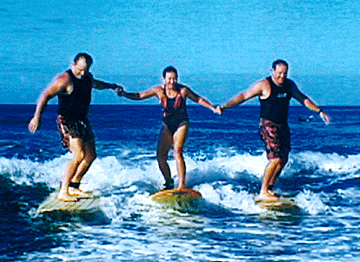
Dr. Shay Bintliff surfs with sons Grady and Gibb
in "Surfing for Life" footage.
Surfing:
A metaphor for life
Senior surfers find secret
By Greg Ambrose
to youthfulness on the waves
Star-BulletinDAVID Brown had just shot Rabbit Kekai blazing across the waves at Queen's Surf this summer, when he asked his still-dripping subject if he knew of any other old futs who still surf who he could film for his documentary. The legendary beachboy didn't hesitate. "You gotta get Doc."
Doc is Big Island pediatrician Shay Bintliff, a 62-year-old whirlwind who leaves younger people wheezing in her wake as she squeezes every drop of pleasure out of life.
When Bintliff stepped off the plane with two young sons in 1964 to join the faculty of the new John Burns School of Medicine at the University of Hawaii, she felt that she had come home.
Three weeks later, when she discovered the waves at Waikiki, she knew she had embarked on a lifelong adventure.
That makes her a perfect subject for Brown's documentary, which seeks to show that people can age with style and vitality.
"The secret to staying young is that it's never too late to have a good childhood," says Bintliff. "This whole thing with Princess Diana shows that you never know, all you have is today, this moment. If you don't live it to the max, whatever it is that makes your heart smile, you'll miss it."
Bintliff is too busy stringing a lei of memories to dread aging. "I remember surfing one moonlit night at Queen's, taking off our bikinis and tying them to our arms, and surfing butt naked. Those are the double rainbows in life that you remember."
San Francisco surfer and gerontologist Roy Earnest had approached Brown with the idea for "Surfing For Life." After filming 10 award-winning documentaries about the devastating consequences of the nuclear age, Brown welcomed the chance to work on a life-affirming project.
David L. Brown Productions
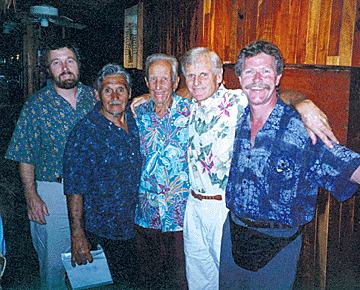
Co-producers Roy Earnest, left, and David L. Brown,
right, flank legendary Hawaii surfers, from left, Rabbit
Kekai, Woody Brown and Fred Van Dyke.
They chose surfing, perceived as child's play, to more dramatically wipe out the myth that aging equals feebleness.Although they are an incredibly diverse group, the stars of "Surfing for Life" have several things in common: they are older than 55, they love to surf, and they are too busy having fun to grow old.
The list of subjects reads like a surfing dream team: North Shore big-wave pioneers Peter Cole and Fred Van Dyke; surfing and outrigger canoe paddling champion Anona Napoleon; catamaran inventor Woody Brown; environmental activist John Kelly; and from California, champion surfer Eve Fletcher, and pioneer surf photographers LeRoy Grannis and John "Doc" Ball, who is still surfing and skateboarding at 90.
It turns out that balance is the key factor in surfing as in living a long, healthy life. The essential ingredients are exercise, humor, a passionate involvement in something you love, and a sense of community.
"I hope the viewers see surfing as a metaphor for life. You have to stay in shape, you have to have fun, you have to be out there appreciating nature," says Bintliff.
Earnest hopes that as stereotypes are smashed, Americans will categorize people not by age, but by "how well you are, how much living you're doing, if you're living in a full, complete way."
"This video is more than profiles of healthy elders," says Brown, "It's profiles of lives well spent."
By any standard, Bintliff has always quaffed deeply from the fountain of youth, and made certain that her sons drank, too. As head of the birth defects center at John Burns, she would hold clinics on the neighbor islands, leaving Oahu with her boys after school on Thursdays and holding clinics while they did homework Friday mornings.
Then the three of them would surf all weekend, touring in their rented camper.
"The ultimate is to share the thing you love with the people you love," Bintliff says.
This summer, Brown had Bintliff and her sons, now 38 and 35, surf at Ala Moana Bowl. When they caught a wave together, Bintliff urged the boys to surf closer to her.
"We all reached out and held hands. It was like electricity, it was chicken skin," she says. "It brought out so many memories of so much fun we have had."
Everyone who has seen the 24-minute rough cut of the documentary has been generous with praise and stingy with donations.
"A lot of the documentary was funded on the credit cards of the two co-producers," says Brown. Brown and Earnest pursued every possible avenue for funding, with dismal results. Although they need cash to create a new rough cut to screen for foreign distributors and for PBS and HBO, the footage they shot this summer was a huge boost.
"It's great to be in the home stretch and have the film in the can," says Brown.
"Surfing for Life" will almost certainly inspire seniors, but Brown and Earnest perceive the documentary as a light to guide baby boomers on the path of aging.
Bintliff knows how the boomers feel.
"People get discouraged as they get older, saying to themselves 'I can't do this and that anymore.' I know I can't surf the North Shore anymore, but it doesn't keep me out of the water.""I hope the video inspires people to keep playing tennis or whatever their sport is. It doesn't have to be surfing, just get out there and do it."
Be a surf film 'angel'
To help the producers finish "Surfing for Life," send a tax-deductible donation payable to Film Art Foundation at 274 Santa Clara St. Brisbane, CA 94005.