
There are lots of ways to beat the heat in your home. And it doesn't have to involve air conditioning. You can try ceiling paddle fans or portable tabletop fans but any system, even air conditioners, have to work harder if the home is not properly ventilated.
Most homes have "passive" attic ventilation like eaves, gables or ridge vents. But passive ventilation is never enough to adequately reduce the 150-plus-degree temperatures that hot weather can generate in the upper spaces of a house.
This "hot box" effect acts like a giant radiator, transferring attic heat to the living spaces below. It compounds the cooling problem and sends utility bills soaring.
A first step in cooling a house means beefing up "passive" ventilation. You can do that by:
Increasing the number, size and type of vents.
Wind-driven turbines -- those silver domes you see spinning on roofs -- are also a consideration.
But no matter what method you choose, air exchange is the key. When over-heated air in your home or attic is vented and fresh air is pulled in to replace it, that's air exchange. Cool air enters intake vents, which are located along the underside of the eaves. When air warms, it rises and moves out of the roof or gable attic vents.
Active ventilation systems use mechanical equipment -- specifically fans -- to exhaust hot air. Two of the most widely used are the attic fan and whole-house fan.
An attic fan, which costs less than $100 at most hardware stores, draws hot air out of the home and discharges it to the exterior. The hot air is displaced by cooler air, drawn in from vents in the eaves. A venting fan is generally placed at one of the highest points on the roof. Where a gable exists, a fan can be affixed to the inside face of the gable. In either case, the fan requires an electrical circuit, and more than one fan can be installed depending on the volume of air involved.
By Dennis Oda, Star-Bulletin
Panasonic's whole house fan and other vent systems
are most effective when the outside air is cooler
than the air in the home.
The Home Ventilation Institute, a company that rates air conditioning and ventilation systems, recommends a minimum rate of 10 air exchanges every hour. The higher the air exchange rate, the better ventilated the home becomes.A whole-house fan, which costs less than $250, does everything an attic fan does, but also ventilates the entire house, including the attic.
A whole-house fan draws in fresh air through windows and passes it through the attic where it's exhausted through gable and other roof vents. You cool your home and attic at the same time, and get added benefit of fresh air.
The louvered-shutter intake system of a whole-house fan is typically installed in the attic floor at a central location of the home such as a hall. Installation is relatively simple. (All ventilating fans whether for a single room like those made by Panasonic or a whole house fan have CFM (cubic feet per minute) ratings. The rating gives you some idea of the unit's ability to circulate air. Before buying a fan, estimate the volume of living space in your house so you know how much air the fan will have to circulate. Do this my multiplying the length of each room by the width and height, then adding the totals.
Once you've calculated your home's volume, multiply this number by 0.33 to obtain the recommended fan rating. So a house that has 12,800 cubic feet of space will need a fan with a rating of 4,224 CFM. Your attic may already have some roof vents, but with a whole house fan you may have to add more. Calculate the venting area by dividing the fans' rating by 750. So 4,224 CFM divided by 750 requires 5.6 square feet of unrestricted vent area.
A whole house fans can cost three or four times as much as other fans, but they provide a tremendous amount of cooling effects like portable, ceiling and window fans combined.
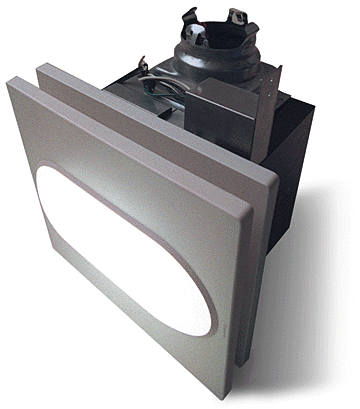
If you only want to ventilate individual rooms, including bathrooms, take a look at Panasonic's new Whisper Series ventilation system.
The six models -- with noise levels ranging from rustling leaves to "a calm office," the lowest currently available in a ventilating fan. The WhisperLites can ventilate up to 190 cubic feet of air a minute, or a room up to 500 square feet, depending on the model. Prices range from $94 to $229.
Ways to vent