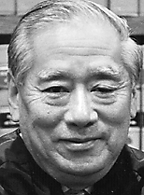
Ex-Justice
Nakamura dies
He was a guiding force in Hawaii's
By Mike Yuen
Democratic revolution of the 1950s
Star-BulletinFormer labor attorney and state Supreme Court Justice Edward Nakamura, widely regarded as a man of integrity unafraid to criticize abuses of power, died early yesterday at Queen's Hospital after undergoing open heart surgery. Nakamura, 74, had suffered a heart attack Saturday, said his wife, Martha Nakamura.
Even after retirement in 1989 after nearly 10 years as an associate justice, Nakamura remained an influential figure. He played a key behind-the-scenes role in the crafting of the Aug. 9 "Broken Trust" opinion piece in the Star-Bulletin that spurred Gov. Ben Cayetano to order an investigation of the $10 billion Bishop Estate, one of the nation's largest charitable trusts.
"It was only after three meetings with Ed over pancakes at the Like Like Drive Inn that I started to see 'the whole picture,'" said University of Hawaii law Professor Randall Roth, one of the five authors of the essay. "Without his guidance, the project might never have gotten off the ground."
He provided needed insight
Nakamura provided insight into how things worked. "It was an insider's look at the Democratic power structure," Roth said. "He was fed up with the way things have evolved. He felt some people in recent years betrayed what the ideals of the Democratic revolution (of the 1950s) were all about. They were watching out for themselves rather than the ideals of their predecessors."Roth added: "In his quiet but firm way, Ed always followed his conscience, even when that was certain to displease powerful people."
In 1993, Nakamura opposed then-Gov. John Waihee's nomination of attorney Sharon Himeno to the state Supreme Court, which drew fire because of her political connections and because her law firm represented her father, developer Stanley Himeno, in a questionable business deal involving the state pension fund.
Nakamura advised attorneys who publicly opposed Himeno's nomination, which was rejected by the Senate.
Resigned from board
That same year, Nakamura testified in the Senate's special investigation into the management of the state pension fund. He said that during his tenure as a fund trustee, a golf course deal was pushed by the then-chairman of the Employees' Retirement System, Gordon Uyeda, that would have provided a financial windfall for Uyeda's friend, developer Rodney Inaba.When the pension board voted to purchase the Wood Ranch Golf Club in Simi Valley, Calif., Nakamura resigned in protest.
But the $31 million deal quickly unraveled with Waihee apparently playing a role in getting trustees to abandon the project.
A self-described liberal
Nakamura was born in Honolulu on Oct. 9, 1922, the son of immigrant laborers. A self-described liberal, he was one of the many Japanese-American veterans of World War II who went to college on the GI bill and joined the Democratic Party, helping it transform Hawaii into a society that offered more educational and employment opportunities for non-Caucasians.Although he considered himself simply a "foot soldier" in the campaigns of John Burns, who would eventually become governor, many considered Nakamura to be a key architect of the Democratic revolution.
After graduating from the University of Chicago law school in 1951, in the same class with U.S. Rep. Patsy Mink, Nakamura joined Bouslog & Symonds, then the only labor law firm in Hawaii at a time when lawyers were fearful of representing workers. It was when McCarthyism fanned congressional investigations into organized labor in search of "subversive activities."
He was 'model attorney'
Martha Nakamura remembers that when her husband, who also served as a University of Hawaii regent, was asked to describe himself, "He always said he was a labor lawyer for 28 years. He always said that first."Attorney Jared Jossem, former state Republican Party chairman who was Nakamura's legal adversary in about 50 cases, said: "He was a model attorney who represented his clients effectively and brilliantly.
"In developing proposals to legally change labor-management relations, he quietly worked the political side to get his clients' and his vision into legislation. He combined intellectual power with inordinate political skills."
Centrist view as justice
When Nakamura joined the high court, there were fears that he would be one-sided since he was a labor attorney with no prior experience on the bench. But that did not happen."As a justice, he adopted a more centrist view balancing the specific interests of unions and employers," Jossem said.
One of the high court's key decisions authored by Nakamura declared that an employer's written handbooks and policies can be considered binding contracts under certain circumstances. That protects workers not covered by collective-bargaining agreements or employment contracts.
Retired state appellate Judge Walter Heen, another co-author of the "Broken Trust" opinion piece, said: "Justice Nakamura will stand out in the history of Hawaii as one of its finest legal minds and one who possessed the highest concern for principle. His opinions reflect both those characteristics."
Retired Hawaii Supreme Court Chief Justice William Richardson, who served with Nakamura, all of the current justices, U.S. Sen. Daniel Inouye, who served with Nakamura in the 442nd Regimental Combat Team, Gov. Ben Cayetano and attorney James King, Nakamura's former law partner, all praised Nakamura for his honesty, integrity and wisdom.
A mentor to many
Scores of legal professionals as old as the 69-year-old Heen and as young as 33-year-old state Rep. Scott Saiki (D, Moiliili) claim Nakamura as their mentor."I think he had so much integrity and wisdom, and he led by example," said Saiki.
Nakamura's nephew, attorney James Kawashima, 31, added: "He was very principled and always ethical. Sometimes that's rare in people and lawyers both."
Nakamura's widow, who met him on a blind date with two other couples on a moonlight picnic at Sandy Beach, said:
"He was very gentle, very considerate -- always. None of that male chauvinism thing. He always said I was an individual, not just his wife."
The Nakamuras were married for 42 years. They had no children.
Funeral services are pending.