
Strike up the band-wagon
A short while ago, it seemed only
the Pope might be popular enough to beat
movie idol Joseph Estrada, in the Philippine
presidential race, but his shimmer
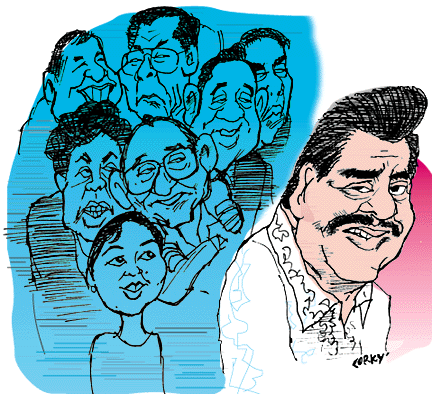
has faded and the race is on . . .Story and illustration by Corky Trinidad
Star-Bulletin
A year ago, Vice President Joseph Estrada looked like he had a lock on the 1998 Philippine presidential race. With President Fidel V. Ramos constitutionally barred from running for another term, the former movie idol nicknamed "Erap" was riding a wave of popularity.
Philippine Vice President
Joseph Estrada, right, and
1. Fidel V. Ramos
2. Gloria Macapagal-Arroyo
3. Miriam Defensor-Santiago
4. Richard Gordon
5. Renato de Villa
6. Jose de Venecia
7. Eduardo AngaraAmong the electorate, generally referred to as the "masa," Erap was media-milking the newly created, high-profile cabinet position known as anti-crime czar. Politicians, led by that barometer of Philippine political climates, Senate President Ernesto Maceda, were jumping onto the Erap bandwagon.
You could go onto any street of any town in the Philippines and ask people who would succeed Ramos. Everyone would say, "Erap."
There was no one on the horizon with the political strength and nationwide popularity even remotely threatening his position.
That was a year ago. And since there is no freeway in Philippine politics -- only a cloverleaf -- Estrada is now just one of at least a dozen declared and undeclared candidates for the job.
As Manila Times columnist Jose Lacaba puts it, "The beauty of democracy is that anyone can run for president. The trouble with democracy is that everyone is running for president."
That means trouble for Estrada's campaign. It is, in fact, at a new low, eroding the early image that he was unbeatable. Now Estrada is struggling to remain electable.
What happened? Three things.
1. First, the reality of Philippine politics, which is still a politics of people, not of parties.
It's a system ruled not by philosophies and issues but by the popularities and patronages of individuals strengthened by alliances of old family and economic ties; blessed by business, religious and civil groups and associations; and endorsed by the current president.
The successful Philippine presidential candidate is one who can attain the acceptance of this myriad of social, political, business and military establishments.
It's not enough for anyone like Estrada to be popular among the masa. He or she has to attain the imprimatur of the traditional institutions of power, which are based in Manila.
Estrada is an outsider to the intricate socio-political-economic strata of Manila society, which still can't take the former actor seriously as presidential timber.
The business community remains doubtful of his economic credentials or, at the very least, his understanding of the economic underpinnings of the country.
The religious factions, with their stereotypical suspicions of show-biz lifestyles, remain cool to the former actor's moral standing. His women, drinking, circle of friends and even his sons are all fodder for the tabloids, not the social register.
2. Second, the president happened.
President Ramos is doing well and finding it more difficult to leave his seat. In the past year, he has tried every legal means to stay in power, including a "citizens" petition movement to gather as many signatures as possible to urge the lifting of the constitutional ban on a second term, a bill in the House espousing the same ideal, and even a longshot plan to have other countries "urge" the Philippines to retain Ramos to maintain the present economic boom and political stability in the region.
The Supreme Court nixed those ideas. So did the Senate, the press and everyone else who had a hand in framing the present constitution.
Two bigwigs, former President Cory Aquino and Cardinal Jaime Sin, threatened to protest in the streets any attempts to change it. But we can be sure that Ramos will try every legal means to stay in power, short of a Marcos-style coup.
In all of this preoccupation to remain in Malacanang, the traditional "endorsement" of his vice president as successor is the last thing on the president's agenda, especially since Estrada belongs to another party (in the Philippines, presidents and vice presidents are chosen separately).
In the past year, Ramos has used his endorsement (or "anointment," as dubbed by the press) as a way of keeping presidential aspirants in line.
He coyly dangles it before the noses of wannabes -- from Speaker of the House Jose de Venecia Jr. to former Senate President Eduardo Angara. Ramos thus keeps all hopes alive for senators, cabinet members and other candidates, and even allies of aspirants for the job.
One theory is that Ramos is trying to keep from being a lame duck in his waning time in office. Another says it's a way to gather his own allies to help him fight for another term.
Whatever the reason, the only odd man out in this year of waiting and speculating seems to be Estrada.
3. Third, Estrada happened to Estrada. The vice president had a substantial lead on everybody but didn't do anything to build on it.
In the past year, when morality in private life and in government were issues around the world, Estrada didn't take up its leadership to the satisfaction of social and religious factions. When Sen. Gloria Macapagal-Arroyo did, Estrada's hold on the masses began to erode in all the polls, including his own.
In a year when economic issues were the most important in booming Philippines, Estrada didn't create any ties with the business community, or address any economic issues or concerns. When Defense Secretary de Villa did, Makati -- the generic term to describe the business community -- started leaning toward him. Since he is a former defense secretary, it's also safe to assume that the military establishment is for de Villa.
In a year when everyone cried out for reform in government, Estrada didn't lead the charge. But Sen. Miriam Defensor-Santiago did, making it a foundation of her campaign.
In issue after issue, Estrada -- by his silence and by the illusion that he was relying on his popularity and nothing else to attain the presidency -- found himself outpaced by other candidates.
Yet Erap can still win. After all, the elections are still a year away. And no one comes close to his base of nationwide popularity among the electorate.
He has built a wide swath of political debts from politicians he helped in the last elections, and he has the financial backing.
But he has to start clawing his way back into the forefront of the aforementioned establishments and the people of the Philippines to prove that he is not just popular but electable.
The self-destruction of Joseph "Erap" Estrada has opened the door to strong aspirants for the presidency of the Philippines. Among them are: About the contenders
Former Defense Secretary Renato de Villa, who recently resigned his position to announce his candidacy. A favorite of both President Fidel Ramos and former President Cory Aquino, de Villa has the best organization and financial backing for a run. He is also endorsed by the Makati business community. Furthermore, since de Villa is the acknowledged choice for Ramos' "anointment," if (by some political miracle) Ramos is allowed another term, de Villa would likely be his running mate.
Corky Trinidad, who was
born and raised in the Philippines, is the Star-Bulletin's
longtime editorial cartoonist. He is on a year-long sabbatical from his
daily newspaper duties to complete freelance projects
for publishers in Manila.
