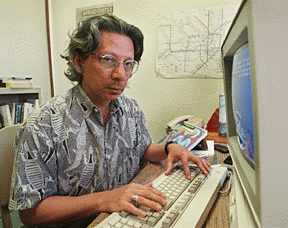
By Dennis Oda , Star-Bulletin
New York poet and teacher of Asian-American
literature Luis H. Francia.
Shadowed
literary voice heard in
‘Flippin’: Filipinos’
Author shares his views
By Burl Burlingame
on the Filipino-American experience
Star-BulletinONE hundred years ago, almost no one in the United States even knew where the Philippines were. Ninety-nine years ago, the Philippines became part of the United States, and the paths of both countries have intertwined ever since. The thousands of islands of the archipelago were a prize won in a brief war with Spain, and American troops then had to contend with Filipino independence movements and guerrillas. Eventual independence was delayed by Japanese invaders during World War II, and Filipino place names became part of the Allied mythology of the war -- Bataan, Corregidor, Manila, Luzon.
Thousands of Filipinos moved to the United States and the Territory of Hawaii, and even today, Filipinos comprise one of the largest groups of immigrants coming into the United States. The governor of Hawaii is of Filipino descent.
Despite this rich, shared history and culture, literary works about the Filipino-American experience weren't exactly thick on the ground. This situation puzzled Luis H. Francia, a poet and teacher of Asian-American literature at Sarah Lawrence College in Bronxville, N.Y., and he decided to do something about it.
The result is "Flippin': Filipinos on America," an anthology Francia co-edited with poet Eric Gamalinda. Francia will speak about the work tomorrow at the University of Hawaii-Manoa.
"We figured we'd do a book that looked at how Filipino-American literature felt about America," said Francia. "Even though we were a colony of America, there had never been a book that looked especially at our feelings. The book does accomplish that. The Philippines were a colony of an officially 'benign' superpower, after all. We wanted to look at that mythology."
Francia is also a writer for the Village Voice in New York, and his grandfather came to the Philippines from Philadelphia in the Spanish-American War. "Yep, a Yankee from up East," said Francia. He sucked distractedly on a pink smoothie from Manoa Garden.
"The Asian-American Writer Workshop got us the money because no such anthology existed. No one really talked about our colonial past. As it turned out, ours was the third anthology on the subject in four years, joining 'Brown River, White Ocean,' which I also edited, and Nick Carbo's 'Returning a Borrowed Tongue.' Then this! Three anthologies where there were previously none."
"Even though the pieces are all different, common themes emerge, such as the importance of family, and the confrontation between modern America and our cultural background," he said.
Francia said contributions came via Internet and word of mouth. Some were submitted; others were solicited. "Some works are reprinted from dead authors; their words live on."
The book is in English, which is one of the three official languages of the Philippines along with Tagalog and Arabic.
"There's such a thing, though, as Filipino English, like the difference between Indian English and British English," pointed out Francia. "The locutions and the tones are different, and there are many expressions that have invisible context. The writers in our anthology assume you know the context. Faulkner, after all, didn't have to explain Southern customs in his works.
"We've tried in the past to explain the Philippines endlessly, and we're tired of that. If it's good writing, it travels. I don't understand Japanese culture completely, but I'm able to understand (author Yukio) Mishima well enough."
Despite thousands of islands and hundreds of cultures in the Philippines, English, despite its relatively recent introduction there, has firmly taken root.
"English was brought in by the Americans. It's easier to rule a country when you share the same language and culture," said Francia. "The American line was that, 'We aren't here to oppress you. We're here to give you democracy and independence some day. In the meantime, here's free education for all,' which is really a democratic ideal.
"There's a lot of good will still toward Americans because of the big differences between the Americans and the Spanish. The Spanish friars ruled the country for more than 300 years and didn't have the same effect the Americans had in 50. Still, even when I was at the University of Ateneo (in Manila) -- run by American Jesuits in the '60s -- we were forbidden to speak Tagalog. There were monitors on campus to report us if we spoke Filipino."
The first Filipino immigrants to the United States were bachelors who continued to send money back home, maintaining the tie between the two countries. Many eventually settled here.
"They weren't alien, but they weren't citizens either," said Francia. "They could stay, work, marry, but not own land. And then, suddenly, we were allies in World War II."
The anthology examines what it means to be Filipino-American, to be from a Pacific island surrounded by Japan, China and Malaysia, to have alien cultures from Spain and the United States lathered on top of the mix.
"The Philippines is like a displaced country," said Francia. "We have Spanish names and customs that no one else in Asia has. In fact, the popular image of the Philippines in Southeast Asia is that it's a Hispanic country. Some think Filipinos should be thought of as Hispanic Americans. In New York, people always assume I'm Hispanic."
"Most Americans don't know what to make of Filipinos. Some don't even consider Filipinos Asians. There are hierarchies in the Asian-American world, in art, in politics, in everything, and to some folks 'Asian' automatically means East Asia: Chinese and Japanese. In Hawaii, it's easier, because Asian-Americans aren't a rarity. The question doesn't even come up."
Despite independence, despite anti-U.S. rhetoric, despite the withdrawal of American interests from the Philippines, deep connections remain.
"We blend in easily in America," said Francia. "There are no Fliptowns in America like there are Chinatowns. . . .
"In a way, it's a disadvantage. With a Chinatown, people are forced to deal with you as Chinese-Americans. You have that identity. But the Philippines, with so many islands and so many languages and cultures, it's very regionalistic. You don't think of yourself as 'Filipino' until you come to America."
Francia says he can "intuit" differences between Filipinos from Hawaii and those from other locales. "I can tell a New York Filipino from a Hawaii Filipino right away. In New York, each group gives its voice stridency. It's more subdued here. It's more Asian, maybe."
Speaking of stridency, "Flip" is generally thought of around here as a derogatory term. Won't it cause comment as a book title?
"That's why we took it!" laughed Francia. " 'Flip' is derogatory only if it's used outside the culture. And -- we were playing with the notion of the 'flip side of the coin.' Filipinos are the flip side of the American coin!"
Meet the author
Luis H. Francia speaks on "Flippin': Filipinos on America":
When: 7:30 p.m.' tomorrow