


ON Father's Day morning, Elizabeth Kent and her husband, Kent Davis, were walking the beach at Malaekahana near Laie when they saw a dark green wine bottle washed up on the sand. Peering inside the securely corked container, its surface encrusted with sand and ocean growth, Elizabeth could make out a rolled-up paper. A note in a bottle! A request for peace,
via a note in a bottleHow serendipitous, thought the 38-year-old Kailua resident. This was the same spot that she had twice before found glass balls, fishing weights that are now considered collector's items. She had always believed Malaekahana to be a special, sacred place. And here, yet another bonanza of a find.
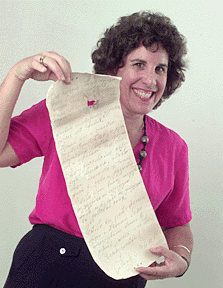
Elizabeth Kent and
her letter from RussiaExcited with curiousity, Elizabeth and Kent gingerly cracked open the bottle. Inside they found a hand-written letter on a delicate brown sheet, and Elizabeth immediately recognized some of the words as being Russian.
How did she know? Because Elizabeth had taken three years of the foreign language at Hawaii School for Girls and another three years in college. What are the chances of a person studying Russian finding a note in a bottle from Russia?
When Elizabeth got home, she asked her former professor, Michael Klimenko, now retired after 29 years of teaching Russian at the University of Hawaii, to decipher the message. What are the chances of knowing a learned person who can accurately translate a difficult language?
According to Klimenko, the gist of the note read:
"This was written the first of January 1986 by seamen of the Russian fleet. Whoever finds this writing we wish heroic health and many years of life. Let peace and happiness accompany you and the beams of the greatest light warm your house. We Russian seamen wish that our planet Earth lives in peace and joy. May the clouds of war never cover the blue sky or muffle children's laughter. May all achievements of science and technology be used for peaceful purposes. Peace to you."
That was all. The letter was unsigned.
Elizabeth was moved by the deep philosophical nature of the message. But Professor Klimenko pointed out that most of the masses in Russia probably felt this way at that time, and still do. They were very concerned about aggression between nations, as the Soviet Army had invaded Afghanistan and allied forces always posed a threat.
And don't forget, the missive was written well before the fall of the Berlin Wall and the break-up of the Soviet Union. Elizabeth still wonders how such monumental societal change must have affected the lives of those who threw the bottle into the sea.
When she told UH marine biologist Richard Grigg about her find, he estimated that it must have bobbed completely around the Pacific Ocean at least five times before finding land on Oahu 11 years later. Its durability and historical significance have enhanced the worth of the letter so much that Elizabeth is going to frame it for her office wall.
WHERE exactly is her office wall? At the Queen Street Building, where Elizabeth is director of the Judiciary's Center for Alternative Dispute Resolution, a state agency bent on dispensing conciliatory justice in a litigiously combative community.
What are the chances that someone dealing with disputes and legal wrangling every day would find a wistful message for peace from the other side of the world?
About as much chance as finding a note in a bottle.