Ke Kumu Aupuni
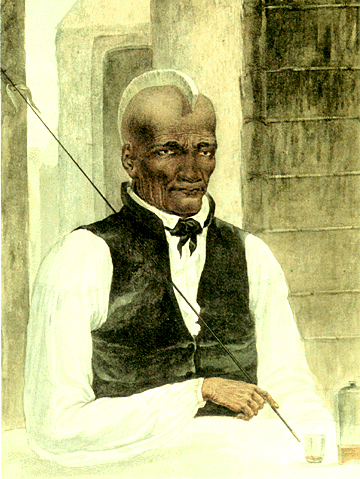
A prized portrait of Kamehameha the Great was painted by
Russian artist Mikhail Tikhanov in 1818, the day after
Kamehameha's sister died and one year before the king died
at about age 61. A modern-day Hawaii emissary traveled to
St. Petersburg, Russia, to obtain written permission for
use of the likeness in "Ke Kumu Aupuni."
In his mother tongue
19th-century Hawaiian historian
By Catherine Kekoa Enomoto
Samuel Kamakau's work on Kamehameha the Great
finally becomes available
as he wrote it
Star-Bulletin
Ke Kumu Aupuni: By Samuel Manaiakalani Kamakau, 325 pages, $35, 'Ahahui 'Olelo Hawai'iAn exquisite hardbound edition of Samuel Manaiakalani Kamakau's "Ke Kumu Aupuni," or The Foundation of Nationhood ('Ahahui 'Olelo Hawai'i, 1997, $35) makes its debut Thursday at a reception in the main branch of the Hawaii State Library.
"It's the first time that Samuel Kamakau's history has been available in his own language and in the order in which he told it," said Puakea Nogelmeier, assistant professor of Hawaiian language at the University of Hawaii at Manoa.
Nogelmeier served as editor of the five-year project, a collaborative effort by some 18 people, including students, friends and other UH faculty members. Key collaborators were UH lecturer Lalepa Koga, who collected and typed materials; Sahoa Fukushima, who proofread, corrected the manuscript and helped index; and Noenoe Silva, principal compiler of an inclusive 62-page index.
The lone page in English in the 325-page text explains that Kamakau (1815-1876) wrote a landmark history of Kamehameha the Great and his kingdom. The account appeared as a serial column in two Hawaiian-language newspapers over three years, from 1866 through 1869. This book presents half of that text; a sequel will publish the second half. The book also features 15 color plates, including several little seen photos of ali'i, or royalty.
Nogelmeier said David Malo, another 19th century author, presented ethnography -- social and cultural description. However, Kamakau offered history as well as ethnography.
"Kamakau set out to do a historical sequence from the time that Kamehameha was born," Nogelmeier explained. "He was doing a very careful and detailed account of events and forces that shaped them. For clarity he added ethnography."
Kamakau's writings spanned 40 years, he said.
Nogelmeier said nonspeakers of Hawaiian can use "Ke Kumu Aupuni" to check specific sections of the English-language "Ruling Chiefs," a definitive work which is drawn from Kamakau's writings.
But, more than a reference, "Ke Kumu Aupuni" is a textbook, he said. "It's also a history book. It's also a pleasure novel. There are lots of great little stories and vignettes in it. To access it on a pleasure-novel level does take some fluency" in Hawaiian language, he added.
The reception will feature chant by Kalani Akana and Kamuela Chun, radio personality Hau'oli Akaka impersonating Kamakau, an English speech by Nogelmeier, refreshments and book sales. The event is open free to the public, but reservations are required by calling 'Ahahui 'Olelo Hawai'i, 528-5453.
The 'Ahahui, a Hawaiian-language resource group, published only 2,000 copies of the collector's first edition in hard cover. The book is dedicated to the preeminent Hawaiian scholar, the late Mary Kawena Puku'i, who translated Kamakau into English and provided "the bridge that takes us back to the original source," Nogelmeier said.
Dwayne Nakila Steele, owner of Grace Pacific Corp., initiated and provided financial support for the project, he said.