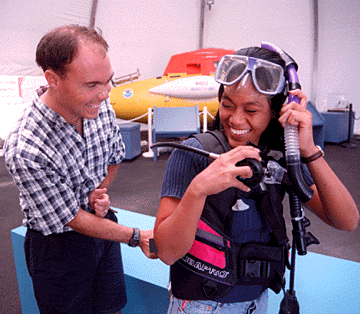
By Craig T. Kojima, Star-Bulletin
Mike Levad helps Jennifer Hermosura with diving equipment
that's part of the Ocean Planet exhibit. Behind them is the
Undersea Research Laboratory submarine Makalii.
Make waves
at Bishop Museum
New exhibit explores
By Burl Burlingame
the watery depths of the sea
Star-BulletinLike the old gag goes -- you see that ocean over there? It sure is a lot of water -- and that's just the top of it! "Ocean Planet" is a mega-exhibit created a few years ago by the Smithsonian Institution, and Saturday it opens at the Bishop Museum's Castle Memorial Building and runs through Oct. 5. You'll have all summer to dive in.
The exhibit follows the Smithsonian's usual high standards of craftsmanship -- even the hidden parts of the exhibits are sanded, polished and buffed -- as well as the Smithsonian's usual blind spots, such as an East Coast bias toward fish species.
And, as usual, the Bishop Museum is adding a distinct Hawaiian flavor to the exhibit using their own resources and collections.
"One of the interesting omissions -- and I've heard that this isn't unusual for a Smithsonian exhibit -- is that the military isn't mentioned," even though ocean exploration was largely a military activity until recently, said Kay Fullerton, Bishop's community program manager. The museum is adding some military references and a hands-on demonstration of how submarines work.
The museum staff was busy assembling the exhibits earlier this week, and they were nearly as complicated to put together as the average Barbie Dream House. The exhibits have nautical design themes, such as a section on man-made ocean problems that are mounted on "buoys," and the pillars have a distinct steering-wheel motif.
"An ocean exhibit in Hawaii . . . is that like bringing ice cubes to the Eskimos?" wondered public-programs wrangler Ken Miller, Bishop's designated quotemeister. "No, we don't think so. There's a lot to the ocean and there's always something to learn. And this exhibit takes a global view that we don't often see here."
"This space (at Bishop Museum) really lends itself to the exhibit, and this state really lends itself to the subject," said Fullerton. "And we're bringing in special people like deep-sea explorer Sylvia Earle, who almost personifies the exhibit. She really has the passion of the true explorer."
"Ocean Planet is a celebration, but it's also a bit of a warning," said Miller. "Our environment is at risk, and the ocean is a big part of that. Although some of our exhibits have been for kids, and some have been for adults, this one appeals to both groups."
Framing the entrance to the Castle building, the public-events tent to the left holds the Hawaii Undersea Research Laboratory submarine Makalii and some hands-on displays, the area to the right encourages "wet play" for the kids, including a current tank and wave generator.
Through the front door, there's an environmental feel as undulating lights and textures make the entrance like Captain Nemo's living room.
One prominent part of the entranceway credits the work of ocean shipping, in particular Sea-Land Service, heroes of the Bishop Museum because they pick up shipping charges for popular shows such as this one.
The planetarium has "Oceans in Space," a new show that uses up-to-the-minute images downloaded from the Internet.
In the building core, there's a sculpture of hanging etched-Plex phyla, a kind of Christmas tree of biodiversity. Beyond that is a kind of ship's fo'c'sle, which gives a grounding in ocean exploration. "The pieces are really large, and they're high quality," said Fullerton. "It's a challenge to put it all together."
An area added by Bishop Museum examines the "Twilight Zone," the area of the ocean between 250 to 500 feet deep. The museum has a world-class scientist in this regard, Richard Pyle, and many of his discoveries will be presented.
"Richard apparently can't make a dive into the Twilight Zone without bringing up another new species," said Fullerton. "It's really an overlooked area of the ocean, too deep for divers and too shallow to make it worthwhile for submersibles."
The pressures of this zone are evident in the Squish-A-Fish display, and there will be live species in a tank.
Some fish disappearances are a source of controversy, and Bishop Museum is adding its own local spin to the interpretation. Unlike exhibits of the past, in which the "facts" are intoned in the godly voice of the museum, this area will be open to several different interpretations. "This is really a different step for us," said Fullerton.
In another unusual step, the usually sacrosanct stairwells have been painted in an ocean scheme and decorated with fish species pictures drawn by students at Assets School.
The second floor also features an actual Hawaiian fishing shrine, constructed by fisherman Atwood Makanani. It is part of an area dealing with Hawaiians and the sea. There is also a spectacular globe of the Earth built by artist Larry Fuente, in which the currents and continents are depicted in costume jewelry. The section, called "Message in a Bottle," will have viewers' thoughts about the fragility of the ocean ecosystem on display.
The "SEAstore" shows how products from the sea wind up in the home, and another section shows how the sea has affected popular culture and literature. Plus there's a fish market, showing some nice big fish reclining in a bed of crushed ice. It's all artificial, of course, but it's at this point we realized that there's something missing.
Not that anyone will miss it: that fishy smell.
Ocean Planet
Place: Bishop Museum's Castle Memorial Building.