By Kathryn Bender, Star-Bulletin
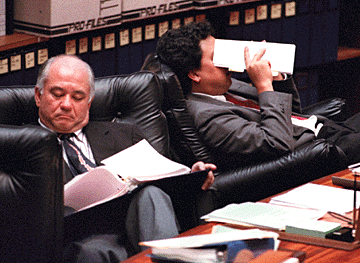
Reps. Merwyn Seichi Jones, left, pores over papers while
K. Mark Takai briefly uses his documents in a creative way during
yesterday's marathon House floor session, which ran about 11 hours.
Bills, bills, bills
The Legislative session winds down
By Mike Yuen and Jim Witty
on a positive note, but with the key
issue of privatization unresolved
Star-BulletinUnlike last year's legislative session that ended in a cross-fire of blame for unfinished business, state lawmakers are wrapping up their work on a generally positive note.
But as they concluded a marathon session last night approving nearly 200 bills and prepared for tomorrow’s adjournment with formal approval of a measure aimed at lowering the state’s high auto insurance rates, some call their indecision on a contentious issue “a ticking time bomb.”
The issue: dealing with the ramifications of a state Supreme Court ruling that threw into question state and county contracts allowing private businesses and agencies to perform an array of public services. The court sided with the United Public Workers union, concluding that government workers’ jobs can’t be jeopardized by those contracts. But the court also stated that “clear guidance from the Legislature is indispensable.”
Lawmakers failed to do that amid controversy last night, swayed by neighbor island mayors and supporters who claimed the House-Senate compromise was worse than no bill.
Russell Okata, executive director of the Hawaii Government Employees Association, which represents roughly 25,000 public service employees statewide, this morning said the compromise bill was a good one and that the neighbor island mayors who fought it “overreacted.”
He lamented that failure to pass the legislation, which called for temporary exemptions of existing and future contracts from civil service laws, throws hundreds of contracts in question.
“We believe the conference draft provided the necessary protections for public employees ... and for the employers to contract out public services,” Okata said, adding that the attorney general signed off on the draft and Honolulu Mayor Jeremy Harris supported it.
He said HGEA is prepared to meet with the various public employers to reach agreement to “satisfy the employees” the union represents.
HGEA will now seek an inventory of contracts from the employers to see if they are in compliance with the court decision, Okata said.
House Minority Leader Gene Ward (R, Hahaione Valley) yesterday said lawmakers’ indecision on the issue is “a ticking time bomb simply waiting for existing (public) contracts to expire.”
The legislative session, which was to have adjourned yesterday, was extended two days to tomorrow to deal with a late agreement on reforming the state’s no-fault auto-insurance system. House Speaker Joe Souki (D, Wailuku) said it is highly unlikely that he’ll extend for the privatization issue.
Senate Co-Majority Leaders Les Ihara Jr. (D, Kaimuki) and Mike McCartney (D, Kaneohe) said lawmakers will continue to wrestle with how to boost the state’s lagging economy.
“We’ve got to do more than tourism,” McCartney said. “If we work on the economy, money (for state revenues) becomes less of an issue.”
By Dennis Oda, Star-Bulletin
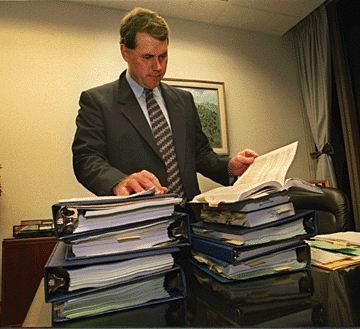
Rep. Ed Case goes over a few things in his office after the
House session completed its work for the night.
Those broad themes were reflected in the debate over the state’s $11.6 billion operating budget for the fiscal biennium that begins July 1.“Unfortunately, this budget does not reflect the economic hardships faced by the people of Hawaii,” said Sen. Sam Slom (R, Kalama Valley), who cast the only dissenting vote in the Senate.
Countered Senate Ways and Means Co-Chairwoman Carol Fukunaga (D, Makiki): “We have held down the growth of government as much as possible. The Ways and Means Committee wanted to provide as much relief for small businesses as we could.”
In the House, Finance Chairman Calvin Say (D, Palolo) said his panel tried to shape a budget in hard economic times that maintains educational standards, helps the poor, eases prison overcrowding and stimulates the economy.
Say said the House held firm against deeper reductions pushed by the Senate, which would have hurt state programs and services. But he added the times when state government can attempt to provide for all public needs are over. “It is time that we say once and for all: Government cannot, must not, and will not be all things to all people,” Say said.
House Minority Leader Ward said even Gov. Ben Cayetano’s initiative to borrow $1 billion to speed up public works projects won’t be that effective in creating jobs or bringing about an upturn. Half of it must be used simply to bring the construction industry back to levels it previously had, while the state’s bond rating will be jeopardized, he said.
Lawmakers also acted on two key issues left unresolved from last year -- same-sex marriage and eliminating the pension perk for state and county lawmakers. In exchange for a proposed constitutional amendment to ban same-sex marriages, certain marriage-like benefits and rights for same-sex couples were approved.
Lawmakers also passed a measure that extends the life of the Hawaiian Home Lands claims review panel by two years, but it also will exclude native Hawaiians from seeking damages because they were on the waiting list for land for years -- the bulk of the 3,516 unresolved claims.
By Dennis Oda, Star-Bulletin
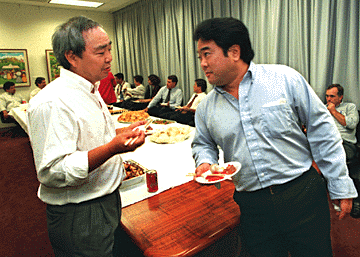
Reps. Ryan Yamane, left, and Paul Oshiro enjoy some food
while chatting in an informal get-together in House Speaker
Joe Souki's office after the House quit for the night.
House Hawaiian Affairs Chairman Ed Case (D, Manoa) said damages from the so-called “waiting list” claims could amount to more than $100 million. He said the 1991 law that established the panel was not aimed at them, but at individuals who suffered because of a direct wrongdoing, such as a lost application.But Rep. Quentin Kawananakoa (R, Nuuanu) said claimants were promised they could come forward and present their cases to the panel.
On the controversial privatization issue, the consensus bill called for a two-year exemption for existing and future contracts from the civil service laws so that the matter could be studied.
House Speaker Souki sent the measure back to committee, effectively killing it and leaving the counties’ mayors to wait for an expected high court opinion clarifying its decision.
But Senate President Norman Mizuguchi (D, Aiea) and 16 other senators yesterday voted to pass out the bill, much to the displeasure of eight other senators.
Sen. Randy Iwase (D, Mililani) asserted that it was highly unusual for the Senate to take up a bill that the House had already voted to bury. “This is inconsistent with history and inconsistent with precedent,” Iwase said, charging that leadership with interpreting and applying rules and procedures in an “inconsistent manner.”
When Slom voiced his opposition, he acknowledged the presence of “the 26th senator” who “crafted” the bill. It was a barbed reference to UPW chief Gary Rodrigues, whose lawsuit led to the Hawaii Supreme Court decision and who was in the Senate gallery.
After the Senate session, Mizuguchi told reporters that, contrary to what Iwase maintains, the Senate is not obligated to agree with a House decision to recommit a measure. “I don’t think we can be reactionary. They’ll hold us hostage,” Mizuguchi said.
The Senate’s action means it is up to the House to make the next move: keep the measure bottled up or pull it out and agree with the Senate. Sen. Norman Sakamoto (D, Moanalua), one of the dissenters, countered: “Resolving this crisis requires leadership combined with the determination to make tough choices.”
A N A L Y S I S
Legislators showed
they listened to votersLawmakers were more active after
By Mike Yuen
three colleagues were ousted in 1996
Star-BulletinEmbarrassed by last year's "do-nothing" legislative session and chastised by voters who swept out three powerful Senate committee heads, lawmakers were determined, even desperate, for results this year. They achieved it — on same-sex marriage, crime, eliminating the legislative pension perk and, if all goes as expected tomorrow, on lowering automobile insurance rates.
But in doing so, they revealed some fundamental differences between the House and the Senate.
The House, despite its continued centralized structure that funneled power through committee chairpeople and ultimately to Speaker Joe Souki (D, Wailuku), was more productive than the Senate. It moved more of its bills out of House-Senate conference negotiations and yesterday the Senate agreed to numerous House drafts of legislation.
The Senate, despite its new system of co-chairpeople intended to promote collaboration and power-sharing, remains a chamber filled with political intrigue. Dissidents still question the leadership of Senate President Norman Mizuguchi (D, Aiea).
The rebels have concluded that the public would be disgusted with the sort of open warfare that led to the downfall of then-Senate President James Aki (D, Waianae) and Mizuguchi's ascendancy 3-1/2 years ago. So they chip away, pointing out perceived missteps by Mizuguchi and others in the ruling faction with jab-like floor speeches rather than engaging in bloodier political maneuvers.
But the Senate did have its bright spots this session. Arguably the best example of dual committeeship was Sens. Matt Matsunaga (D, Palolo) and Avery Chumbley (D, Kihei), who were not part of the inner circle that reorganized around Mizuguchi late last year.
In the same-sex marriage debate, their teamwork was evident. They were like-minded in their approach to the issue, aware of its legal complexities and committed to giving gay and lesbian couples state marital benefits substantially similar to those given heterosexuals.
Their personalities also complemented one another. Matsunaga, who still believes same-gender couples are entitled to equal protection, appeared the more idealistic of the two. Chumbley seemed more the political strategist, faster to lock horns with House Judiciary Chairman Terrance Tom (D, Kaneohe).
In an issue where philosophy played as strong a part as voter perception, their united front was effective.
The pair didn't fare as well on crime legislation, however. While they consistently presented a united front against Tom's calculated jabs, they failed to come to terms with the House on several key bills, including measures that would get tough on robbers and require convicted felons to serve at least 85 percent of their sentences.
Nonetheless, a spokesman for the Law Enforcement Coalition, made up of the state attorney general and county prosecutors and police chiefs, gave Matsunaga and Chumbley an A-minus for their work this session.
A pleasant surprise in the Senate was freshman Sen. Sam Slom (R, Kalama Valley), an outspoken business advocate. As expected, he wasn't afraid to engage in verbal combat with pro-labor colleagues. Slom, however, has managed to be both thoughtful and forceful.
In the House, Souki helped bring home results for Gov. Ben Cayetano and the visitor industry. But Souki had to do it behind closed doors with Mizuguchi, including an eleventh-hour, late-night bargaining session that broke a budget stalemate by their money committee chairpeople.
Souki managed to advance several key administration measures for economic development, including tax breaks for hotel renovations and for Continental Airlines, after they stalled in the Senate.
House Hawaiian Affairs Chairman Ed Case (D, Manoa), a sharp second-term lawmaker, impressed legislative observers with his handling of two volatile issues — Hawaiian Home Land claims and the dispute over how much the state should pay for using lands once controlled by the Hawaiian monarchy.
Throughout the session, House Finance Chairman Calvin Say (D, Palolo) was more open than his Senate counterparts in explaining his chamber's budget plan and its rationale.
As for Senate Ways and Means Co-Chairwoman Lehua Fernandes Salling (D, Kapaa), even members of the Senate's controlling faction concede that her floor speech to explain the Senate's budget draft was rambling and unfocused.
While Fernandes Salling initially handled most of the money-related conference talks with the House, she had a diminished role at the table after Souki and Mizuguchi held their marathon closed-door meeting.
Yesterday on the Senate floor, it was the other Ways and Means co-chairwoman, Sen. Carol Fukunaga (D, Makiki), who defended the Senate's money plan while Fernandes Salling sat silent.
Government watchdogs are giving legislators above-average marks this session on bills affecting public access to information — not so much for what they did, but for what they didn't do. Public access
Many of the measures that would have limited access stalled at the committee level.
"Reasonably favorable," said Common Cause spokesman Larry Meacham of the session. "I'll give them a B or B-plus."
Said Moya Davenport of the Office of Information Practices, "There were some good efforts made to maintain public access in a reasonable fashion."
Among the public access-related legislation that survived the session is a bill that opens up the records of certain juvenile offenders to public scrutiny and another that requires public notification of the registration records of convicted sexual offenders. An additional measure allows confidential information be released to a child death review team to track the causes of death.
University of Hawaii journalism Professor Gerald Kato, a frequent critic of the Legislature, credited lawmakers with funding a permanent program at the Capitol that provides citizens with ready access to bills and legislative information.
Other closely watched bills died along the way.
Among the measures that faltered were:
A bill that would have allowed county corporation counsels to declare that conditions for an emergency meeting exist and allow public boards to forgo public-notice requirements.
Hawaii residents should rest a little easier following this legislative go-around. But lock the doors just the same. Crime
That's the conclusion of the state's law enforcement coalition, which saw several key crime bills shot down this session.
While the coalition — composed of the state's four police chiefs, prosecutors and the attorney general — gave the Senate Judiciary Committee high marks, the Legislature as a whole barely garnered a 'C,' said Deputy Attorney General Kurt Spohn.
"I think people will be safer because of the sexual offenders bill," Spohn said. He was referring to a measure requiring people convicted of a sexual offense against a minor or a sexually violent offense to register with police. Information of the offenses would be made public. "But (the public is) not nearly as safe as they could have been ... We were deeply disappointed that truth in sentencing didn't pass. It succumbed to a campaign of disinformation."
In the end, truth in sentencing, which would have required convicted felons to serve 85 percent of their sentences before becoming eligible for parole, fell victim to prison overcrowding. Proponents claimed the enhanced sentencing provisions would have little effect on the prison system for several years; critics said passing such a law under current overcrowded conditions would have been imprudent.
Of 10 bills in the coalition's crime package this year, just four survived.
They include the sex offenders bill, a bill banning the manufacture of methamphetamine or ice, a measure lowering the age a minor can be tried as an adult from 16 to 14, and another extending current sanctions against sexual assault on a prisoner to police officers.
Other bills that died were "three strikes" bills to impose tougher sentences for those convicted of successive misdemeanors and thefts, a measure mandating life imprisonment without parole for all murders, a bill tightening the robbery-assault law and another extending enhanced assault penalties to all law enforcement officers.
Senate Judiciary Committee Co-Chairman Matt Matsunaga (D, Waialae-Palolo) vowed to bring truth-in-sentencing legislation back next year.
By Dennis Oda, Star-Bulletin
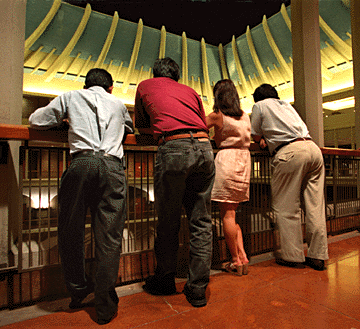
Legislative aides Colin Hayashida, Nathan Higa, Sheri
Sakamoto-Cheung, Bryan Okamura and Ryan Pauline, from left,
enjoy a quiet moment after the House session ended last night.
Nineteen ninety-seven may be remembered as the year lawmakers funded the expansion of Hamilton Library and added a student as a voting 12th member of the University of Hawaii Board of Regents. Higher education
A feared 8 percent cut did not materialize, and instead, the university will continue with the current $272 million operating budget into the next biennium, said Eugene Imai, UH senior vice president for administration.
Moreover, Imai said, lawmakers funded $196 million in construction projects over the next two years, including $36.9 million for the third phase of Hamilton Library; $15.4 million for new facilities at Maui Community College; and $5.6 million to complete the Special Events Arena and athletic support facilities.
"Considering the very difficult times that the Legislature was facing, we received very good support," Imai said.
Rep. David Morihara (D, Puunene-Kula), chairman of the House Higher Education Committee, said lawmakers approved a two-year pilot project for the UH Athletics Department that exempts it from state public proceedings law and allows it to change ticket prices, rental rates or fees without public testimony on the price increases.
"It will give them a little bit more flexibility because they have to act quickly in a lot of instances, especially where there's playoffs and special situations," Morihara said.
Lawmakers delayed until the 1999-2000 fiscal year the implementation of Act 161, which would have returned UH's operating budget to 1995 levels. The $80 million mandated increase would have bankrupted the state, said Rep. K. Mark Takai (D, Waimalu-Newtown), vice chairman of the committee.
Takai, who has been trying to get a voting student regent on the UH board for the past 12 years, said the regent bill allows the governor to appoint a student from any of the UH's 10 campuses to a two-year term.
Also passed this session are measures that:
As the nation watched, state lawmakers again grappled with the emotional and legal complexities of same-sex marriage. Same-sex marriage
This time around, they succeeded in passing legislation that addresses the issue. One thing seems clear, though: While their action advances the debate, disputes — perhaps fierce ones — lie ahead.
The Legislature convened under the gun.
The state in December had failed to prove in Circuit Court that it had a compelling reason to limit marriage to heterosexuals, and the working assumption was the Hawaii Supreme Court on appeal would mandate same-gender marriage, in line with a pivotal 1993 ruling. Voters, in the meantime, were disgruntled over inaction on this and other key issues last session. Underlying the situation was a sense of weariness among participants, who were engaging in the struggle for the fourth year.
The House Judiciary Committee signaled early on a willingness to compromise. It proposed a constitutional amendment to prohibit same-sex marriage, in line with previous stands, but also offered to extend five state marital benefits to nontraditional couples who register as "reciprocal beneficiaries," gays and lesbians included. The panel's liberal Senate counterparts accepted the notion of an amendment, to the dismay of civil libertarians, but countered with a vastly expanded benefits package.
The result, hailed as historic by both sides, was a proposed amendment giving the Legislature authority to ban same-
sex marriage, and a package granting more than 50 rights and benefits to reciprocal beneficiaries. The amendment will go before voters in November 1998.
The benefits package, if signed by Gov. Ben Cayetano, will take effect in July.
But questions and controversies remain. Among them is the cost of the benefits package, which will be open to any two people who cannot legally wed, such as a father and daughter. A two-year audit on the major benefits will be conducted. And many expect Hawaii to become a national battleground as the ratification vote nears.
If it passes, more lawsuits are likely.
The bottom line: Same-sex marriage may be out of the legislative arena, but now it moves on to a wider stage.
"Difficult" is how House Hawaiian Affairs Chairman Ed Case (D, Manoa) describes a legislative session in which the controversy over ceded land revenue overshadowed other Hawaiian issues. Hawaiian affairs
"Terrible" is how trustee Rowena Akana describes the outcome for the Office of Hawaiian Affairs.
The Legislature has agreed to give OHA no more than $15.1 million annually for the next two years while an eight-
member commission studies a way to resolve a ceded land dispute between OHA and the state. OHA estimates its share as $33.9 million.
The ceded land compromise, Case said, will give the Legislature time to fix the much-litigated formula governing OHA's 20 percent share of revenue from ceded lands.
Akana, however, called the session the worst assault on OHA by any Legislature in her six years in office. OHA supporters next year will target its legislative opponents in an attempt to vote them out of office, she warned.
"They just came at us from all sides, and there was somewhere around 160 bills introduced against us," she said. "We had to fight each one."
Hawaiian bills approved this session include ones:
Like an approaching storm, the first raindrops from federal welfare reform started falling in Hawaii while lawmakers were in the midst of trying to shape a balanced budget. To their credit, they didn't turn their backs on the problem. "I guess it could have been a lot worse," said Robert Nakata of the Committee on Welfare Concerns, an advocacy group. In light of the state's financial woes, that's almost a positive statement. Welfare
An example is Gov. Ben Cayetano's initiative for the state to pick up some 3,000 legal immigrants who will lose Supplemental Security Income benefits in August. The state Human Services Department said the Legislature provided full funding in the first year of the biennial budget, but not the second. The hope is that Congress will restore benefits by then. A class-action lawsuit argues denial violates equal protection guarantees.
The same mixed results are seen in the state's general assistance program, which gives benefits to some 7,000 single disabled people. Lawmakers granted almost all of the administration's request for $27 million annually, and agreed not to drop from the rolls about 2,000 recipients due to hit a two-year limit June 30. Because there was no funding increase, though, benefit levels for the entire group will drop.
The outlook remains hazy, meanwhile, for the roughly 25,000 families getting benefits from the Temporary Assistance for Needy Families program, which sets a five-year limit on payments and requires able-bodied adults to find work in two years. In February, under a state plan shaped around a fixed federal block grant, benefits were cut 20 percent. Jobs, though, remain scarce. The Legislature authorized Human Services to use benefits as wages, but did not pass bills which, for instance, would give tax credits to businesses that hire recipients.
Deputy Human Services Director Kate Stanley said the department did "fairly well" this session. But for advocates, rising homelessness and despair remain concerns, if the trend hasn't already begun. Their wish list — which included a minimum wage hike and taxes on the rich — got nowhere.
"The pressures are going to be building up," Nakata said. "It'll be a bigger battle next year."