HAWAIIAN LANGUAGE IMMERSION PROGRAM
By Dennis Oda, Star-Bulletin
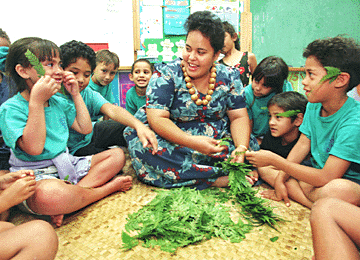
Gina Malia Nobrega, a teacher at Anuenue School,
demonstrates for students how she made a lei
for a hula halau.
‘I am a flower
of this lei’
Both students and teachers
By Mary Adamski
at Anuenue School learn about
‘becoming the Hawaiian inside’ themselves
Star-BulletinIt's part of school days in Hawaii, memorizing a song for the Lei Day program. Students and their school
Unlike many youngsters, the students of Anuenue School don't need help in translating the songs they'll perform. For them, it's another chapter in their Hawaiian language immersion program.
Their confidence in the language vibrated at a recent rehearsal with a loud and clear chant about Palolo and a resounding rendition of the new school song "Lei Anuenue," which fittingly begins "I am a flower of this lei" in Hawaiian.
Lei Day is a major event this year. The entire 213-member student body will perform at Kapiolani Park as part of the city's annual May 1 program.
Principal Lani Kapololu said the faculty and staff decided to go for the big-time stage to join Anuenue teacher Gina Malia Nobrega, who was selected as this year's Lei Day Queen.
But there's more to the immersion program than song and dance. There's math and science and social studies and art, and it's all in a language they're learning as they go along.
Most of the youngsters started in immersion classes as kindergartners, and they can continue through grade 12. The first class to enter the program has now reached 10th grade, so next semester will be the beginning of the first 11th-grade curriculum.
The Class of '99 started with 20 youngsters and is now down to six.
"We lose a lot in the sixth grade," said Kapololu, a time when parents seek intermediate school alternatives. "Because they are pioneers, it has been a big sacrifice for parents to leave them in a new program."
By Ken Sakamoto, Star-Bulletin
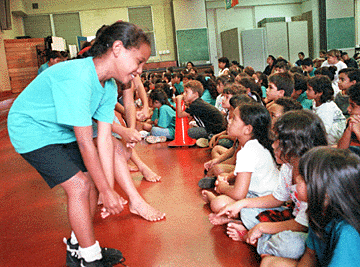
Ka‘iulani Manuwai-Oiph, in the foreground above, and
other Anuenue School students practice the dances they
will perform at the city's Lei Day celebration on Thursday.
No small part of the family sacrifice is the fact that most youngsters are transported by bus from as far away as the Leeward Coast. The program was started at Waiau Elementary School and moved two years ago to the shady Palolo Valley campus now devoted solely to language immersion classes."As the curriculum becomes stronger, the enrollment goes up," said the principal. The program began with the same curriculum as all other schools, just in a different language. There have been growing pains as educators consider how to change the program to reflect the Hawaiian culture, for example, in timing the introduction of subjects or the way academic and practical matters are combined.
English is introduced in the fifth grade, but "we don't discourage reading earlier," she said. Speaking English is no problem, of course, since it's the language at home of virtually all students. But reading and spelling the unpredictable and unruly English language is difficult after years with the consistent pronunciation of the Hawaiian language.
By Ken Sakamoto, Star-Bulletin
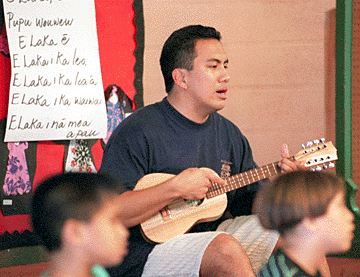
Music teacher Kale Chang provides music for the dance.
Posted behind him are Hawaiian words to a song -- words the
students can understand, not simply memorize.
Are Hawaiian immersion students prepared for the 21st century workplace they face?"We're trying to get that point; we're seeking to provide the skills necessary in life. I still have concerns, not so much in academic abilities but more so in social," said Kapololu, who described the close-knit school as "our Hawaiian immersion bubble." There's no question that there are more varied opportunities at other schools, she said.
"These are normal kids, same as other kids. But because they are so close with each other, they are not so comfortable when we go out." The school is partnered with Roosevelt High School so that its students can participate in team sports, cheerleading, dances and other events.
"It is a big adjustment ... in our culture more so than others. We grow up to be less independent, because the family seems to be stronger."
The Hawaiian cultural values are a boon, too.
"Our teachers discipline more like a mother. We say this is not a part of our culture to tell someone 'you're not going to be my friend.' When we teach the discipline, the morals, why our elders did this, the importance of who you are ... these are the most important things.
"It is in the language that we create the bond and the self esteem. You can become the Hawaiian inside of you," said Kapololu.
But if a student becomes haughty about being the rare person to have the native tongue, "we have to remind them, you're not the only one who knows how to speak. It is not correct to criticize others."
A couple of parents and their youngsters stood chatting outside Anuenue School, and it was the adults who struggled to communicate with the teacher. One teacher's story
The rule on the Palolo campus is to speak the Hawaiian language, which flows fluently off the tongue of Malia Nobrega, a substitute teacher at the Hawaiian immersion school.
Nobrega, 25, is in her own personal immersion program, and the next chapter will be to reign as Lei Day Queen in the city's annual May 1 celebration at Kapiolani Park.
A 1993 University of Hawaii graduate, she earned her professional diploma last semester in secondary education with an emphasis on the Hawaiian language.
She will seek a master's degree in educational technology with the goal of applying 20th century tools to the immersion program, which aims to return youngsters to literacy in the ancient language. "I hope to do my thesis in the Hawaiian language."
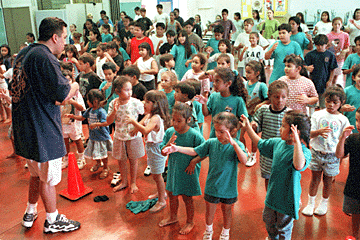
By Ken Sakamoto, Star-Bulletin
Chang helps a class learn hula.
When Nobrega headed for college in 1989, "I knew I was going to be a teacher, I thought it would be a math teacher. I took Japanese language in high school, and I was going to take it at UH, but a counselor said I should try Hawaiian."From the first day of class, I knew it was what I was going to do.
"When I learned the language, it opened up a whole new world for me, everything started to blossom. I have learned a lot about myself."
Nobrega grew up in Hanapepe, Kauai, in an English-speaking household. But the language which has become the rhythm of her life was in her ears as a small child. "My brothers and I had babysitters from Niihau," the only island where Hawaiian has never stopped being the common language.
"Now when I go home, the Niihau families will say 'you're so smart, you speak Hawaiian.'
"Hawaiians should learn their ancestry language. A lot of non-Hawaiians are learning it. It allows you to learn more about the culture and appreciate it. To learn another language brings out something in you."
She was one of the featured actors in a Hawaiian language play, "Kaluaiko'olau," presented last year at the East-West Center Kennedy Theater and elsewhere.
Nobrega taught hula and music for three years in the immersion program but this semester, the subject is more likely to be intermediate school mathematics. Even with seven years study of the language, the teacher said she is struggling to convey "principles like inverse operations, rhombus, parallelograms ... a challenge to translate."
The Lei Day Queen competition requires a speech in Hawaiian which candidates are allowed to memorize or read from notes, options which Nobrega didn't need. "I talked about what lei-making means to me, how my mother taught me to make leis and how I would go out to pick things wild on Kauai," she said.
It wasn't just talk. Lei-making for family, friends and celebrations are part of her life. "My boyfriend and I made palapalai (fern) leis for 23 girls and three chanters for the Merrie Monarch ... for their heads, necks, wrists and ankles. I enjoy going up to the mountains to collect." And she enjoyed the end result, in the audience of the hula competition in Hilo. The leis were worn by Na Hula O Kaohikukapulani, a Kauai halau led by Kapu Kinimaka-Alquiza.
Nobrega has taken hula lessons since age 5 and danced with the halau, traveling to the mainland, Japan and Tahiti. She is now in a class on Hawaiian chant given by John Keola Lake.
"I was just dancing. Now that I know the language, it makes it real. It puts a picture in my head, I know what I'm dancing about."
Lei Day events
"Na Lei Mae'ole" -- never-fading lei -- is the theme of this 70th year of the city's celebration of Lei Day. The Thursday event at Kapiolani Park will feature a musical program from 10 a.m. to 5 p.m. Anyone can compete in the lei-making contest. Entries must be delivered between 7:30-9 a.m. The program at the bandstand is:
10 a.m.: Royal Hawaiian Band concert.