Star-Bulletin
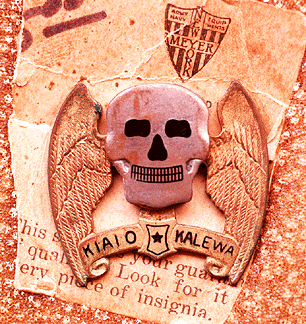
The Hawaiian phrase on this 18th Bomb Group DI translates to
"Guardian of the Sky." At far left is a Vietnam-era "beer can"
insignia of the 14th Infantry, 25th Division.


 ven though Ken Sparks served in the U.S. Cavalry, in the Alamo Scouts in World War II and in three tours in Vietnam, and Charles Aresta served in the postwar Army in tough details such as graves registration, war-criminal jailer and military police, they're both scared of the same thing.
Shellac.
"It yellows, it gets gummy, it damages the insignia," says Aresta. "Shellac ruins it. When we see something with shellac on it, we know someone was trying to make it look nice, but they wound up ruining it."
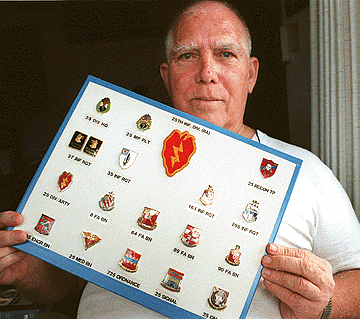
The insignia he's talking about are distinctive. In fact, that's what they're called - "distinctive insignia" or "DIs." These are small metal unit badges the Army allows soldiers to attach to their uniforms. They're generally locally made, in small runs, and are highly prized by militaria buffs because of their scarcity, uniqueness and artistry.
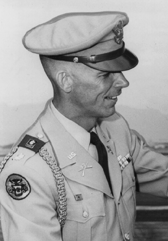
Sparks, originally from Canada, joined the American 7th Cavalry during the last days of horse campaigning in the late '30s.
"I've been in uniforms of one kind or another since I was 8," said Sparks. "From Cub Scouts, to my last tour, which was as a military policeman." He has a special interest in British Empire insignia.
Star-Bulletin
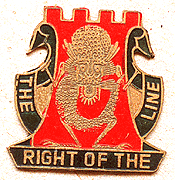
A Vietnam-era "beer can"
insignia of the 14th Infantry, 25th Division.
Aresta also has a personal interest in Hawaii-made distinctive insignia. "I'm Portuguese, and all the engravers who made these things were Portuguese. Real artists. They made the dies with tiny hammers and chisels - what a chore!"
Aresta has gone into the DI-making business himself, and his "Aresta of Hawaii" reproduction insignia are known worldwide. He and Sparks have formed the Hawaii Military Insignia Collectors and Study Group to document the history of these tiny artifacts. (Membership is $12 a year, and includes publications and first chance to buy DIs at cost. Information: 537-2753.)
 By Ken Sakamoto, Star-Bulletin
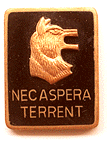
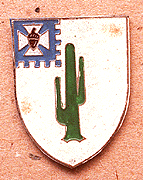
This distinctive insignia is from the
35th Infantry, 25th Division..
The pair are gruff and no-nonsense about their passion. Says one member of their study group, "Charlie and Ken are two really cranky old guys, but they sure know their stuff."
Aresta occasionally disagrees with members of ASMIC, the American Society of Military Insignia Collectors, on the disposition of particular insignia. ASMIC wants proof before study that insignia actually were worn, and Aresta is content with designs that were approved, although it may be hard to tell if the DIs actually were manufactured or not.
The problem is that, although DIs were approved Army wear, their manufacture and distribution were not handled by the Army, and the DIs are by nature a regional phenomenon.
DIs originally were worn on the cap or the epaulette, and today are worn on the right breast pocket to indicate the individual's home unit. "Colin Powell, for example, even when he was in command of the Joint Chiefs, wore the insignia of the 48th Infantry on his pocket, because that was his unit of record," said Aresta.
The pair have flown as far as Danville, Ill., tracking down elusive insignia. Rare insignia can command hundreds of dollars; reproductions can go for as much as $10.
What: The Hawaii Military Insignia Collectors Show