There’s more to Hawaii art than
leaping dolphins, but seeing is believing and
these new artists are showing the way
Second of two parts
By Nadine Kam
Assistant Features Editor
 THERE'S�more to Hawaii's art scene than the abundance of craft galleries, leaping dolphin paintings and seascapes lead the casual observer to believe.
Even the "Artists of Hawaii 1996" show, generally celebrated as a showcase for the best Hawaii has to offer, received criticism for its focus on craft and technique, rather than expression, when it opened last month at the Honolulu Academy of Arts.
Another overview of the work being done here was presented by the University of Hawaii Press' "Artists/Hawaii," a book released last fall, highlighting the work of 22 local artists as selected by their peers. Though eye-opening, the book serves as merely an introduction to the contemporary art scene.
If it has seemed quiet on the art front, independent curator Jeffrey Baysa has a lot of thoughts on the subject. A doctor specializing in preventive and asthma care, Baysa is among people to watch in the art scene. He parlayed his love for the arts into several thought-provoking shows, from "Kayumanggi '93" at the Academy Arts Center at Linekona, to "Naked Truths" last year at the University of Hawaii Art Gallery.
"In order to have a lively art scene you need producers, consumers to support the artists, curators, critics to evaluate the work and digest it for the public, and venues," he said. "It's like a
five-legged stool. In Hawaii's case, we have one very long leg - which is represented by the producers - and four very short legs, which makes it very uneven."
Hawaii is also unique, Baysa said, in that, "There is competition between natural beauty and purchased beauty."
Instead of walls, people tend to have large glass windows that offer outdoor views, a cheaper alternative to art, which is considered a luxury item even in the best of times.
Now, there seems to be less disposable income to go around, and Baysa said, "Most people I know use their disposable income to go out and eat. It's an oral pleasure, and I wish we could switch (the focus) to a visual one."
Yet, not all the artists' woes can be placed with the public. Baysa also said that artists need to develop a greater sense of professionalism.
"They need to be prepared. If I'm interested in an artist, I'll call to see if they have bios and slides available, and they don't."
And although some artists complain that Hawaii's isolation is holding them back, Baysa said, "We live in a global village now. Through e-mail and faxing, Hawaii artists are not at that much of a disadvantage, except for schmoozing at parties."
In pinpointing some of the emerging artists to watch, Tom Klobe, a professor of art at the University of Hawaii at Manoa, said he first looks at works that are intriguing, then studies the artist.
"You have to look at how determined they are. And they have to be independent enough to take a different stand and not follow the norm. That can be very tough."
The traits the following new artists have are persistence and a need for self-expression that is not tied to monetary gain or ego. Here are just a few artists named by Baysa and Klobe (both could name a dozen more). These artists, against all odds, continue to produce and push forward, without relying on trends or bowing to the popular or pedestrian.
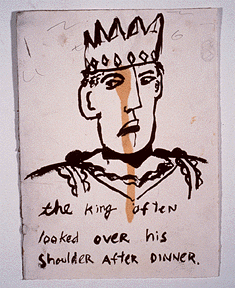
Artist Ian Gillespie prods viewers to question any combination
of text and illustration, uh, newspapers for instance.
Ian Gillespie
In Ian Gillespie's topsy-turvy world, the ordinary becomes weird, wild, wonderful stuff. Take contact lenses, for instance. "They're something you can't see that help you to see," notes the 1990 Iolani graduate.
His observations have led to a series of seemingly simple images, gone humorously astray. He is particularly intrigued by the interplay between objects, symbols and words, and the seemingly arbitrary meaning and importance we assign to them.
"I've taken another look at kid's books, the kind where you see a dog and there's a picture of a dog," Gillespie said. "This is how kids learn. They learn to recognize the meaning of that. But what if you changed the word to 'duck.' I think you'd go through life a little tainted, a little odd, which I think is good, absolutely fabulous."
Gillespie says his mission is not to confuse, although confusion mixed with a sense of wonder are natural responses to his work.
"Some people might laugh, but I want them to ask themselves, 'Why am I laughing? Why do I think this is funny?'
"I want people to rethink what they know, examine another viewpoint. Maybe they've looked at something without really seeing it. Looking and seeing are two different things.
"I want them to question what they read and see."
Gillespie is constantly amazed by the power of advertising - also a potent blend of words and images - to lure consumers.
"I get sucked in just like everybody else. I think ads are great, but I'm always trying to figure out what's going on. Why am I buying Nikes when I don't need Nikes? Who is speaking to me when I'm told to, 'Just do It'?
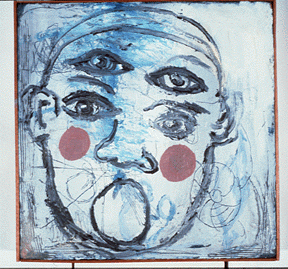
"The Argonaut," by Ian Gillespie, ponders the meaning
of wearing glasses.
Gillespie's work has been shown in a number of "new artists" exhibitions in Chicago, where he earned his B.F.A. degree at The School of the Art Institute.
Since returning to Hawaii in 1995, his work has been included in the juried Recycled Art Show at Honolulu Hale in April 1995; "Artists of Hawaii 1995" at the Honolulu Academy of Arts; "Cargo Cult" at the Flux Gallery in July 1995; and "In Dog Years" at the Flashlight Gallery in November 1995.
This year, his work will be among those shown in a Valentine's Day exhibition at Che Pasta, and he will continue to seek out smaller venues for one-man shows.
Although he loves Hawaii for its nurturing nature, he's already beginning to feel growing pains, saying that in spite of the modern-day miracles of the Internet, e-mail, television and faxes, "As good as all that is, there's something about seeing the stuff that's real. We don't have the 10 or 12 museums for people to go to. Art is just not accessible.
"It's not an ideal situation."
Meanwhile, his studies of paradoxes continues, and in work such as "The King Looked Over His Shoulder After Dinner," he catches the viewer off guard.
"It's a tidbit of a story. It's like a joke, but you're just coming in at the beginning or on the punch line. You're given certain information, but you're not getting all the information, and that's an issue in the art world, in terms of 'I don't know.' "
Bernice Akamine
Years of watching women in the workplace make little progress helped to shape the politically charged works of Bernice Akamine, who has been right there toiling beside her "sisters" in the construction and hotel industries.
Akamine, now a graduate student at UH, first found work as a mason, working with cement and tile as a journeyman tile setter. She now works as part of a hotel maintenance crew, but often gets angry over the plight of hotel maids.
"They work so hard for so little and why? Because they're uneducated? Because they're foreigners so we take advantage of them?
"Feminism and women's rights, those are ideas from the '60s, but those things bother me, and feminist issues keep coming up. There's a lot we still can lose, and yet we've gained so little."
Akamine has shown her work in 1991's Hawaii Craftsmen juried exhibition, "Material Voices"; the Association of Hawaii Artists' 1992 juried exhibition, "Art of Recycling," and numerous college art and undergraduate exhibitions at the UH.
Her work was shown at Queen Emma Gallery's "Showcase '95," and last year she won a 3-D Best of Show award at the juried "College Art" show at AMFAC Exhibition Hall.
At the recent "Graduate Show" at UH, where Akamine is working toward a master's degree in sculpture and glass, she exhibited a piece that addresses women's plight. She constructed a red room measuring 2 by 20 feet and tapering to 20 inches on one side. The room was bathed in red light with shards of glass spread dangerously on the floor.
"It was confining, but I wanted it to feel that way, because women's role in society is confining. If you're not educated, what are you going to end up doing?"
The piece bore a message from the original tale of "Cinderella" by the Brothers Grimm. It reflects the same kind of message - a demand for beauty, sacrifice and submission - that continue to bombard women today. It read: "... Then were the two sisters glad, for they had pretty feet. The oldest went with the shoe in the room and wanted to try it on. And their mother stood by but she could not not get her big toe into it, and the shoe was too small for her.
"Then her mother gave her a knife and said, 'Cut the foot off; when thou art queen thou wilt have no more need to go on foot.' "
Akamine took a circuitous path to art. She had zeroed in on masonry as one of the few well-paying options open to women, but she hadn't expected school to be part of the path toward becoming a mason.
"I had to take things like blueprint reading and other classes related to construction, but I enjoyed it, so I kept going to classes."
She planned to pursue a bachelor's degree in Asian studies, but with space on her schedule for one elective, she signed up for a glass class and never looked back.
"I loved everything about it. I love the heat. That's number one. And glass is so alluring. There's all this color available to you, you can get it to be transparent or opaque. It's really attractive. It really draws you in, and it's hard to get away from that, from making it so pretty."
Ultimately, she said art is about fostering positive change. "We need to educate people about art, and not only visual art, but all art - music, dance, everything. That's what makes cultures so rich. That's what makes your culture. And without that, I don't think we're much of anything.
"You can't expect changes overnight, but you might change someone's attitude or perspective, and by doing that you create change."
If nothing else, art can be the impetus for public debate on issues and through their work, artists have the ability to make their positions known on what they will or will not tolerate.
This semester will be one of change for Akamine. She will be headed to study at the College of Arts and Crafts in Oakland, which in spite of its name, is not a craft school.
Akamine said she was rejected by the school at first, due to its personnel's perception of the UH as a small craft school far, far away.
"We may be in the middle of nowhere, but that doesn't mean we don't think and don't make art. We have the change peoples' perceptions and we can only do that one person at a time."
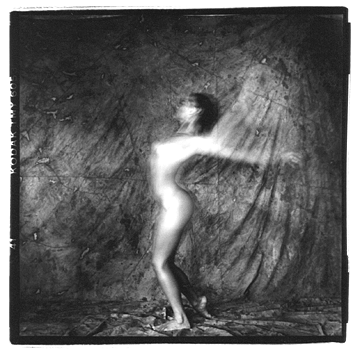
Shown above is one of the as yet untitled works from
Sergio Goes' "States of Bardo" series.
Sergio Goes
More satisfying than the security of a well-paid career in advertising and marketing for Sergio Goes, is his ability to tell a story through photographs.
Born in Sao Paulo, Brazil, in 1964, Goes had worked in advertising at Nestle Chocolate before moving to Los Angeles to study advertising and marketing at UCLA. Even then, however, he knew his heart was elsewhere.
On a vacation in 1988, he fell in love with Hawaii and stayed, working odd jobs, all the while honing his skills as a photographer. His first works encompassed nudes and landscapes. Today he says, "I challenge myself all the time to come up with a unique way to photograph the body. It's a natural evolution that comes from photographing the body over and over and over again."
Recently the photographer reached the point where he can either embrace or disregard technique. Opting to let go of convention, he says, "I'm very happy with that. I think my last photographs have been very free and spontaneous."
This is not to say one must do away with technique, he said. "I devoted several years to being a really good printer. In my work there is still technique and craft, but it is free and goes beyond the effect of making a 'perfect' print. What is that anyway? There is no perfect print."
Goes' new-found freedom is reflected in his ongoing "States of Bardo" - a transformation series with Andrea Torres, a member of the Iona Pear Dance Company. Through motion photography the dancer appears to sprout wings in one photo. Her arms become serpents in another.
Although it appears, at times, as if part of the images are painted onto a backdrop, Goes said all the work is done by camera. The resulting images bear an ethereal, painterly quality.
Spontaneity is also part of his ongoing "Encounters" series, focusing on random street encounters with the homeless, drug addicts or transvestites - often regarded as society's invisible or throwaway people.
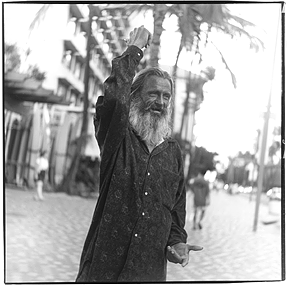
One of the homeless subjects from Goes' "Encounters" series.
"I've often wondered what it is like to be behind that face, to be in that body," Goes said. A camera requires him to capture that spirit, tell the individual's story in a mere fraction of a second. Eleven such portraits were on display at Borders last year.
With landscapes, too, Goes attempts to make viewers look twice at something they take for granted.
"There's a tendency, when looking at landscapes, to disregard it as just another beautiful picture," he said. "But if you go into a space where there's a different kind of light, it gets people to look at it in a new way."
He shows work from a series of minimalist and Zen-like landscapes under a black light. The result is a 3-D quality that opens a window to another dimension.
Goes received the City Art Works Award in the "66th Honolulu Print Makers Annual Exhibition" in 1994. He participated in the "Inclusion/Exclusion" photography exhibition at the Honolulu Academy of Arts in 1995, and "Visions of Angels" last year at Hawaii Theatre Center.
This year Goes' work will be seen in the Image Foundation's August show at the Honolulu Academy of Arts. In addition to finding venues for all his series this year, Goes says he plans to shift toward social documentary photography. He plans to revisit Brazil this summer to focus his lens on Brazil's large population of abandoned children.
With an interest in the idea of transformation, he also wants to document the relationship between religion and mind-altering substances.
"They have some trippy religions there, where they take yahuasca, a psychedelic drug that's a tool to get to an altered consciousness."
It's one of the ways he's dealing with growing pains.
"Hawaii is getting to be a limited space. I'm starting to be divided. I love the place, but I feel I have to move to be challenged and be around a more thriving art scene.
"I think every artist goes through that ... but you tend to create good art in difficult situations. A little suffering keeps the creative juice flowing. If you're too comfortable, you settle down into a little routine, so I welcome the hardships. They keep me going."
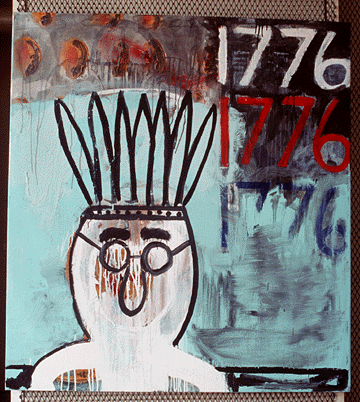
Dan Rudoy commemorated America's Bicentennial
with this work, entitled "Founding Fathers."
Dan Rudoy
Given the choice, most artists with bill-paying jobs would gladly give those up if they could survive on art alone.
Not Dan Rudoy. He is as passionate about the work he does as an automobile mechanic and partner in Island Auto Center as he is about creating art.
"They're both kind of the same thing for me. I love them both. With the cars, it's more of a concise, analytical art, and with actual art, the products are more of an abstract expression.
"I get to use both sides of my brain," he said.
With an assortment of found materials, Rudoy creates three-dimensional assemblages that often call for his analytical and construction expertise. These may feature any combination of mechanical elements - sound, spinning gears and flashing lights - which encourage interaction within the work and between the piece and the viewer.
Recurring themes in Rudoy's work as an "urban anthropologist" include society's rituals and relationships. "I'm very interested in the way we interact with things," he said, "whether it's with other people, objects, philosophies, or the way we perceive the world."
In a show in Peru last year, entitled "Cajas & Pinturas (Boxes and Paintings)," he had a voyeuristic thrill in watching viewers respond to his work.
"It was very entertaining. Some were shocked, some just laughed, some were very intrigued. There was a wide range of response and I didn't expect that. I just wanted people to enjoy it."
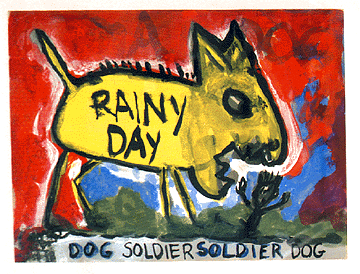
Dan Rudoy went back to basics, revisiting childhood
for a series of works he exhibited in Peru.
In addition to his sculptures, Rudoy employs drawing and painting, recently with very different results. Where his sculptures have the gritty look of urban decay, his paintings, though similar in content, employ childlike bursts of color and energy.
Prior to discovering the child artist within, Rudoy said, "I had become too precise, too retentive," he said. "My drawing became too tight.
"I sensed that somewhere along the line of doing art, I had looked far ahead and kept going ahead," Rudoy said. "It's as if you were building a house, and somewhere along the way you weren't paying attention so you forgot to put in a wall. When you reach the end you find the roof's crooked and in going back, you find the missing wall."
Rudoy said he needed to go back and rediscover drawing with a child's eye and a kind of looseness that stems from a young child's obliviousness to rules of proportion and perspective.
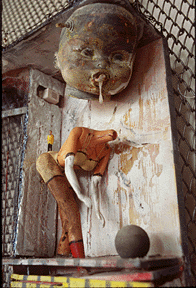
Dan Rudoy's "Let's Play Ball" is a mechanical,
interactive ode to relationships.
Rudoy, who was born in Peru, graduated from Kaiser High School in 1985, and attended college briefly, thinking he would go into food service and open a restaurant. Along the way, he decided this wasn't right for him, and returned to art.
He has shown his work at the juried 1994 Association of Hawaii Artists Show; the juried First Annual Absolute Vodka Show; 1995's Hawaii Art Exposition; and 1995's Flux grand opening; as well as several solo exhibitions, including "tribalism speaks" at the Tri Espresso Cafe and Waimanu Gallery's "pushing hard."
This year his work will be shown at the Che Pasta Valentine's Day show, and he plans to work with Ian Gillespie on a "surprise" end-of-the-year show, all the while exploring people's perceptions.
"If I use a piece of wood to look like a brick, I disguise it and push past the limits of what it is," Rudoy said. "I like the idea of bending, changing boundaries or perceived boundaries."
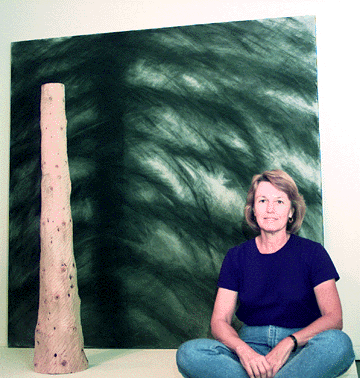
Ken Sakamoto, Star-Bulletin photo
Linda Kane explores interaction of another sort in "Long After the Echo," on view at the Honolulu Academy of Arts.
Linda Kane
Visitors to the "Artists of Hawaii '96" show at the Academy of Arts can't miss Linda Kane's "Long After the Echo, 1995," featuring a wooden sculpture standing in stark contrast to an ebony canvas. The piece was awarded the Alfred Preis Memorial Award in recognition of outstanding achievement in the arts.
Another piece, "Balancing Act, 1996," a wooden talon topped with carbon, beeswax and wheat, also reflects Kane's fascination with installations. "I've always been intrigued by installations. I like big canvasses and I like the way they envelope the viewer."
Although schooled in drawing and painting at the UH Fine Arts Department, where she now works as a lecturer, Kane said, "I ended up doing most of my work in sculpture. I felt a need for something more besides two-
dimensional work and doing installations, where there are things happening on the wall that have a dialogue with an object in front of it. I've made a turn in my career in the last year and a half," she said.
Influenced by a concern for the environment, the raw materials for her work range from aluminum to tree trunks. To enhance her artistic abilities, she took up welding.
Even so, she admits that her direction toward installations isn't very practical in Hawaii, where studio space tends to be cramped and/or expensive. She's resigned herself for the moment to being somewhat of a "bag lady" of the art world.
"I might start a piece in my back yard, then go to the (UH) Foundry, then if I'm working on metal I'll go to the welding lab, then I'll drag all those pieces home again to see how they look in the back yard."
This year, Kane will push to have her works shown on the East and West coasts of the mainland. Locally, look for her works to appear in the International Shoebox Exhibition slated to open at the UH Art Gallery in March; in "Shrines: The Sacred Dimension of Art and Ritual" at Maui's Hui No'eau Art Center in May; and in a group exhibition with some of her classmates from graduate school days.
"We don't get a lot of recognition, but I have a circle of friends and we share ideas and reinforce each other. We critique each other's pieces just to get feedback and keep each other going."
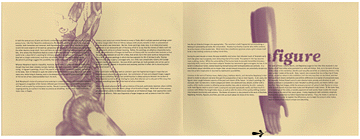
Books open to reveal two pages of equal size, but graphic designer
Michael Yap Cueva "increases" the size of one page and scales down
the other, without changing a book's overall dimension. The arrow
shows where one page of the "Naked Truth" brochure ends,
and the next begins.
Michael Yap Cueva
Consider this piece of type. For most readers, a font is only as important as the sum of its letters, adding up to a recognizable, meaningful word or phrase. But for graphic designer Michael Yap Cueva, each of the letters that make up this sentence is a work of art.
Cueva, who along with partner Kelly Hironaka recently started the graphics house, No. 3, said his interest in graphics dates from childhood, when he discovered books scattered around the house belonging to his father, an amateur calligrapher.
"I was fascinated by it, even though it's something most people take for granted. Designing type, even the simplest thing, is hard. It blows my mind to imagine that someone had to sit down and design this, or some font dating to the 1500s."
Discovering the ancient Alibata script of the Philippines while studying Tagalog at UH fueled his enthusiasm for type, causing him to "explore the geometric possibilities" and create a font based on the Sanskrit-like characters.
Unfamiliar with the language at first, Cueva said he was taken in just by the form of the characters. It's only when understanding is reached that people can begin to understand the symbolism of the characters, and the superstition and status conveyed by them.
The future in graphic design, he said, will be in a more active cerebral -rather than passive visual - approach.
"The more words, pictures, the more languages you know, the more possibilities you can find in terms of expression," he said.
Cueva was born in the Pampanga province of the Philippines in 1971. His father was in the U.S. Navy. His family eventually lived in Guam and California before settling in Hawaii when Cueva was in the 5th grade.
Cueva graduated from Campbell High School in 1989 and went straight to UH, where he intended to pursue a music degree. A saxophone player who until recently played with El Toupe and who still performs Dread Ashanti, Cueva said he took up typography in school and renewed his interest in the arts. He earned a BFA, then studied at the Art Institute of Seattle before returning home.
Out of school for just a year, he's still at the stage of building a portfolio and says he's lucky from an artistic stance in that he's been able to pick his clients - people he knows are open to new ideas and new ways of doing things.
For the "Naked Truth" art show brochure, for instance, he was able to "increase" space and expand photos by splitting facing pages into page-and-a-half and half-page dimensions, rather than the usual full page facing full page.
Blurred imagery and a minimalist approach to language on business cards, fliers and postcard mailings also convey meaning at a glance - saving time for message receivers, usually frazzled, time-starved consumers.
Some of Cueva's work will be on view at Borders in February.
Although commercial work by graphic houses rarely gets gallery exposure, Cueva said the lines between fine art, commercial art and graphics are narrowing.
"I've seen fine artists do design work. But in the end, I think comprehending words makes a big difference.
"It's gonna come down to who can think. Everyone's gonna have the tools, the computer, the weapons. But the person who will be left standing is the one who knows how to use it all."
© 1997 Honolulu Star-Bulletin
http://starbulletin.com