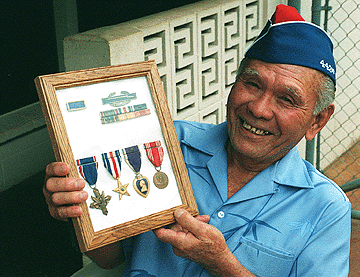
By Craig T. Kojima, Star-Bulletin
Richard Yoshimi Fujiwara, one of six being inducted into
Fort DeRussy's Gallery of Heroes, displays
his World War II medals.
Fujiwara returned to the islands after fighting in Europe with the 442nd Regimental Combat Team, made up mainly of Japanese Americans. He had won two of the nation's highest medals for valor: the Distinguished Service Cross and the Silver Star.
Today, Fujiwara, now 73, will be inducted into Fort DeRussy's Gallery of Heroes, along with another nisei hero, Private 1st Class Thomas Yamanaga, a member of the 100th Battalion who was killed in battle, and four other Distinguished Service Cross awardees from World War II, Korean War and Vietnam.
They will become part of an exhibit that now features six local Medal of Honor recipients and 25 other Distinguished Service Cross honorees at the Hawaii Army Museum. The gallery was established in 1988.
Fujiwara this week recalled that he was only 23, living in Wahiawa and working as a carpenter, when Pearl Harbor was attacked by Japanese war planes Dec. 7, 1941. When the call came for volunteers, he said, his father questioned him at dinner.
"Did you volunteer?" he asked me. "I told him not yet. The next day when I came home for work he asked me the same question. I told him the same thing.
"The next night he asked me the same question and then told me, this is your country even though you are Japanese xxx I felt then that I should volunteer as a way to prove my loyalty.
"To protect our democracy someone has to fight," Fujiwara said.
On Oct. 14, 1944, Fujiwara, then a staff sergeant, won the DSC, one of 10 awarded to nisei soldiers in that campaign for preventing German tanks from breaking through company lines. As a squad leader with G Company, Fujiwara had climbed a small hill outside the German-occupied town of Bruyeres to stop the advance of two tanks. Running defiantly into intense machine-gun fire, Fujiwara disabled one of the German tanks using a bazooka, forcing the second one to withdraw.
A month later, he won the Silver Star fighting in the Vosges Mountain region. Fujiwara, wounded in the neck, led his platoon against several German-held strong points near La Houssiere and forced several German machine gun crews to surrender.
The Army, at the urging of Hawaii Sen. Daniel Akaka, is doing a 24-month study to determine whether racial discrimination prevented any of these nisei veterans from receiving the Medal of Honor.
Fifty-three Japanese Americans were awarded the Distinguished Service Cross, which is the nation's second-highest medal for valor.
In honoring the six inductees today, Lt. Gen. William Steele, Army Pacific Forces commander, said the soldiers exemplify "the Army's core values", the ones demonstrated at Valley Forge and Yorktown during the Revolutionary War where "our army fought so that a free nation could be born."
The bravery of five others is also being saluted today
By the Star-Bulletin Staff
In addition to Staff Sgt. Richard Fujiwara, five others will be inducted into the Fort DeRussy Gallery of Heroes today:
Sgt. Kenneth Andrade
Company A, 3rd Battalion, 4th Infantry Division On Feb. 27, 1968, near Dak To in South Vietnam, Andrade's platoon was under heavy attack by North Vietnamese soldiers. While helping move a wounded soldier to the ambulance helicopter landing zone, an enemy grenade landed near him. Andrade picked up the grenade and threw it at several enemy soldiers. He then picked up the wounded soldier and carried him to the helicopter under a hail of enemy gun fire. As he returned to the fight, he was killed by a North Vietnamese grenade.
Lt. Gen. Edgar Doleman
On Sept. 22, 1943, Doleman, then a lieutenant colonel, was wounded while leading an attack on enemy fortifications at Acerno, Italy. He refused medical attention after being hit by a mortar round and prepared for a counterattack. Rallying his forces, he helped destroy an enemy machine-gun position and led the assault that captured an enemy strategic strong point.
Sgt. Robert Kobashigawa
On Oct. 3, 1951, Kobashigawa was on a hill near Chorwon in Korea, under attack by Communist troops that greatly outnumbered the American force. As he directed the fire of automatic weapons, Kobashigawa also kept the enemy at bay by throwing hand grenades. When the machine gunner next to him was killed, he manned the automatic weapon and resumed firing at the enemy. Facing heavy casualties, the Communist troops finally withdrew. But Kobashigawa kept firing until he collapsed and died from his wounds.
Gen. Frederick Weyand
25th Infantry Division On two separate occasions, Weyand was commended for his actions while serving as commander of the 25th Division in South Vietnam. On Jan. 8, 1967, Weyand accompanied the first helicopters that went to the aid of company soldiers who were pinned down and surrounded by Viet Cong. On arrival, he organized the evacuation of the dead and wounded soldiers and walked around the treacherous perimeter of the battlefield comforting the casualties and encouraging the remaining defenders.
On Feb. 3, 1967, Weyand organized the search for two vehicles and 10 men who had accidentally strayed into Viet Cong terrain. He spotted the vehicles moving deeper into enemy territory and, despite the threat of mines and enemy soldiers, ordered his pilot to land the helicopter, then led a successful retreat.
Pvt. 1st Class Thomas Yamanaga
Company A, 100th Battalion On Oct. 20, 1943, the 100th Battalion was leading the 34th Division along the foothills near San Angelo d'Alife, Italy. From Hill 529, the Germans had excellent coverage of the valley and pinned down Yamanaga's company. During the night of heavy firing, Yamanaga covered his squad's withdrawal with his automatic rifle. Yamanaga, mortally wounded, won the battalion's second DSC.