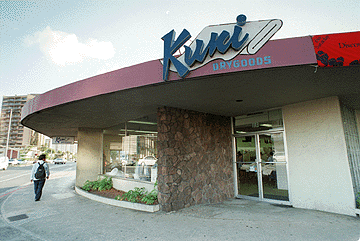
Kuni's Dry Goods on the corner of King and University prepares for
Saturday's Discover Moiliili Festival.
Photo by Dennis Oda, Star-Bulletin
Kuni's Dry Goods on the corner of King and University prepares for
Saturday's Discover Moiliili Festival.
Photo by Dennis Oda, Star-Bulletin
 Come to think of it, there was little of what today makes up the Moiliili commercial district, recalled Harry Kunimune, whose father started the fabrics shop in 1948.
Not only has the physical character changed, so, too, have the faces. When Kunimune went door to door soliciting participation in Saturday's Discover Moiliili Festival, there was hardly a soul he recognized among the businesses.
Moiliili is a transitory, less-familiar community these days, he said, not like the early years, when it was dominated by a close-knit ethnic group - the Japanese - in its homes and shops.
A group of people with strong ties to Moiliili hopes to re-ignite "the community spirit" and revitalize small businesses through Saturday's daylong celebration.
It started in January, when Muriel Miura-Kamenaka was going through the clothing racks at Nui-Mono, a tiny mother-daughter shop in Moiliili. She began musing about the old days.
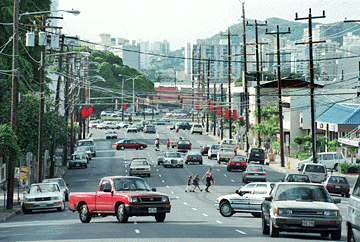
Storefronts line King Street, along with bridge red flags that announce Saturday's Discover Moiliili Festival.
Photo by Dennis Oda, Star-Bulletin
Fortuitously, Rebecca Ryan, executive director of Moiliili Community Center, overheard her. "She said that was a great idea," said Miura-Kamenaka, a retired home economist for Honolulu Gas Co.
It's a measure of the kind of place that Moiliili is that in just a few months, 20 volunteers were able to put together the ambitious celebration. (See schedule, [Features] online.)
Through Kunimune's family, you can trace much of the more recent history of Moiliili's shopping district.
Kunimune's father, Kosajiro, left Japan to work in Hawaii's sugar fields. He went on to open a restaurant in Iwilei, where Harry was born in 1930, then took over a store at the corner of Kahuna Lane and South King Street, selling dry goods and groceries.
The family, eventually grown to three girls and four boys, lived behind Moiliili Store. "Business and family life were wrapped all in one," Harry, 66, said. His mother died when he was a child and his father never remarried.
Kunimune remembers when trolley cars tooled along King Street. On his side of the street there were small markets selling meat, fish or produce. There was a tofu factory, a bakery, a pharmacy, an okazuya and a playground.
"Directly across Moiliili Store was an okazuya, a teahouse, a service station and, where Kamoiliili Center is now, a vineyard," Kunimune reminisced. "There was Kanda store, flower shops, a barber shop, a shoe repair shop. Near where 7-Eleven is today, they used to have sumo tournaments."
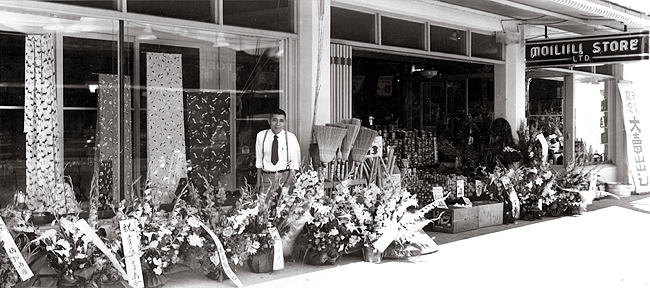
Floral congratulations grace the front of Moiliili Store after
Kosajiro Kunimune held a grand reopening in the late 1930s.
Kunimune family photo
Kosajiro died in 1969 at age 84. Way before then, he had seen the potential of creating a separate dry goods store in the same neighborhood. While his older sons, Makoto and Frank, ran Moiliili Store, his two youngest, Harry and Tom, eventually were given reins of the new venture.
When Moiliili Store's lease expired in 1991, the older brothers decided to retire. Kokua Market, a natural foods cooperative that started 25 years ago at the ewa end of Moiliili, now occupies the space.
Kuni remains, but it hasn't been without a struggle. At its peak, the store had seven outlets - five of them concessions in the now defunct GEM stores. Kuni rose and fell with GEM's fortunes.
"Sewing was a big thing, especially among the Japanese population," Kunimune said of the heydays. "Christmas used to be a busy time because people bought fabric as gifts. Then there was change in lifestyles ... People didn't have time to sew ...
"In 1991, '92, those were still good years," he said. "Then I guess the bubble began to burst." In the past year, the Kamehameha Shopping Center, Pearlridge and Kaneohe stores closed.
Kuni's is back to one. "It means getting used to being small again," Kunimune said.
It also means adjusting to a different market, offering more craft items and classes.
"We try to keep a focus on fabrics, on what they call wearable arts," Kunimune said. "We have re-emphasized our craft and sewing classes and that has kept us going. Most people who get into sewing these days get into sewing crafts, not just dresses."
A big draw is "make-and-take kits," which customers can purchase, then put together in free classes offered by the store.
For now, the Kunimunes have no thoughts of retiring. There is no third generation waiting to take over and "I don't advise them going into it anyway," Kunimune said.
Of the future, he said simply, "I think the future is left in God's hands."