But for the Estate of Samuel Mills Damon, those 235 acres of leasehold land are a financial workhorse for the real estate and banking empire that Forbes magazine described as one of the richest family fortunes in the country.
Publicity shy and risk averse, this $800 million family trust in many <P>ways embodies the unassuming characteristic of its Oahu land holdings.
Unlike its high-profile counterparts such as Bishop Estate and the Estate of James Campbell, this big landowner shuns the often-
speculative land development business, opting instead to live off rents from its land and dividends from its stock holdings.
"It must be like clipping coupons," said Desmond Byrne, a longtime watcher of Hawaii's big land trusts and chairman of Common Cause Hawaii. "They're just collecting rent."
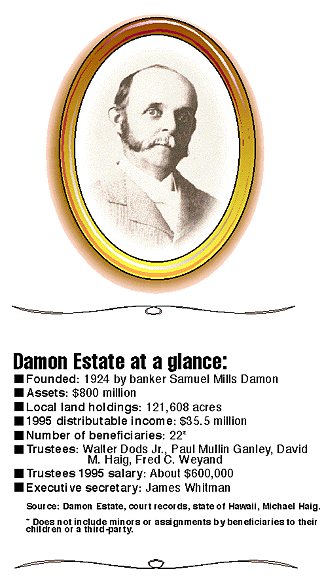
And they've collected a lot of rent lately. Last year, the trust's distributable income was $35.5 million, up about 1.2 percent from <P>the previous year's $35.071 million, according to Michael Haig, a member of the Damon family.
Distributable income is the amount of money disbursed to Damon beneficiaries.
The estate declined comment, saying that as a private trust it is not required to disclose its finances. But a representative for the trust did verify some of the data uncovered by the Star-Bulletin.
The estate's healthy bottom line has meant hefty commissions for its trustees. Last year, each Damon trustee - First Hawaiian Chairman and Chief Executive Officer Walter Dods, local attorney Paul Mullin Ganley, businessman David Haig and former First Hawaiian executive Fred Weyand - received slightly more than $600,000, according to a source involved in the trust.
Bishop Estate paid its trustees $938,000 last year, while Campbell Estate trustees earned $840,000.
For Dods, the trustee commission are in addition to the $1.35 million he received last year at First Hawaiian.
"Being a trustee must be a cruise," Byrne said.
Much of the trust's income comes from the lease rent it re<P>ceives from the 121,600 acres of land the estate owns in Hawaii.
Mike Sklarz, research director at The Prudential Locations Inc. real estate brokerage, said based on government tax records, the estate's lands in Hawaii alone are worth $472 million.
The estate also receives substantial income from its 8 million shares, or 25.7 percent, of First Hawaiian, the state's oldest and second-largest financial institution. Last year, Damon earned more than $9.4 million in dividends from its First Hawaiian holdings, which are valued at about $240 million.
For one Damon family member, Dods' dual role as trustee and First Hawaiian's boss, as well as the trust's management of its First Hawaiian shares, have been sore spots.
Michael Haig, 48, has complained that trustees haven't done enough to maximize the estate's investment in the bank.
In an Aug. 30 letter to trustees, Haig, who is entitled to a 1/32nd share of the estate when it is terminated, said trustees should "make a reasonable effort" to pur<P>sue a takeover or merger of First Hawaiian by a third party.
Haig has urged Dods to resign as a Damon trustee or to resign from First Hawaiian, citing a conflict of interest.
"On one hand he has a fiduciary duty to the trust to make a reasonable effort to bring about a sale or merger of the bank prior to or upon the termination of the trust," Haig said. "On the other hand he has a duty to the stockholders."
Dods defended himself, saying that his actions as chief executive of First Hawaiian show he is maximizing shareholder value. He also said he would never do anything that would harm the interests of the trust or the bank.
A July 1995 report by the trust's court-appointed master, attorney Leighton Wong, said Hawaii's estate law allows Damon trustees to serve on First Hawaiian's board. Wong also noted that in the past, several First Hawaiian executives have served as Damon trustees and that the current trustees "have done a diligent job" of managing the trust's assets.
The Haigs argued that the Damon Estate should end with the <P>death of Samuel Damon's last grandchild, which the trust estimated could occur in about 14 years. Three grandchildren are still alive: Joan Haig, Harriet Damon Baldwin of Maui and Francis Damon Holt of Oahu.
Others heirs, however, said the breakup should occur 21 years after the death of the last grandchild. That would have extended the termination date to about the year 2031. The trustees were neutral on the dispute.
In 1992, Circuit Judge Patrick Yim ruled that the trust would end 21 years after the death of the last grandchild, but that decision was reversed two years later by the state Supreme Court.
Haig said he opposed the later termination date because it went against the intent of his great-grandfather's will. The later termination date also would deprive younger heirs such as him of the use of the trust's assets during the prime of their lives, he said.
Haig said he now favors a termination plan in which the assets of the estate are converted into a publicly traded real estate investment trust, or REIT. That way, shares of Damon Estate would be sold on an open market, just like other securities. Investors, in turn, would be entitled to receive 95 percent of any income earned by the trust.
A REIT would allow beneficiaries to sell shares or borrow against their shares, Haig said.
A source within the Damon Estate said the board is examining several options, including a REIT.
"They have a duty to convey the transfer of the assets of the trust to the (heirs) as efficiently as possible and in such a way that creates a maximum value," Haig said.