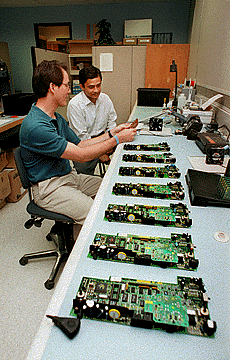
Engineering technician Ron Ho, left, works on a prototype of a transaction terminal, or smart phone, yesterday at VeriFone's facility at Mililani Technology Park as Ramanathan R, from VeriFone's operations in Bangalore, India, watches. Photo by Dennis Oda, Star-Bulletin
VeriFone's leader
urges state to nurture
high-tech business
By Russ Lynch
Star-Bulletin
VeriFone Inc.'s transition from a Honolulu business that made no money in its first six years to a global business showing a profit every quarter since 1987 proves that Hawaii can develop and nurture high-tech businesses, says the company's leader.
VeriFone, founded in 1981 by East-West Center scholar William Melton, was an early leader in the development, manufacturing and marketing of electronic credit approval machines and software.
In the late 1980s, it was the first tenant in Castle & Cooke Inc.'s Mililani Technology Park, where it still has a research and development staff of 90. The company also maintains a nine-person testing staff at Laupahoehoe on the Big Island.

Hatim Tyabji
Now, VeriFone also is an international company with 3,000 employees in 30 countries, businesses in 100 countries and nearly half a billion dollars in annual revenues.
Hawaii can create that kind of success, said Hatim Tyabji, VeriFone's chairman and chief executive, at the first seminar of the recently formed Hawaii Technology Council on Monday.
Because the company is so heavily into international electronic communications it really has no single base although it has been headquartered since the late 1980s in Redwood City, Calif., Tyabji said.
Geography and time differences mean nothing to a truly worldwide electronic company, he said.
"The fundamental ethos in the company is that there is no paper in the company," he said. All communications are electronic. "That means you are time-insensitive, distance-insensitive and geographic insensitive. We are not centralized and we will never be centralized," he said.
"If you are going to allow yourself to be shackled by geography you are going to fail," said Tyabji, who joined VeriFone in 1986 when it was still purely a Hawaii company. Soon afterward, VeriFone moved its base to California but Tyabji said he still considers Hawaii to be its home and looks on its shares, issued when the company went public in 1990, as a Hawaii issue.
The state however, wasn't much help when VeriFone considered establishing a manufacturing plant here around 1990, he said. Tyabji said he went to the Waihee administration to see what kind of help might be available for a start-up manufacturing operation and got words of welcome but nothing else.
Tennessee offered a five-year tax holiday and other incentives. The Dakotas offered something similar and there were plenty of incentives to establish businesses in other places but Hawaii declined to offer any specific help, he said.
In the end it didn't matter. VeriFone's international growth led it to set up a facility near Shanghai, China, in addition to its basic manufacturing plants in Taiwan and Southern California.
What Hawaii can do, he said, is concentrate education and the development of resources in technology to bring in clean businesses that pay well and provide rewarding international jobs.
In such a business, Hawaii's high labor costs don't mean much, Tyabji said. At VeriFone, labor equals about 6 percent of its costs. It's the other 94 percent of the business that makes the real impact and Hawaii could help such a business with a number of incentives that aren't related to labor, he said.
VeriFone's basic business remains credit-card readers and the systems that support them but it is also the only company to get big-bank support for its plans to approve credit transactions on the Internet and recently signed working agreements with Netscape Communications Corp. and Oracle Corp., Internet service and equipment suppliers.
The way to get that sort of business, Tyabji said, is to stay ahead of others. "If you have a year to make a decision and you don't make it in three months you will go out of business," he said.
Monday's seminar was the first for the Hawaii Technology Council, a state-private sector outgrowth of the nonprofit Economic Development Corporation of Honolulu.