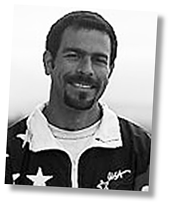
 Harbold's sights have always been high, ever since he was 3-years-old and convinced that his shoulder blades would eventually turn into wings. The Icarus wannabe had to change his flight plan, but not his dream.
For the past 20 years, Harbold's flying has come on the water. Whether it was outrigger canoes, surfskis, sailboats, surfboards or, now kayaks, his plan of getting from one point to the other has been simple: be fast, be first.
This time around, in Atlanta, Harbold will go at it alone in the K-1. It's a big change from the fours he competed in at the 1988 Seoul Olympics and the doubles of Barcelona in 1992, when he placed eighth with teammate Peter Newton of Hawaii.
The change has been good, very good. For him and the U.S. team.
Last August, Harbold qualified the first U.S. boat for the Olympics in the K-1 when he finished seventh in the 1000-meter K-1 at the ICF World Sprint Championships in Duisburg, Germany.
Not bad for someone who considers himself the weakest paddler on the U.S. men's team. His technique, however, has lifted him into the world's elite, giving him a realistic shot at becoming only the second American to win a gold medal in the K-1. (Greg Barton was the first in 1988).
"Who knows what will happen," said the Academy of the Pacific graduate. "The best thing is for me to go race and see what happens. It's been a natural progression to the singles from the doubles ('92) and the fours ('88).
"I like the idea of paddling with other people, being in with a team for the common goal. That's how I grew up, paddling outrigger canoes. With kayaking, though, your partners don't always have the same attitude toward racing and you don't want to depend on them or put your values on them. It's important for me to race in singles to test myself."
The late Kala Kukea, who coached Harbold at Hui Nalu Canoe Club and Hawaii Canoe/Kayak Team, once said: "What is surprising about Mike is that he doesn't test out in the physical testing. But get him on the water and something happens. The water gets him where he wants to go."
It has taken Harbold around the world for competition. It led to his marriage in 1991 to the former Alexandra Bernhart, who is also a member of the U.S. team and slated to paddle in the K-4 with Dru van Hengel, who trained briefly with the HCKT before returning to her native New York.
The couple was the first to live together at the USOC ARCO Training Center in Chula Vista, Calif., south of San Diego. The coed K-2, though not an Olympic event, warranted an article in this week's issue of Sports Illustrated.
"There are some people who say it's never going to work because, to be a top athlete, you have to be really selfish," said Alexandra Harbold. "But here we are."
They train together, helping each other, pushing each other. He is responsible for repairing the equipment; she controls the alarm clock and provides the push to get up for their predawn workouts.
"Nonny nonny booboo," said Mike Harbold with his 'we-showed-them" attitude. "It's such a unique situation, not your mellow 9-5 job where there's not a whole lot of stress. It's not like we can change jobs. We're completely absorbed in what we're doing.
"There was a good chance I wouldn't make the team or that she wouldn't make the team. It could have been a 'Now what do we do?' We've been together practically 24 hours a day since we've been married (Dec. 1991).
"There's a tremendous amount of risk in what we do. It's very stressful. There's always a chance that one of us could completely fail and the other is going to go on to, perhaps, greatness. How do you deal with a thought like that? Those are the things we understand about the sport, things we understand about ourselves and we both deal with them the best we can."
"We focus on the positive and train the best, so we can be on the team together.
Harbold calls his wife the "toughest competitor" he'll ever have." He'll put weights in his boat, to slow down to her level, while training side-by-side.
"I'll be thinking, 'She'll back off, she's going to slow down now,' " he said. "But she doesn't."
To put it into outrigger canoe training terms, it's like pulling a tire. And the tire talks back.
The Harbolds aren't sure if they'll try to stay with the U.S. team through another Olympics. Mike has a job offer in Florida and he recently took his written test for a private pilot's license.
"Flying will have to take a back seat until the paddling has run its course," said Harbold. "It may be this year. I'll go until I think I've reached my potential. Alexandra and I have both talked about what will happen after. If they ever get the (Olympic) training center in Hawaii, I know two qualified coaches who would want the jobs.
"But, right now, to think about anything but paddling is wasted focus."
Harbold said he'll be very happy to medal. His goal is to make the finals, improving on his eighth-place finish from '92.