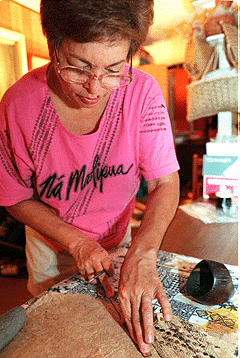
Moana Eisele presses 'ohe kapala to kapa.
Photos by Kathryn Bender, Star-Bulletin
Moana Eisele presses 'ohe kapala to kapa.
Photos by Kathryn Bender, Star-Bulletin
"You also must look at negative design and what that creates," 'ohe kapala instructor Moana McPherson Eisele said. "Often people only see one dimension, and there's more than that.
"How the space in, of and around the designs was used is important, because all or part of the design is not just the raised areas or hard design. You have to look at it a little differently."
Eisele teaches a two-part class on 'ohe kapala (bamboo stamp) the next two Saturdays. She's been studying the intricate art form since 1978 and teaching it since 1984.
The class introduces Hawaiian kapa making and students receive two 'ohe kapala blanks, or bamboo pieces. Students sand and carve the blanks with an Exacto knife, learn about Hawaiian natural dyes, then print their designs on Fijian tapa.
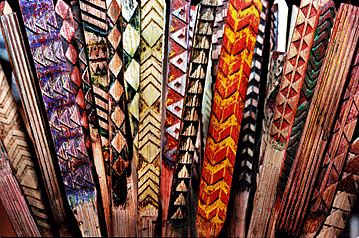
Intricate designs are carved on bamboo. The small size of the stamps makes printing time-intensive.
"It's most expensive in the time," Eisele said.
Also, taking a sharp-edged instrument to carve a design on bamboo is simple, "but most people don't understand what's in a design nor how to use it," she said.
Most designs are tiny and intricate - usually 1/2-by-2 inches each - and feature diamond, square, parallelogram and triangle forms, she explained.
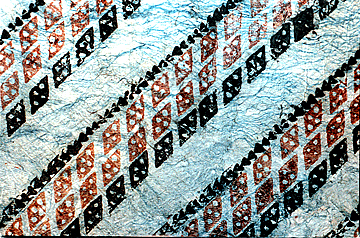
"But it is the way you place it and the negative space that is created that are also part of the design. That's what is so fascinating to me, to see that (negative space) in the mind's eye. A lot of times, the stamp looks like one thing, but after it's gone through a series of placements, you sometimes can't tell what the original stamp looked like."
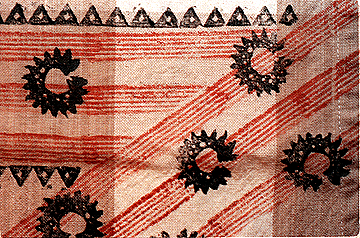
Also, Big Islander Ed Glendon and his Kapu 'Euhi firm sell rubber-tipped 'ohe kapala at Native Books & Beautiful Things downtown and Cook's Discoveries in Waimea, Big Island. The modern takeoffs come in 38 designs and sell for about $15 each.
"We have done research and most of these designs evolved post-Captain Cook - with no kauna (hidden meaning) and no deep family significance. We're careful to select strictly artistic designs," said Glendon, who said he branched into petroglyph designs and pure-rubber tips two weeks ago.
Order a four-page catalog of designs by contacting him at P.O. Box 858, Mountain View, Hawaii 96771; phone/fax 968-8366.
What: 'Ohe kapala class
When: 9 a.m. to 11 a.m. Saturday and July 20
Where: Temari Center for Asian & Pacific Arts, Kaimuki
Cost: $30, plus $10 materials fee
Call: 956-8400