
But the issue of gender equity in high school sports flickered almost unnoticed on the back burner a few weeks ago when the ADs met again on Kauai.
Issues like league expansion and the elimination of state tournament consolation games drew more debate.
So, what has happened to the gender equity cause on the high school level? How many inroads has it made here since Title IX advocates threatened a lawsuit to try to force the Hawaii High School Athletic Association into full compliance with the law?
If you ask Jill Nunokawa, the vocal president of the Gender Equity Sports Club, the HHSAA remains in clear violation of the law.
"The most positive thing they did this year was to put the girls' state basketball tournament in a facility (the Special Events Arena) the girls deserve," said Nunokawa, a state public defender.
"But that was a fluke because the Hilo Civic Center had a scheduling conflict. It took 20 years for the girls to get to a place like that. And now the HHSAA is taking two steps backward."
Nunokawa is angry that the girls' state tournament will be held in Hilo next year while the boys will continue to play at the spacious Blaisdell Center.
She said that is in clear violation of Title IX's requirement that male and female athletes have access to comparable facilities for competition.
"But we got killed (financially) at the Special Events Arena," said HHSAA president Al Nagasako. "The cost of playing there was very high."
Tournament director Bill Villa, athletic director at Assets School, said the rental fee for the arena was waived. But other costs, including air conditioning and security, still made it an unusually expensive experience for the HHSAA.
Clay Benham, executive secretary for the Interscholastic League of Honolulu, said economics is an overriding factor.
"If the HHSAA loses money, we are not doing what we should to benefit all girls and boys," he said. "I would be against it (holding the state tournament in the Blaisdell) for the boys, too if I thought we'd lose money.
"Title IX was not established with enough research into different parts of the country."
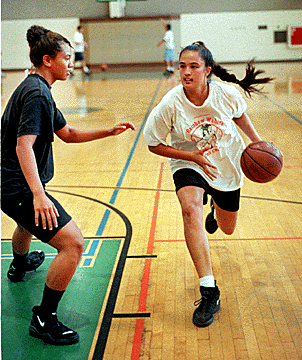
Campbell's Summer Aona drives against Iolani's Karyn Fitisemanu during practice for Saturday's girls basketball jamboree at Iolani. Photo by Dennis Oda, Star-Bulletin
Nunokawa doesn't accept the financial argument put forth for placing the girls in a smaller state basketball tournament facility.
"It's a shame they (HHSAA) turn their backs on what's happening at the University of Hawaii, where athletic officials are making a big effort to comply with Title IX," she said. "Affirmative action and gender equity are nonexistent in Hawaii high school athletics. The day will come when a lawsuit is filed."
Benham insists that his league "has never deviated from the philosophy of doing what we can" for gender equity.
But Nunokawa said she has more faith in the OIA leadership of Nagasako and his executive secretary, Ted Fukushima. She said they've displayed an increasing commitment to balancing the playing field for girls and boys.
"I think the OIA has shown a lot of vision with regard to gender equity," she said.
Fukushima pointed out that his league worked out a television deal for both boys' and girls' volleyball from the Blaisdell last season. But he complained that lack of funding for athletics in public high schools remains a major obstacle to full implementation of Title IX here.
Nagasako said the HHSAA did take a few steps this year toward greater gender equity with the establishment of separate sports seasons for next school year. No longer will the end of one season overlap the start of another. That, according to Nagasako, will give girls more opportunities to play more than one sport.
He also said that a new rule requiring that all state volleyball matches be played at center court will result in the girls' and boys' tournaments being played on different weeks.
But UH assistant athletic director Marilyn Moniz-Kaho'ohanohano, who argued strongly for girls' sports rights at the 1995 HIADA conference, said this year's achievements are a poor excuse for gender equity progress.
"The HHSAA hasn't even done a self-analysis, as required by Title IX," said Moniz-Kaho'ohanohano. She said self-analysis is a basic requirement for compliance with the law.
A gender equity committee was formed by the HIADA conference last year to study such subjects as the possibility of aligning the girls' basketball season, now in the spring, with the boys' winter season. Gender equity advocates argue that the girls suffer in recruiting because most girls' leagues in the country play in the winter.
But the HHSAA committee has not recommended combining the seasons. Athletic officials cite inadequate facilities to accommodate two programs.
"The present arrangement gives our girls 180 hours of court time and the boys 180 hours of court time," said incoming HHSAA executive director Dwight Toyama, athletic director of Kaimuki High. "Combine the seasons and they'll have to split court time. That's going backward." Toyama said students and coaches alike favor the separate basketball seasons.
Some have suggested that the state softball tournament needs a better venue than Roosevelt High. The baseball tournament has been held at either Rainbow Stadium or Aloha Stadium.
Toyama said he'll consider moving it to the new UH Wahine facility once that is built. But for now, he said Roosevelt is the only softball site where admission can be charged. Nunokawa said she still considers equal sites for competition an important gender equity issue and she doesn't plan to give up on it.
"People said the Berlin Wall wouldn't fall," she said. "Well, the gender bias wall will also fall."