
 RAINSong Guitars' current advertisement shows Keli'i Reichel strumming one of its creations in the midst of a tropical jungle downpour. The image slides right past those who don't play, but the soaking instrument gives guitarists the willies.
And for good reason. A guitar is a delicate marriage of art, craftsmanship and technology, shaving seasoned woods as thin as possible so they'll resonate, and then placing the components under an intolerable strain by stringing it with nylon or steel cables and torquing them until they twang.
 A shift in the weather, a movement across locations, a nudge when setting it down, an imperceptible slip in the cosmos, and traditional guitars fall out of tune, crack, shatter, develop curvature of the neck. For such a hard-working tool, guitars have to be babied.
Physicist John Decker was attending an outdoor wedding on Maui a decade ago when a sudden downpour dampened the hired guitarist. An amateur classical guitarist himself, he sympathized with the musician's dilemma - run for cover, save his guitar and risk the wrath of the bridal party, or keeping playing and buy a replacement guitar in the morning?
 If the inspiration that struck at that moment had a sound, it was probably a solidly strummed E-chord. Decker, with a background in aeronautical engineering, plasma physics and composite materials technology, realized that advances in such materials in the last decade could, and should, provide a reasonable replacement for the traditional wood guitar.
He formed Kuau Technology on Maui, and began researching the problem. Seeing an article in a guitar magazine about master luthiers Pimentel and Sons, an Albuquerque, N.M.,-based classical-guitar shop, Decker enlisted their professional expertise. On the advice of Maui windsurfers, Decker also sought out composite-materials master George Clayton of BI-MAR International in California.
"The Pimentels are phenomenal," Decker said. "They can rap on a piece of wood and tell whether it has acoustic potential."
Decker soon discovered that it's the fine woods themselves that carried the sound, otherwise guitars would have been made of waterproof materials long ago. The trick was coming up with a composite material that had the acoustic properties of wood but the strength of aeronautical composites.
 This isn't a simple matter. Guitarists fiercely debate the merits of ash- vs. maple-wood necks, the subtle resonances of Brazilian rosewoods, the meaty thump of flame maple. The new guitar would have to sound as good as a traditional wooden model, or it was no dice. "That's the reason you don't see plywood guitars," Decker said.
Brazilian rosewood is now an endangered species, and it's illegal to trade it internationally. Until some bright agri-business wonks start growing it in Hawaii, it'll be hard to come by.
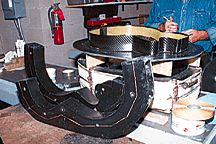
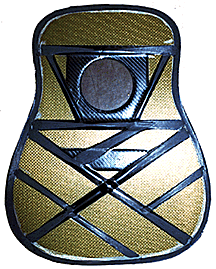
The team wound up with a sounding body made of graphite/epoxy with a tightly controlled Kevlar mesh embedded in it. The neck is made of graphite/epoxy over a foam core. The pieces are laid up like a surfboard in a steel mold and cured, using heat and a vacuum chamber. The whole unit is bonded together and then polished. Nickel-silver tuning pegs, frets and strings are added, along with any personal touches.
"The trick in designing this is where the Pimentels were invaluable was achieving a right stiffness-to-weight ratio, so it balanced right," Decker said.
They called the test models RainSong, and experimented with various designs. At this point, they made a surprise discovery. Larry Fishman of Fishman Transducers, a guitar pre-amp company, borrowed a RainSong guitar to show off one at a trade show.
"Fishman came back to our booth all excited and said, 'What'd you do with our transducer?' " Decker said. "At first, I thought we'd busted it, but then he plugged in and played it for us, and it sounded great."
As nice-sounding as the acoustic version of the RainSong was, it turned out that the graphite/epoxy material had terrific neutralizing properties on electrical amplification. Most of the professional musicians buying the guitar do so because of the plugged-in sound, Decker said.
Last spring, Decker and associates set up shop on Maui and began manufacturing a dozen models of RainSong guitars, ranging from classical Spanish-style to Tennessee flat-tops to basses. Business has been good enough that they expect to make a profit this spring.
The RainSong factory is an odd mix of a traditional luthier's workshop and a space-age composites lab rows of tuning pegs, a vacuum table, coping saws, resin-injection machines. It's a fairly clean business, producing only a bag of graphite dust a week - "About the most inert stuff on Earth," said Decker - and having a car-sized spray booth just for spraying decorative lacquers.
"It probably the only legal paint-spraying booth in the islands," Decker said.
They decided to locate the factory in Hawaii because of the skilled labor at reasonable rates. Besides, even in the aeronautical factories of Southern California, lacquers and polishes are banned. Other than the method of creating the components, the "amount of workmanship in putting them together is as high as a wooden guitar," Decker said. The house luthier is Mike Rock.
The RainSong guitars look oddly metallic, and are cool to the touch, and don't warm up the way wooden guitars do. The sound, however, is warm and intimate.
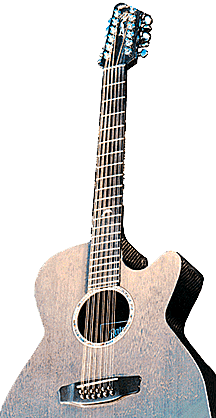 RainSong instruments are expensive compared to mass-produced instruments, comparable to hand-made guitars. Expect to pay $3,500 to $4,500 for a RainSong, depending on the model and added amenities, which can include abalone inlays of dolphins and topless hula girls. "The abalone inlays are cut in Germany," Decker said. "We have a more modest version of the hula girl, but there's been zero demand for it.".
The price hasn't scared off professional musicians such as Reichel, Jon Anderson of Yes, or Nashville sessionmen Steve Gibson and James Burton, who like hard-working guitars utterly unfazed by temperature, humidity or pressure changes on an air trip.
"It's probably the only guitar in the world that ships out tuned and arrives still in tune," Decker said. "The only part of it sensitive to water is the electronics. Otherwise, you could use it as a canoe paddle if you wanted.'
They sell all over the world Japan is the largest single market through a few dealers, and primarily through word of mouth. "Even if we ramp up production, we could only make about 500 guitars a year," Decker said. "Right now, we need like 50 guitars yesterday."
Unfortunately, the quality of RainSong guitars hasn't improved Decker's own fingerpicking skills any. "I'm still a pretty bad guitarist," says he.