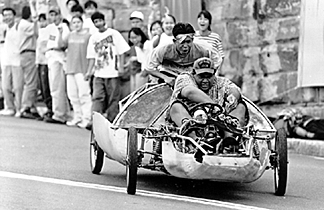
Gilbert (J. Moki Cho) drives the solar car as Marco (Dion Basco) cheers him on. TriStar photo.
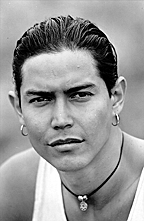 During his years at St. Louis High School, Anthony Ruivivar sometimes sat at the end of Magic Island gazing seaward, torn between his love for Hawaii and his dream of being an actor.
"I asked myself a million times how would I ever get a chance to do this," Ruivivar, 25, said in a telephone interview from his New York home. "When people learned I wanted to act they would always, always say 'Oh sure, but what are you really going to do'."
Ruivivar, son of Tony Ruivivar of the Society of Seven, began pursuing his dream in the 10th grade by acting in local theater productions before heading to Boston to attend college, then to the actors' Mecca, New York City.
Last year, Ruivivar's impossible dream of working professionally in Hawaii became a reality when "Race the Sun" filmed for a week on Oahu.
"I never thought the dream would come true," he said.
"Race the Sun," which stars Halle Berry and James Belushi, tells the story of the Big Island's Konawaena students - in the film the school is called Kona Pali - who in 1990 entered the World Solar Challenge, an event inaugurated in 1987 and held every three years in Australia. The 2,000-mile-long Challenge course took them over some of the harshest terrain in the world. They persevered to finish the grueling race.
A special premiere for the Hawaii Theatre for Youth will be held tomorrow night. The film opens nationwide Friday.
Ruivivar plays Eduardo Braz, an embattled spirit, fiercely proud of his "local" status and protective of the solar team's honor. He's hot-tempered, and resents another student's leadership role in the team; he's also very protective of his girlfriend, Luana Kanahele - portrayed by Big Island resident Adriane Napualani Uganiza. The team's computer expert is Gilbert Tutu - Big Islander J. Moki Cho - an overweight, gentle, insecure young man who just wants a chance to drive the Cockroach, but is deemed too big for the delicate solar car.
"That started the acting bug rolling," he said. "And I quickly realized that I would have to go to the East Coast. . .to get the background I needed."
Ruivivar graduated from Boston University's School for the Arts in 1992. He moved to to Hoboken, N.J., signing with a "bi-coastal" talent agency which got him an audition for the starring role for the television series "Island Guy" with Er-nest Borgnine. He got the job but the pilot foundered. Then Ruivivar moved to New York City for theater work, and got the starring role in the film "White Fang II."
"I've been very lucky," he said. "People can come out of a theater training program and then do regional theater, a Broadway show, or a touring company. Eventually it leads to auditions for film or television. I got there sooner than most."
Ruivivar remains in New York because "it's a place more concerned with the work rather than just making money or image."
"I decided a long time ago I didn't want to be a flash in the pan," he said. "If I get a film and work three months a year, the rest of the time I can do plays here, honing my craft."
When the casting call went out for "Race the Sun," Ruivivar, who has lived on the mainland for eight years, didn't know the real life story about the Kona students.
"The director and producers didn't want us to. . .re-enact the actual characters," Ruivivar said, "but to act it from our own point."
While the film is based on a true story, writer Barry Morrow fictionalized some of the events, Ruivivar said.
Morrow calls "Race" a "fictional drama about a group of rough, low-income kids who pull together to achieve the extraordinary.
"All of the eight kids and two teachers have their own individual stories of personal growth, which are played out during the action and excitement of the races in Hawaii and across Australia," he said.
"The picture is not about winning or losing, it's about growth and change, about being able to make your mark in life and doing the very best you can."
Ruivivar says his character is "a real proud local kid, kind of a moke, a thug, but good at heart.
"He's got this grudge against a lifelong friend, Daniel, a haole guy, who has lived on the island the same amount of time as Eduardo. It's a typical island story: a haole kid and a local kid both raised in Hawaii but for some reason the haole kid gets treated like an outsider. The one bonding aspect is that Daniel also is considered lolo like these local kids. They're all on the same boat.
"My character grows by learning how to understand where Daniel is coming from."
Local audiences may take some exception to what Ruivivar called "some superficial usage" of pidgin.
"We use 'lolo' a lot and it's really not a word that's used that much in Hawaii," he said. "Some of the (mainland actors) just couldn't get their mouth around pidgin."
Ruivivar sees the film's message as art imitating his life: Through perseverance and hard work despite incredible odds, and by not giving up even when other people have, you can accomplish your goals."
Ruivivar's next film is the science fiction thriller "Starship Trooper" directed by Paul Verhoeven.