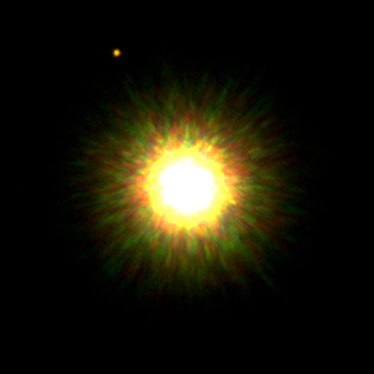
COURTESY GEMINI OBSERVATORY
Astronomers using the Gemini North telescope on Mauna Kea have taken what is likely the first picture of a planet around a normal star similar to our sun. Three University of Toronto scientists captured the image of the planet, about eight times the size of Jupiter, 500 light-years from Earth.
|
|
Scope finds planet orbiting sunlike star
Astronomers discover a satellite larger than Jupiter orbiting a "normal" star
HILO » For the first time ever, astronomers using the Gemini North Telescope on Mauna Kea have taken a picture of what likely is a planet circling a star similar to our sun.
Discovered by astronomers from the University of Toronto, the planet is nothing like Earth and only moderately like our solar system's Jupiter.
The star, with the awkward designation of 1RXS J160929.1-210524, is like the sun in being yellow and medium-size. Unlike our 4.6 billion-year-old sun, the star 500 light-years away in the constellation Scorpio is a brand-new baby, just 5 million years old.
For a decade or more, astronomers have calculated that certain stars must have planets from the way they wobble. In 2004, astronomers at the European Southern Observatory in Chile photographed a planet circling a brown dwarf, also known as a "failed star."
But the Canadian team was looking for a planet around a "normal" star, a Gemini statement said.
The youthfulness of the Scorpio star attracted the Canadians. Old planets cool down. Young ones near young stars are hot.
"We targeted young stars so that any planetary mass object they hosted would not have had time to cool and thus would still be relatively bright," said team member Marten van Kerkwijk.
The planet they found is eight times the mass of Jupiter and glowing with a temperature of about 2,700 degrees Fahrenheit. Jupiter shivers with a temperature of minus 170 degrees Fahrenheit.
The most distant planet from the sun, Neptune, is 30 times the distance of Earth from the sun. The newly discovered planet around the Scorpio star is 330 times the sun-to-Earth distance.
A photo of the star and planet seems to show them almost side by side, but that is the result of smearing of light by Earth's atmosphere.
"The evidence is very compelling" that the object next to the Scorpio star is a planet, said Toronto astronomer David Lafreniere. But two years of study are needed to confirm the find.