CINDY ELLEN RUSSELL / CRUSSELL@STARBULLETIN.COM
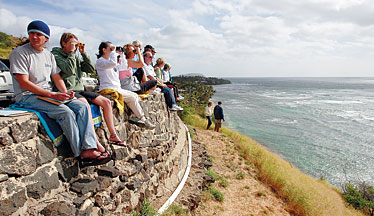
Volunteers scanned waters off Diamond Head for whales yesterday during the Hawaiian Islands Humpback Whale National Marine Sanctuaries ocean count.
|
|
Plan targets humanity’s effect on whales
A proposed dedicated national research program aims to study the effect of human behavior on marine mammals, including humpback whales that make Hawaii their home in winter.
U.S. Rep. Neil Abercrombie unveiled a bill yesterday that would authorize the U.S. Marine Mammal Commission to provide steady funding for research.
Abercrombie's announcement coincided with the annual effort to count humpback whales at 56 sites around the state.
"The protocols for doing research, passing money through and so on needs to be institutionalized," said Abercrombie, speaking at the Diamond Head scenic lookout, one of yesterday's whale count sites.
The bill would establish an interagency coordinating committee to develop a five-year national marine mammal research plan. Part of that plan will include a study on the impact of human-related activities, including pollution and the use of sonar on marine mammals, and will identify critical research gaps and uncertainties.
Abercrombie said he hopes to find more co-sponsors in Washington, D.C., but does not expect much opposition to his bill.
"This one is so nonpartisan, so broadly supported and has such an obvious appeal. ... I think I've got a good chance," said Abercrombie, who is a member of the House National Resources Committee.
The official season for humpback whales in Hawaii is from December to April, with an average of more than 9,000 whales sighted each season, said Naomi McIntosh, superintendent of the NOAA's Hawaiian Humpback Whale National Marine Sanctuary.
The whale count, coordinated by National Oceanic and Atmospheric Administration, began in 1996, with only 150 volunteers.
Now with 600 volunteers, the shore-based survey takes place in Oahu, Kauai, the Big Island and sometimes Kahoolawe on the last Saturday of January, February and March. Yesterday morning from 8 a.m. to noon, an average of two whales were counted every 15 minutes at each of the 56 sites statewide.
"As we see the (whale) population increasing, we understand we'll probably see more interaction with humans," McIntosh said. "It helps us understand how animals are utilizing different sites."
HOW TO JOIN
Two more Sanctuary ocean counts are scheduled for Feb. 23 and March 29. To become a volunteer, contact the appropriate sanctuary office:
» Oahu: 397-2651, ext. 253
» Kauai: 246-2860
» Big Island: (888) 55-WHALE, ext. 253
|