Wow, what a concept!
These kids' books are easy to read, but not so easy to write
STORY SUMMARY »
They're called "concept books," for the obvious reason that they teach basic concepts to the very young.
ABCs, 123s, up-down-over-under -- all those spatial and elemental ideas that a kid must understand in order to make sense of the world. Not to mention learning to read and balance a checkbook.
Their beauty is their simplicity, but that doesn't mean writing them is a simple matter. In fact, they're quite challenging little pieces of literature.
SPECIAL TO THE STAR-BULLETIN
FULL STORY »
Stories by Elaine Masters
Special to the Star-Bulletin
If you have a small keiki, you're probably familiar with concept books. They're very popular with the younger set. The most common are the A-B-C and 1-2-3 books, teaching the concepts of the alphabet or numbers, whether counting (ordinal) or amounts (cardinal), although you can find books about many different subjects. They can be board books, which have cardboard pages to satisfy teething babies, or they can look like any picture book with regular paper pages.
What makes a concept book? A concept, according to our friend, Mr. Webster, is a generalized idea of a thing. For instance, if you tell a keiki, "that tall, feather-duster-type plant is a coconut tree," he may not believe you when you tell him that the broad-spreading, red-flowering plant nearby is also a tree, an African tulip tree. You may have to point out a number of examples before he gets the abstract idea of "tree." Concept books teach about abstracts.
A few years back, I learned that the best-selling books of Bess Press were concept board books. Island Heritage had published some of my books, so I approached owner Dale Madden with some ideas. Dale OK'd the project. In fact, he wanted four books, any topic.
I set to work. How hard could it be? Just a few pages, a simple sentence, maybe even one word on each page. Piece of musubi!
Not!
I discovered it's much easier to write long (wordy) than short (concise). I labored more than I'd anticipated, making sure the concept was clear and well-developed, that there were no extraneous words (or words like "extraneous"). The books should "sing." The great Australian author, Mem Fox, says, "You don't write children's books with a pen. You write with a metronome." Indeed, even if a children's book isn't written in rhyme, it still will have rhythm, a euphonious, felicitous flow.
CRAIG T. KOJIMA / CKOJIMA@STARBULLETIN.COM
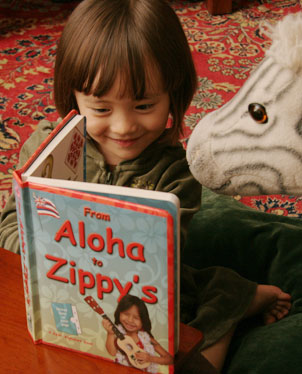
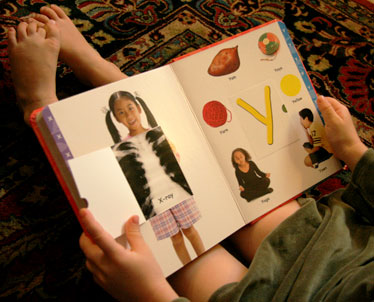
"From Aloha to Zippy's" by Carol Colbath teaches the alphabet with the help of "lift-a-flaps" that reveal a little extra meaning for the young reader.
|
|
CRAIG T. KOJIMA / CKOJIMA@STARBULLETIN.COM
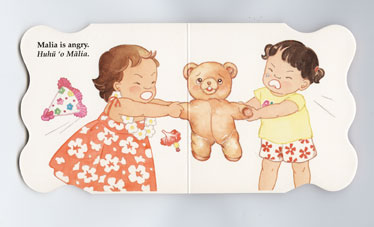
"Malia's Happy Birthday," was one of Elaine Masters' concept books, teaching about emotions.
|
|
So I put together four stories about a girl named Malia and her baby brother, Kimo. Two had preposition concepts: over, under, behind, etc. A third showed action: sit, crawl, climb, etc. The fourth showed emotion: excited, angry, friendly. I chose those topics because, as I know from my English as a Second Language classes that students need to know concepts other than the alphabet, numbers and colors.
Island Heritage approved the texts and sent them to illustrator Yuko Green on the Big Island, who painted delightful pictures to go with the stories.
When the finished books came back from the printer in Hong Kong, I was pleased except for one thing: I'd suggested we include the Hawaiian translation of each concept word, but instead the publisher had translated whole sentences. I thought, oh well, the books will be picked up by the Hawaiian immersion schools.
Dale orchestrated a big send-off. He sent colored mail-outs to all the bookstores. All the stores stocked the books, and ... they sat on the shelves.
Alu Like and other Hawaiian-language schools never bought large quantities. Tourists didn't seem to take to them. A couple of moms told me the books were hard to read because the kids insisted they read the Hawaiian words as well as the English.
In a few months, they went out of print. Ever since, I've had great respect for the writers and illustrators of successful concept board books.
Keeping old ideas fresh is important for children and parents
Those who follow the kiddie lit market know that every year a new crop of concept books springs up. The reason is simple: Every year, new babies are born. Just as Parents Magazine constantly runs articles on the best way to feed a toddler, so it is that parents buy concept books for their new family additions.
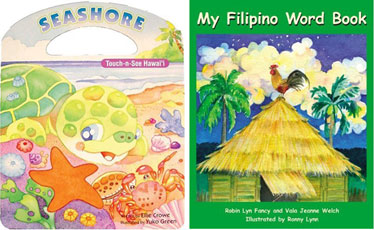
The books are getting more clever, more appealing. I love Ellie Crowe's and Yuko Green's recent "Touch-n-See" books dealing with how things feel: a soft feather, the sticky foot of a gecko. The books have a built-in carrying handle, just right for the 18-month-old scholar to tote around. Yuko has another book with a squeaky dolphin sticking through the pages for the tiny tot to poke and giggle at.
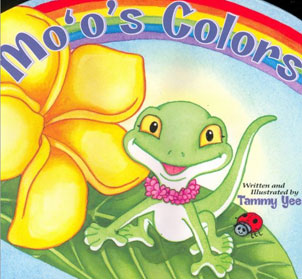
Some books are in rhyme. Tammy Yee, who writes and also illustrates (I'm so jealous!) does a great job on books such as "Mo'o's Colors." Young keiki love swingy rhymes and will ask to hear a poetry book over and over.
Which brings us to the problem of parent poop-out. Knowing that Mom and Dad will be re-reading the story many times, publishers are looking for manuscripts that can be read on different levels, keeping the adult entertained as well as the child.
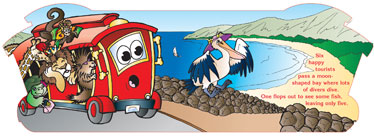
In an article in Children's Writer Newsletter, Theresa Howell, managing editor of Rising Moon, says that everything's been done at least once. She's looking for creative people to do it again in a new and exciting way. Jane Gillespie of Beachhouse Board Books counted in clever rhymes from 10 to 1 in her "1-2-3 Waikiki Trolley," delightfully illustrated by Ruth Moen Cabanting. She found a new way to present an old concept.
Some concept books are really pictorial dictionaries. I've used them effectively in English as a Second Language classes. A great new one designed by Carol Colbath, "From Aloha to Zippy's," is illustrated with photographs and "lift-a-flaps" that reveal information or images beneath.
Bess Press takes dictionaries a step further with word books such as "My Filipino Word Book," by Robin Lyn Fancy and Vala Jeanne Welsh, illustrated by Ronny Lynn. Teachers say these books help capture the imagination and cooperation of their immigrant students.
I'm giving some Hawaiian coloring and activity books to my grandchildren in Denver and Atlanta. As they work the puzzles and color the pictures, they'll practice their numbers and alphabet and also learn a bit about Granny's home state. Great!
I look forward to the next crop of concept books. Will authors find new and exciting ways to present old concepts? Stay tuned.
ABOUT THE WRITER
Elaine Masters is a writing coach and author. Her newest book is "Momi's Birthday Surprise." It is not a concept book! Contact her at
eomasters@hotmail.com.