CRAIG T. KOJIMA / CKOJIMA@STARBULLETIN.COM
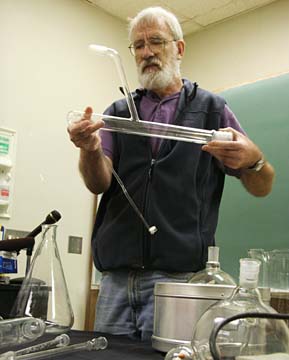
Thomas Hemscheidt, chairman of the UH Chemistry Department, held up yesterday a glass lab instrument worth $350 donated by the U.S. Immigration and Customs Enforcement office.
|
|
Lab gear goes from crime to chemistry
Glass containers, tubes and other laboratory equipment intended to be used to make crystal methamphetamine will instead be used by researchers at the University of Hawaii at Manoa's Chemistry Department.
The equipment, valued at about $15,000, was seized in June 2005 from a storage locker under the H-1 freeway near the Lunalilo Street offramp as part of an investigation into a meth lab operation in Mililani, said Wayne Wills, special agent in charge of the Immigration and Customs Enforcement office of investigations in Hawaii.
The last defendant in the case, Steven Echols, 44, was sentenced last year to 10 years in prison.
Rather than destroy the equipment, the federal agency decided to donate it to UH-Manoa.
"We're very happy that the federal government thought of us in this situation," said Thomas Craven, interim dean of the College of Natural Sciences.
Thomas Hemscheidt, chairman of the Chemistry Department, said the equipment was "an unexpected bounty."
He pointed to a vacuum pump that would sell for $2,500 brand new. Other glass tubes, used for extracting chemicals, can sell for hundreds of dollars.
Hemscheidt said he will use the equipment in his research, which involves extracting potentially lifesaving chemical compounds from marine plants and animals.
Wills said Echols ordered most of the lab equipment from eBay. Echols and his girlfriend, Holly Koliopoulos, 46, operated a meth lab at their Mililani home and were arrested in March 2005, according to a news release from the U.S. Attorney's Office.
Wills said the lab equipment found in Mililani was destroyed. But the equipment seized at the storage facility had not been used yet and was part of an effort to expand production.
"It was clear that Mr. Echols was going to ramp up his operation significantly," Wills said.
In 2005, customs agents learned Echols had placed a large order over the Internet of a chemical used to make "ice." The subsequent investigation led to the couple's arrest and conviction. Koliopoulos was found guilty of possessing a chemical used to make crystal meth and one count of conspiracy to make more than 50 grams of methamphetamine. She was also sentenced to 10 years in federal prison.