COURTESY JACK JEFFERY
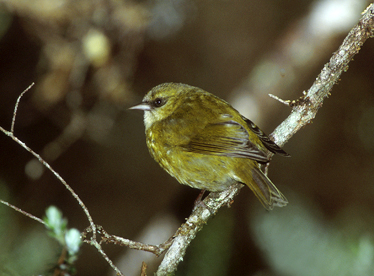
A Hawaii creeper (Oreomystis mana) perches on a branch. The endangered bird species is being introduced into a special preserve on the Big Island. Several other native species are present at the site, which is fenced off to keep out predators.
|
|
Endangered birds thrive in refuge
SADDLE ROAD, Hawaii » Biologist Jack Jeffrey watched from among mature ohia and koa trees as a little yellow-and-brown bird flew out of a protective, wire-enclosed aviary and grabbed a worm on a feeding tray.
The female Hawaii creeper flew to a tree, swallowed her meal and then started poking around for insects on the native vegetation. Soon a second female did the same.
Jeffrey, with the U.S. Fish and Wildlife Service, was delighted. So were officials of the San Diego Zoo, which runs the Hawaii Endangered Bird Conservation program that raised the females, ages 8 and 10.
Following the release Wednesday of the females, four male Hawaii creepers were released Friday in the same area, a 15-acre kipuka, or oasis of old-growth native vegetation, surrounded by more recent lava flows.
Soon, 11 individuals of a similar species, the akepa, will also be released in the area known as Kipuka 21, said Alan Lieberman, in charge of the bird conservation program near Volcano village.
The releases represent success in efforts to turn the state-owned Kipuka 21 into a showcase for a variety of native forest life forms, eventually to be accessible by a quarter-mile boardwalk through the protected area.
Kipuka 21 gets its name from its location near the 21-mile marker of Saddle Road inland from Hilo.
The area has been fenced to keep out pigs and goats, which destroy native plants, Lieberman said. Additional native plants have been added to the area.
Rats and mongooses, attracted by the feeding trays, would be a threat to the birds, so poison has been put out to kill them.
Other native birds already in the kipuka permanently or as visitors from one patch of forest to another are the omao, amakihi, apapane, elepaio and akia polaau, said Jeffrey and Lieberman.
The conservation program did a "soft release" with the two females, giving them nine days of familiarization inside the aviary, Lieberman said. Staff members camped out at the site 24 hours a day during that time, he said.
The male birds required a "hard release," just a few hours in the aviary and then out the door. If the males were left together for any length of time, the toughest would have killed the other three, Lieberman said.
Despite the tough-guy attitude of the 5-inch males, program staff will continue to camp out at the kipuka for at least a week to make sure no danger threatens them, Lieberman said.
"We want to make sure we don't cut them off without a prayer," he said.