|
Nature Calls
Shirley Gerum
|
COURTESY U.S. FISH & WILDLIFE SERVICE
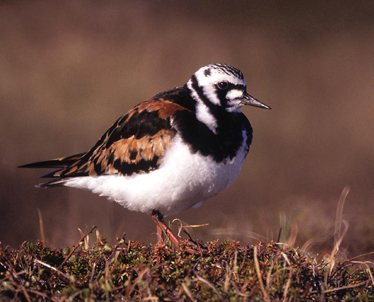
The ruddy turnstone, or 'akekeke, is returning to Hawaii from a long summer migration to Alaska.
|
|
It’s open season on 2 birds’ mating and migratory habits
Soon it will be time to observe some interesting animal behavior -- in open areas, along shorelines, alone or in groups. These would be humans, looking for the long-awaited return of our plovers and ruddy turnstones.
It has seemed so silent since these birds rushed off to mate and nest a few months ago. Last spring, researchers and volunteers from various agencies and institutions were busy taking samples -- banding and tagging the birds as their departure time approached. Then there was silence.
Everything researchers are learning about the migration is incredible -- the timing, the distance the birds cover in their nonstop flights. The 'akekeke (ruddy turnstones) make a looooong migration to western Alaska, often returning to the same spot.
For biologists Phil and Andrea Bruner, one their many questions is, Do the ruddy turnstones we see at Kualoa Beach Park on Oahu and on the Kona Coast of the Big Island return to breed where they were hatched?
Among their other questions:
» If the 'akekeke don't return to the same site, how close do they come?
» Do the birds have more than one mate? Do they reunite?
The only way to get valid answers is to able to recognize the same birds over many years on both sides of the Pacific. In the past, the only way to do this was to assign each bird in the study a specific combination of colors in leg bands. This is still the best way to recognize a returning bird visually. But now researchers are also taking blood samples from the parents and their chicks -- as well as feathers -- to record their DNA.
The molecular/genetics lab at the Alaska Science Center is analyzing the Bruners' samples, hoping to answer the burning question of fidelity. "This year we had two male ruddy turnstones banded in 2004 return back to the (Alaska) study area for the first time since their initial capture," says Bruner, who is with the Brigham Young University-Hawaii Biology Department. "One mated with his original 2004 female. This is our first example of mate retention in our study population."
They have recorded instances where both males and females returned to the same breeding territory, Bruner adds, "but -- until this year -- it was either the male or the female seen the subsequent season, but not both in the same year."
The Bruners have seen one male "wintering" on the Big Island's Kona Coast, but have no clue as to where he nested in 2005 and 2006. He did show up at the breeding grounds in Alaska again this year -- close to where he nested before -- but with a new mate.
They took his DNA and hope to see him back on the Kona Coast within the next few weeks. Kona (as they've nicknamed him) has two blue bands on his left leg and a metal band on his right leg.
The Bruners are eager to keep up with Kona since they now know more about him.
Have you seen any banded ruddy turnstones? If so, contact Bruner at 293-3820 or e-mail brunerp@byuh.edu.
Try to record the date and time of day you see the bird. "Most important, we need to know the sequence of the color bands -- what was the color combination on the left and right legs? Each of our banded birds carries a unique color combination," Bruner says.
"The more eyes looking, the greater the chance of learning how important Hawaii might be to 'wintering' ruddy turnstones that nest at Woolley Lagoon on the Seward Peninsula in western Alaska."
Shirley Gerum teaches botany, ethnobotany and environmental science at Chaminade University. Her column runs on the last Monday of the month. E-mail her at
features@starbulletin.com.