HONOLULU STAR-BULLETIN / OCTOBER 2004
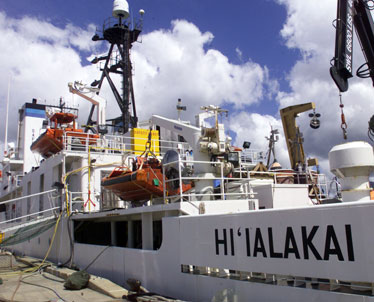
NOAA's research vessel Hi'ialakai.
|
|
NOAA to plumb depths of Northwestern Islands
Researchers aboard the ship Hi'ialakai will soon be sinking a camera more than two miles underwater in the Northwestern Hawaiian Islands, hoping to find undiscovered creatures of the deep.
Talk Story with NOAA scientists
While the NOAA ship Hi'ialakai plies the waters of the Papahanaumokuakea Marine National Monument for the next three weeks, the three government agencies that co-manage the area will host a series of free Saturday morning "talk story" sessions with scientists.
Sessions will be at 9-11 a.m. next Saturday, July 21 and 28, and Aug. 4. All will be at the Outrigger Waikiki, 2335 Kalakaua Ave., on the second floor near the Hula Grill. Valet parking is $5 with validation at the event. For more information, contact Ethan Chang at 921-9731.
|
Other researchers will be identifying types of coralline algae, whose calcium-filled skeletons actually build more reefs than coral.
Still others will take tiny DNA samples from plentiful species of live fish and other sea creatures in the Papahanaumokuakea Marine National Monument, in a project that is helping to unravel the mystery of how much animals there mix with their counterparts in the main Hawaiian islands.
"As usual we have a bunch of very interesting projects," said Randall Kosaki, chief scientist for the voyage, which begins today and visits seven of the remote islands and atolls northwest of Kauai before returning to Honolulu on July 31.
Sixteen scientists, a monument educator and an underwater videographer will be engaged in six research areas, all contributing new information about the plants, animals and overall ecology of the world's largest marine conservation area, said Jo-Ann Leong, director of the University of Hawaii's Institute of Marine Biology, which is sending 10 scientists on the voyage.
"We're all excited about it," Leong said. Managing the vast, 1,200-mile-long area requires knowing about the environment and its inhabitants.
"We have to identify reefs to take special care with and watch very carefully, not just tie a yellow ribbon around it and go away," said Leong, who is not going on the trip.
Kosaki is proud of all the work that will be done -- and of the high-tech ways the scientists hope will make as little impact as possible.
When curious visitors to the remote islands wanted to know what was in the deep water 100 years ago, they sunk a trawl and dragged the bottom, Kosaki said.
Three short trawls yielded up to 20 new species. But this voyage's deep-water camera will not destroy anything to learn about it, he said.
The Hi'ialakai is operated by the National Oceanic and Atmospheric Administration, which partners with the U.S. Fish and Wildlife Service and the state Department of Land and Natural Resources to manage the marine monument established in June 2006.